
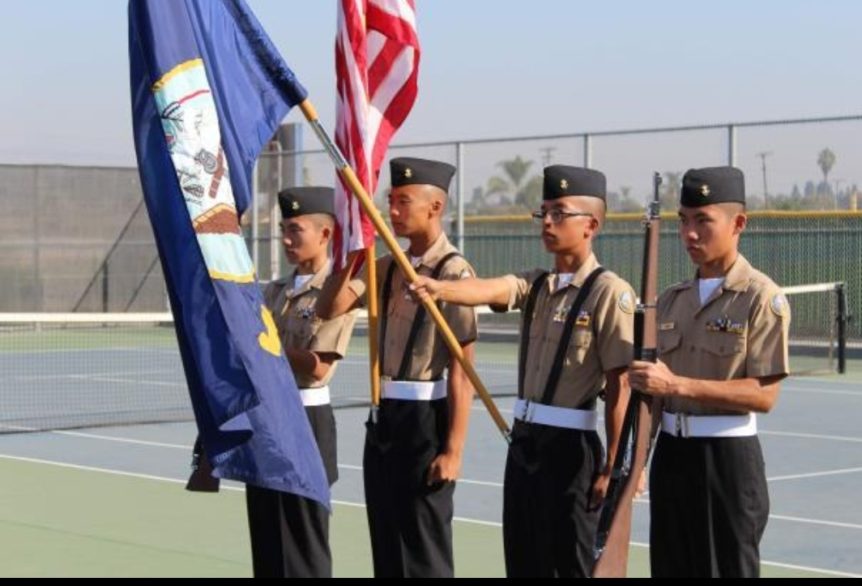
A realization finally clicked for me while responding to a Navy JROTC color guard issue.
The team presented the colors with the National Color, the state flag, and the Navy departmental flag. On the surface, many people would look at that and think, “That seems reasonable. National, state, service. What is the problem?” The problem is not simply the order of precedence. The problem is authority.
A color guard does not carry a flag merely because that flag exists, has symbolic meaning, or appears in a precedence chart. A color guard carries a flag because the organization has authority to carry it in that context. That distinction matters.
This example presents two separate problems: the state flag and the Navy departmental flag. The state flag raises the question of authorization. The Navy departmental flag raises the question of representation. Both must be answered before precedence is considered.
Precedence Answers “Where?”
Precedence answers the question: Where does this flag go in relation to the other flags?
It tells us the order of honor. National before state. State before local. Military service colors in their proper service order. Organizational colors in their proper relationship to the National Color.
Precedence is important. It prevents the color guard from arranging flags by personal preference, local habit, or visual symmetry. But it does not answer the primary question that we have been ignoring for decades.
Authority Answers “May We Carry It?”
Before we ask where a flag belongs in the formation, we must first ask: Is this color guard authorized to carry that flag at all?
That is the question people often skip because we are just used to seeing and doing without questioning. That’s why many of my social media posts seem uncomfortable to some readers. They jump straight to precedence and assume that because a flag has a place in an order of precedence, it may be carried by any color guard that wants to carry it. That is not how military ceremony works.
Precedence governs placement after authorization has already been established. Authority comes first. Precedence comes second.
The Land Services Have Specific Authorization
This is where the Army, Air Force, and Space Force differ from the sea services.
Army guidance specifically provides authority for commanders to authorize the carrying of state, territorial, or national flags during military ceremonies.
e. Carrying of nonmilitary organizational flags. U.S. military personnel in uniform or in civilian clothing acting in an official capacity will not carry flags of veterans’ groups or other nonmilitary organizations; however, commanders may authorize military personnel to carry State and territorial or national flags during military ceremonies.
That matters because it gives the commander a written doctrinal basis to include a state or territorial color in a military color guard when appropriate.
Air Force guidance has also contained similar authority, and because Space Force ceremonial guidance currently tracks heavily with Department of the Air Force protocol and ceremonial practice, this same basic concept applies in that environment as well.
2.12.3. Carrying of non-military organizational flags. U.S. military personnel in uniform or in civilian clothing, acting in an official capacity, will not carry flags of veterans’ groups or other non-military organizations. (T-0) The U.S. flag should never be carried flat or horizontally, but always aloft and free. Commanders may authorize military personnel to carry state, territorial, or national flags during military ceremonies. (T-3) U.S. military personnel in uniform are authorized to carry all Department of Defense (DoD) recognized flags.
So, when an Army, Air Force, or Space Force color guard carries a state or territorial flag, the question is not simply, “Does the state flag have precedence?” The better question is:
For the land services, that authority exists. That does not mean the state flag should be carried at every ceremony. It means there is a doctrinal mechanism by which it may be authorized. That is a major distinction.
These two provisions establish the same controlling principle for the land services: the state, territorial, or national flag is not carried merely because it has precedence. It is carried because a commander with authority under the applicable service standard has authorized it. Once that authority exists, precedence determines placement.
Cadet Programs
That authority extends into the cadet programs of the land services when those programs are operating under their respective service-based standards. Army, Air Force, Space Force, and their cadet organizations, including AJROTC, AFJROTC, SFJROTC, CAP, and SFCC color guard has a doctrinal basis for carrying a state or territorial flag when properly authorized. The state/territory color is added when authorized. It does not replace the organizational color.
The phrase “commanders may authorize” is not a casual permission slip for any instructor, coach, or cadet leader to add flags to a color guard. It refers to commanders with authority under the applicable service regulation or instruction. A retired service member serving as a JROTC instructor may be certified to teach, manage, and supervise the JROTC program, but retirement does not preserve military command authority. The instructor does not become the commander contemplated by the flag regulation simply because the unit wears a service-based cadet uniform.
See, The Why of the Military Color Guard – JROTC and State Colors.
The Sea Services Do Not Have the Same Provision
The Navy, Marine Corps, and Coast Guard do not operate under the same state/territory color authorization structure used by the Army and Department of the Air Force.
That was my key realization. I knew the distinction for a decade but did not realize it until now. The question kept going through my mind, “but why?” and now I get it and want to pass it along.
See also my article, A DrillMaster Study of Sea Service Flag Protocol.
For Marine Corps, Navy, Coast Guard, NROTC, MCJROTC, NJROTC, CGJROTC, USNSCC, Marine Cadets of Iowa, and Young Marine color guards, the issue is not whether a state flag has a recognized place in a precedence chart. The issue is whether Marine Corps and Navy doctrine gives the unit authority to carry the state flag as part of the color guard.
Further reading:
A Caution For Navy Massed Flag Formations: Expressive Movement and Guards
Navy Massed State and Territory Colors Formations
That written commander-authorized provision for state and territorial colors is not present and that means the sea services and cadets programs cannot simply look at an Army or Air Force provision and import that authority into a color guard.
Army authority belongs to the Army as does Air Force authority belongs to the Department of the Air Force. In this case, Navy JROTC must operate within Navy/NJROTC authority.
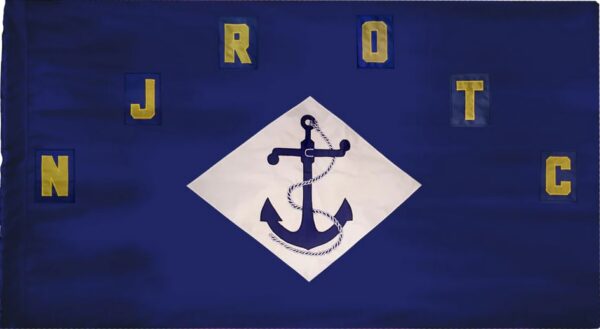
The second issue is the Navy departmental flag.
The Navy flag represents the United States Navy as a military service. It is not the Navy JROTC unit’s organizational color. That distinction is critical.
NJROTC units already have an institutional or organizational color. That is the color that represents the NJROTC unit. When an NJROTC color guard presents the colors, the proper organizational color is the NJROTC color, not the Navy departmental flag.
The Navy departmental flag is not a substitute for the NJROTC organizational color.
It is the service color of the United States Navy.
That means an NJROTC color guard carrying the Navy flag creates a separate authorization issue. The team is not merely carrying “a Navy-related flag.” It is carrying the departmental color of a military service.
That is a much higher level of representation than many people realize.
JROTC Is Not the Same as Its Parent Armed Force
This is where many instructors, cadets, and event organizers get confused.
Navy JROTC is associated with the Navy. It teaches Navy customs, courtesies, leadership, citizenship, and military structure. It uses Navy-based uniforms, rank structure, terminology, and instructional material.
But NJROTC is not the United States Navy.
A Navy JROTC unit does not automatically inherit every ceremonial authority that belongs to active-duty Navy personnel or official Navy ceremonial units.
- AJROTC cannot display or carry the Army Ceremonial or Organizational Color
- MCROTC, YM, MCI cannot carry the USMC color
- NJROTC, USNSCC, Sea Scouts cannot carry the USN color
- AFJROTC, CAP cannot carry the USAF color
- Please read about the difference between the USAF color and the emblem here
- https://thedrillmaster.org/2024/07/12/us-air-force-seal-emblem-and-symbols/
- SFJROTC, SFCC cannot carry the USSF color
- CGJROTC cannot carry the USCG color
The same principle applies across the JROTC world. Association with a service does not automatically equal authority to carry that service’s departmental color in any ceremony the unit attends.
In accordance with MCO 5060.20 and even the NJROTC Cadet Field Manual, an NJROTC color guard should be:
Right Rifle Guard
National Color Bearer
NJROTC Organizational/Institutional Color
Left Rifle Guard
That is the clean, defensible, doctrinally sound formation.
Read Why the Navy and Coast Guard Use the Marine Corps Order for Drill and Ceremonies
“But We Want to Represent the State”
That may be a sincere desire, but sincerity is not ceremonial authority.
If the event host wants the state represented, there are appropriate ways to do that. The state flag can be displayed on a stage, behind a podium, near the reviewing stand, or in a static display with other flags.
Display and carry are not the same thing. Many flags may be displayed; far fewer flags are authorized to be carried by a military or military-style color guard. That distinction solves many problems. A flag can be present at the ceremony without being part of the color guard.
Read Displaying vs. Carrying Flags for more information
This Is Not About Disrespecting the State or the Navy
Correcting this issue is not anti-state. It is not anti-Navy. It is not anti-JROTC. It is pro-standards. We just haven’t had this explained thoroughly before.
The state flag deserves proper treatment. The Navy flag deserves proper treatment. The NJROTC organizational color deserves proper treatment. Proper treatment begins with using each flag in the correct context by the correct personnel under the correct authority. That is what gives the ceremony integrity.
Read The Why of the Military Color Guard – Marine Corps, Navy, & Coast Guard
The Central Rule
Here is the principle that should guide every color guard:
A color guard does not carry a flag because the flag has precedence. A color guard carries a flag because it has authority to carry it. Precedence only tells the team where the flag goes after that authority has been established.
That one principle resolves a great deal of confusion. It explains why the Army, Air Force, and Space Force may carry state and territorial colors under written authorization. It explains why Navy and Navy JROTC teams should not assume that same authority exists for them.
It explains why departmental flags are not appropriate for JROTC. It explains why display is not the same as carry. And it explains why “we have always done it this way” is not a ceremonial standard.
Final Guidance
For Army, Air Force, and Space Force color guards, state and territorial colors may be carried when properly authorized under the applicable written guidance.
For Navy JROTC, the normal color guard formation should be the National Color and the NJROTC organizational color, with guards as required.
Use the flags the unit is authorized to carry and, in some cases, that limit can seem extreme, but you need to work within that framework.
A JROTC color guard should not carry a state flag simply because the instructor, school, host organization, or cadets want it included. The state flag requires authority from the governing service standard or from the command structure empowered by that standard. Without that authority, precedence is irrelevant.
Authority first. Precedence second.