
The Flag Display Team—and Where Even That Is Not Authorized
Across the United States, organizations of many types—federal agencies, uniformed services, public safety departments, schools, and civic groups—seek meaningful ways to honor the United States flag during ceremonies and public events. Often, the first instinct is to form a “color guard.”
That instinct is understandable. The color guard is visible, symbolic, and widely associated with patriotism and ceremony. However, a color guard is not a generic flag-carrying formation. It is a specific military ceremonial construct governed by authority, doctrine, and tradition.
When that authority does not exist, the correct response is not imitation. In many cases, the correct response is adaptation. In some cases, the correct response is restraint.
This article establishes:
- Why a color guard is often inappropriate
- When a Flag Display Team (FDT) is a legitimate alternative
- And critically, when even a Flag Display Team is not authorized
What a Color Guard Actually Is
A color guard is not simply “people carrying flags.” In U.S. practice, a color guard derives from military and armed-service tradition and includes armed guards whose role is the symbolic protection of the colors. It operates under formal drill and ceremonies doctrine, representing institutional authority, command, and lineage.
Arms, authority, and doctrine are not optional features. They are defining characteristics. Without them, a formation is not a color guard—regardless of uniforms, titles, or intent.
The Common Error: Borrowed Ceremony Without Authority
Many organizations fall into the same pattern:
- A sincere desire to honor the flag
- Exposure to military ceremony without doctrinal context
- The assumption that uniforms or federal status confer ceremonial authority
The result is often a formation that:
- Appears military without being authorized
- Uses commands or movements without doctrinal grounding
- Creates public confusion about institutional authority
- Places members into symbolic roles they are not empowered to represent
This is rarely done in bad faith. It is, however, avoidable.
Organizations That Have Authority to Form a Color Guard
1. Armed Forces (Primary Authority)
- United States Army
- United States Marine Corps
- United States Navy
- United States Air Force
- United States Space Force
- United States Coast Guard
Why they qualify:
They possess sovereign authority, established doctrine, and codified procedures for the protection and presentation of national and organizational colors.
2. Military Cadet and Auxiliary Programs (Derivative Authority)
- Junior Reserve Officer Training Corps (all service branches)
- Civil Air Patrol
- United States Naval Sea Cadet Corps
- Young Marines
- See this article for more cadet programs
- Not Sea Scouts (see Flag Display Text next)
Why they qualify:
They operate under formal alignment with the Armed Forces, inheriting structure, customs, and (to varying degrees) doctrinal expectations.
3. Public Safety Honor Guard Units (Civic Ceremonial Authority)
- Law enforcement agencies (local, state, federal)
- Fire departments
- EMS agencies
- Corrections honor guards
Why they qualify:
They represent government authority and public service, especially in funerals, memorials, and official civic ceremonies. Their color guards are extensions of institutional honor, not performance.
4. Veterans Organizations (Conditional Authority)
- American Legion
- Veterans of Foreign Wars
Why they qualify (with limits):
They represent prior service and are widely accepted in ceremonial contexts. However, their authority is representational, not doctrinal—quality varies significantly.
Organizations That Do NOT Inherently Have Color Guard Authority
These groups may carry flags—but that does not automatically make them a Color Guard.
Marching and Performance-Based Organizations
- Marching bands
- Drum and bugle corps
- Winter guards
- Pipe bands
- Dance teams/auxiliary units
Classification:
Flag Display Team (or performance color guard, not ceremonial Color Guard)
Why:
- Their purpose is artistic expression or entertainment, not ceremonial authority
- Equipment, movement, and flag handling are not bound to national standards
- Flags are often treated as props rather than symbols under protection protocols
The Key Doctrinal Distinction
This is the line that will anchor your article:
A Color Guard exists to represent authority.
A Flag Display Team exists to present flags.
From that:
- If the organization has recognized authority, lineage, or sanctioned representation, it may form a Color Guard.
- If it does not, it is displaying flags, regardless of how formal or disciplined it appears.
When someone asks:
- “Why can’t a band have a Color Guard?”
The answer is:
They can carry flags—but without institutional authority and doctrinal alignment, they are functioning as a Flag Display Team, not a ceremonial Color Guard.
The Gray Area: Reenactor Groups and Color Guard Authority
Historical Reenactment Units
- Civil War reenactment units
- Revolutionary War groups
- WWII living history organizations
- Napoleonic and other historical military groups
Do They Have Authority?
Short answer: No — not in a modern ceremonial sense
Why:
- They are not recognized governmental or military entities
- They do not operate under current binding doctrine (e.g., Army Training Circular 3-21.5, Marine Corps Order 5060.20)
- Their authority is interpretive and educational, not official
What They Actually Represent
Reenactors function as:
Historical simulation units preserving and demonstrating past military practices
That includes:
- Period-correct colors
- Historical formations
- Authentic (or near-authentic) drill
But that is representation of history, not exercise of present authority.
Proper Classification
1. At Public Events (Parades, Ceremonies)
Flag Display Team (Historical)
Even if:
- They are highly disciplined
- Their uniforms are accurate
- Their drill is excellent
They are still:
- Not acting under current authority
- Not representing a living command structure
2. Within a Reenactment Scenario
Simulated Color Guard (Contextual)
This is the only place the term Color Guard is doctrinally acceptable for them.
Example:
- A Civil War battle reenactment where a regimental color is carried into formation
In that closed historical context, they are:
- Portraying a legitimate color guard
- Operating within the time period being interpreted
The Critical Distinction
Reenactors do not carry colors under authority—
they portray others who once did.
Common Misconception You’ll Encounter
Argument: “They’re representing the military, so they are a Color Guard.”
Response:
They are representing a past military unit, not acting as a current one.
Without present-day authority and doctrinal alignment, the correct classification is a historical flag display, not a ceremonial Color Guard.
Edge Case: When They Are Paired With an Official Unit
If a reenactor group is:
- Invited to support a ceremony alongside a military or public safety honor guard
Then:
- The official unit = Color Guard
- The reenactors = adjacent historical display element
They do not merge into one authority.
Reenactor Bottom Line
You can state this cleanly:
- Reenactor groups do not have independent authority to form a Color Guard
- They may:
- Portray one in historical context
- Function as a Flag Display Team in modern ceremonies
The Flag Display Team: A Civilian Ceremonial Alternative
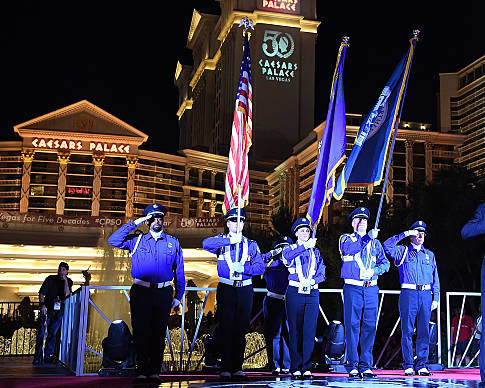
Note: the photo at the top of the page shows a proper TSA Flag Display Team.
For organizations that possess civilian ceremonial authority but lack military authorization, the correct solution is an FDT. I coined this term through extensive research and wanting to help others see that there are differences as well as requirements that must be met. The FDT gives civilians and certain organizations the leeway to respectfully render honor to our flag without the strict constraints of a military color guard. Honestly, this alleviates some stress for the people involved and even the audience.
The definition of the Flag Display Team
The FDT is a civilian ceremonial formation that respectfully presents and displays the United States flag and authorized organizational flags without arms and without military symbolism.
The FDT is:
- Civilian by design
- Unarmed by definition
- Intentional, not improvised
- Respectful without imitation
It is not a reduced color guard. It is a different system.
Authorized Characteristics of a Flag Display Team
A Flag Display Team may:
- Display the US flag in a dignified, upright manner
- Display an authorized organizational or state flag
- Civilian sizes for flags are easily obtainable: 3’x5’ or 4’x6’.
- The brown “office” civilian staffs come in sets
- The eagle finial is very appropriate in this setting and the finial for your second flag is your choice.
- Utilize simple, coordinated movements appropriate to civilian ceremony
- Maintain professional bearing consistent with the organization’s mission
A Flag Display Team does not:
- Use military drill commands
- Perform manual-of-arms movements
- Employ guard symbolism or protective postures
- Represent itself as a color guard
Who May Form a Flag Display Team
A Flag Display Team is appropriate only for organizations that meet both of the following criteria:
- They possess independent civilian ceremonial authority, and
- They are not subordinate to or embedded within a military ceremonial system
Examples include:
- Civilian federal agencies (e.g., TSA)
- Law Enforcement, Corrections, Fire and EMS departments (it’s permissible to switch depending on manning and/or location)
- Schools, universities, and civic institutions
- Scouts, including Sea Scouts
- Armed guards are not authorized
- Scout guards can use the hiking staff manual of arms
- Sea Scout guards can use the boat hook (firefighter pike pole)
- Private or corporate ceremonial organizations
- Pipe bands and other musical ensembles
In these cases, the FDT provides a legitimate, bounded, and professional solution.
Where the Line Is Drawn: When Even an FDT Is Not Authorized
Not all organizations that cannot form a color guard are eligible to form a Flag Display Team.
This distinction is critical.
Certain entities occupy a hybrid or subordinate status—they are uniformed, federally affiliated, or service-adjacent, yet do not possess independent ceremonial authority.
These include:
- Coast Guard Auxiliary (CGAux)
- National Oceanic and Atmospheric Administration (NOAA) Commissioned Corps
- US Public Health Service (PHS) Commissioned Corps
As addressed in detail in the companion article examining these organizations, Don’t Form a Color Guard, the issue is not respect or professionalism—it is authority.
These organizations:
- Derive identity from a parent service or federal framework
- Lack independent ceremonial doctrine
- Do not possess standalone authority over national or organizational colors
- Are not empowered to redefine ceremonial roles by substitution
As a result: They cannot form a military color guard, and they also cannot default to a Flag Display Team. In these cases, the correct ceremonial posture is participation without presentation.
A Short Story
Around 2023, I completed a public critique of a federal civilian organization whose uniformed members were presenting the colors—something they were never authorized to do. Years earlier, the organization had produced its own “honor guard pamphlet” and was operating under an assumption of authority that did not exist.
After I published the critique on my YouTube channel, I received an email requesting a discussion about the video and related ceremonial practices. During the call, I found myself gradually persuaded that I should help them rewrite their honor guard pamphlet so it would at least be correct.
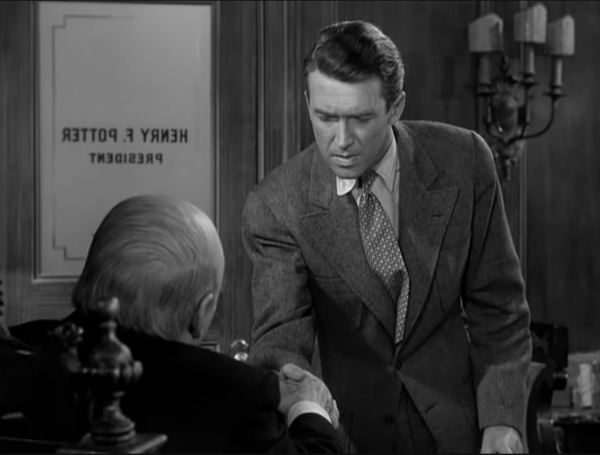
About thirty minutes into the conversation, I had a moment of clarity—much like George Bailey’s realization in It’s a Wonderful Life (watch this scene here). I recognized that I was on the verge of compromising my own principles by lending legitimacy to a ceremonial construct that had no doctrinal basis to exist in the first place.
That realization ended the discussion. This story in no way is intended to portray the officer I spoke with as an evil entity (“shaking hands with the devil”). Not at all. The officer was sincere and truly thought her organization had the authority to form an honor guard.
Proper Alternatives for Service-Adjacent Organizations
For organizations such as CGAux, NOAA, and PHS, appropriate options include:
- Attending ceremonies in uniform without ceremonial roles
- Providing administrative, logistical, or representational support
- Deferring all flag presentation to an authorized military or civilian organization
- Participating jointly only when assigned a clearly defined, non-ceremonial role
This is not exclusion. It is structural integrity.
Why These Boundaries Matter
Ceremony is symbolic authority made visible.
When organizations step outside their authorized lane—whether by imitation or substitution—regardless of intentions—the result is confusion rather than honor, symbolism without legitimacy, and ceremony weakened rather than elevated.
The Flag Display Team solves a real problem—but it is not universal. It applies only where authority exists to support it.
Final Thought
Not every organization can form a color guard. Not every organization that cannot form a color guard should form a Flag Display Team.
Respect for the flag is not measured by how much ceremony is performed—but by how accurately it is performed.
Clear boundaries preserve meaning. Clear systems preserve trust. And ceremony, done correctly, honors everyone involved.
Comments 8
Reenactors: Do they fit into an exception here? Context being; say a Revolutionary War or Civil War reenactment group provides a color guard for a parade. I think your answer is “yes, as it’s heritage is based in military drill and a tradition of authority,” but it’s still a civilian organization. I think a more common example is a drum and fife corps which may have a color guard.
And one that’s beyond weird: bagpipe bands… They wear uniforms that vary from a shirt and kilt to “number ones.” They work off British drill manuals. It’s a civilian organization with… strange tendencies and traditions. Should these organizations refrain from color guards?
Thanks for your take on this.
Author
Hi Sir,
Thank you for your comment, it really made me think and I added quite a bit to the article to answer your question.
DrillMaster
Wow, that’s a lot of thought and work on your part. I see the changes. Thanks! What you’ve added makes sense, and I agree. It would be hard for someone on the street to differentiate the historic representation of a color guard in a parade from one with authority, though it sounds like it’s only problematic if said team is attempting to assume authority under an existing unit where none exists.
Two scenarios brought this to mind: The first a pipe band which carried both American and Scottish flags under arms in a parade (which is beyond salvage, there’s really nothing there to be ok with). The second a group of veterans wearing their old or current uniforms slapped together with grandpa’s M1s and the flags out of the town hall. If you haven’t already, it’s a candidate for one of your “don’t do this” photos. It crossed my mind that a historic representation of a color guard from a reenactment organization would seem a bit more professional than said gaggle of veterans.
Author
I was a member of a VSO for 12 years. I contacted the HQ and volunteered to be the drill master for the organization. I was told the position was already filled. We can see, on an almost daily basis, on the lack of knowledge and guidance the HQ provides to units.
Respectfully, I would have to disagree with your premise here. While I appreciate your argument, I don’t see it rooted in law or tradition. For example, when Congress chartered the Boy Scouts of America in 1916, the BSA had been in existence for 6 years and had already established a working manual for drill and ceremony. (And in its inception was certainly more of a cadet organization that it has since evolved into).
Throughout almost the entirety of the 20th Century, the Boy Scouts were synonymous with respect for the flag, not “just” color guards, but flag retirements as well. Images of scout color guards leading parades is foundational to any image of a small town America parade.
And I will not even entertain the notion of an American Legion without color guards.
But I think there is an additional issue here that is more central. And forgive me, but your position is actually quite un-American. We the people are sovereign, and do not need explicit permission for things that are rights. Protecting our country and flag are one of those rights, and I would argue that any American organization dedicated to upholding and defending the Constitution are inherently endowed with the rights and privileges to form a color guard. We are not a European country which require patents and charters, but rather a country founded by volunteers in militias who raised those militias with neighbors. Who voted their officers.
Now having said all of that, I think there are organizations that should think long and hard about forming color guards. Without the discipline and work to do it well, it is frankly an embarrassment and brings discredit on their organization. Wearing a uniform is not synonymous with being able to drill.
So yes, I agree with you that “Ceremony is symbolic authority made visible.” I just would argue that in the good ole US of A, that that authority derives from the people, and is inherent in being an American; it requires no special dispensation, and is inherent in both the First Amendment (the flag itself) and the Second Amendment.
Author
Why are some who are associated with scouting bent out of shape with my article and citing the history of BSA? It’s as if I attacked someone personally. Sir, I have ZERO control over what you or anyone else does. I write to provide guidance. Whether you adhere to it is your choice and not my concern.
In your reply to Bill H, you chose to cherry pick one part of his comment then created a strawman response that failed to address any point he had made. That approach matches nearly everything I have seen from you.
You presume that you are the singular expert and thereby the singular authority on all matters that you choose to address. You criticize others for lacking “authority” when you yourself have none.
Many times your articles talk about things that are “not authorized” as if your opinions were the authority. As you yourself point out, the military services each have their own documents (which each differ) but those documents only apply to the specific service publishing the document. If another organization wants to publish its own procedures, your notions about what the military does have no bearing on any other organization regardless of whether that organization is federal, state, local, or non-government.
Much of what you say is absolutely correct, at least by tradition, but much is simply a matter of your personal opinion or interpretation of what ought to be correct.
Author
You seem to think I need to address absolutely everything in every comment.
You also seem to think that what I write is opinion.
Both of those are 100% wrong.