
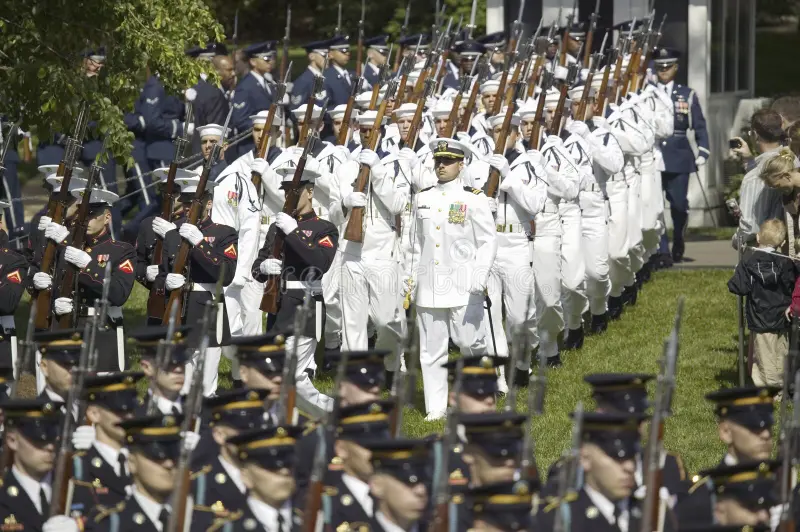
From time to time, someone will object to the Navy’s reliance on Marine Corps Drill and Ceremonies (D&C) standards with a simple statement: “We’re the Navy, not the Marine Corps.”
While emotionally understandable, that response misunderstands how military doctrine actually develops, stabilizes, and endures.
The historical progression of sea service ceremonial guidance shows a clear pattern. Over time, the Marine Corps maintained the most complete, continuously applied, and operationally relevant system of ground ceremonial drill—especially in the areas of color guard structure, manual of arms, and formation geometry. Marine ceremonial standards were not merely written; they were preserved through constant public execution, institutional training pipelines, and doctrinal enforcement.
By contrast, Navy ceremonial guidance gradually shifted away from maintaining a fully independent procedural system. What remained most distinct within Navy practice were symbolic and historical overlays—most visibly the use of traditional finials and other service-specific ceremonial identifiers. These elements are meaningful, but they do not alter the underlying mechanics of drill, formation integrity, or manual execution.
Seen in this light, the Navy’s alignment with Marine Corps D&C doctrine was not a surrender of identity. It was a recognition of functional authority. Military doctrine routinely consolidates around the organization that preserves the most coherent and continuously applied system. Across the sea services, the Marine Corps fulfilled that role for ceremonial ground drill.
Color guard doctrine provides the clearest evidence. Effective color guard execution requires exact spatial relationships, codified manual procedures, and uniform ceremonial symbolism. The Marine Corps retained a complete, internally consistent framework for these requirements. The Navy, rather than duplicating an already functional system, adopted the structural doctrine while preserving its own historical distinctions where appropriate. This represents a layered model of authority—structural doctrine from the Marine Corps, symbolic tradition from the Navy.
This same layered relationship extends to the Coast Guard.
By tradition and statutory alignment, the Coast Guard follows Navy ceremonial customs. As a result, Coast Guard color guards and ceremonial formations operate from the same structural foundation derived from Marine Corps drill and ceremonies doctrine, while expressing identity through Navy-derived symbology and tradition. This is not duplication or confusion—it is continuity within the sea services’ shared ceremonial framework.
Understanding this distinction reframes the debate.
The real question is not why the Navy stopped producing an entirely separate manual, but which sea service maintained the most complete and continuously practiced ceremonial system. Once asked correctly, the outcome is unsurprising.
Doctrine in the military does not follow sentiment or service pride.
It follows competence, continuity, and clarity.
In adopting Marine Corps ceremonial structure while retaining Navy tradition—and in the Coast Guard continuing that same doctrinal lineage—the sea services did not blur their identities.
They demonstrated doctrinal maturity: preserving what is symbolic, consolidating what must be precise, and ensuring that ceremonial standards remain clear, enforceable, and enduring.
A Deep Dive, if you will
Let’s dive into the history of drill and ceremonies manuals and see the progression of drill and ceremonies for the US Marine Corps (USMC), US Navy (USN), and US Coast Guard (USCG). We will also see that Merchant Mariners (USMM), Public Health Service (PHS), and National Oceanographic and Atmospheric Administration (NOAA) because, as maritime or uniformed services, they rely on the regulatory umbrella established by the Department of the Navy (DoN).
This article tracks the regulatory history showing that the Marine Corps Order (MCO) became the default drill and ceremonies standard for the Navy and Coast Guard after the Navy ceased publishing its dedicated manuals in 1960, thus establishing a single regulatory foundation for all Department of the Navy associated services.
Note: you can download many of the manuals mentioned below as free PDFs from the Resources page under Military Manuals.
USN Manual History
The history is extensive and varied.
The Landing-Force Manual of 1920/1921 published by the Navy. Chapter III goes through standing manual, marching, and the manuals of arms. There are fascinating descriptions in this chapter. The Landing-Force Manual was published by the Navy again at least in 1938 and then the Landing Party Manual superseded it in 1950. Chapters 2 and 3 go over drill and ceremonies, respectively.
Up to this point, a Sailor was used in the drill and ceremonies section as the demonstrator in each image. In the 1960 version of the Landing Party Manual, OPNAV P 34-03, published by the Navy, a Marine is used as the demonstrator in the images for the first time. Apparently, this edition is the only OPNAV 34-03 ever published. “OPNAV” stands for Office of the Chief of Naval Operations.
First first published in 1902, the Bluejackets Manual of 1917 (the fifth edition), the handbook for Sailors, had nothing on drill and ceremonies. However, the 1938, 1939, and 1940 (the ninth edition) had very similar information on drill and ceremonies just like the Landing Force/Party Manual. All of the drawings are of a Sailor. Recent editions of the manual, (26th edition, 2023), have included a chapter on Courtesies, Customs, and Ceremonies. This includes detailed information on rendering the hand salute, executing Present Arms while armed with a rifle, and flag etiquette.
Drill and ceremonies information specifically for the Navy seems to have ended in 1960 when images of a Marine showed up in Department of the Navy drill and ceremonies guidance. While no single document explicitly states, “The Navy shall now follow the Marine Corps D&C manual,” this transition strongly indicates a conscious policy shift toward standardization and resource consolidation within the DoN. Prior to 1960, maintaining separate manuals for the Navy required duplicated effort in writing, illustrating, and updating regulations. The discontinuation of dedicated Navy D&C manuals and the subsequent appearance of Marine demonstrators in DoN guidance suggests the responsibility for setting the common drill standard was effectively delegated to the Marine Corps, as noted above. This move would ensure all personnel—Sailors, Marines, and later other DoN-affiliated services—executed ceremonies according to a unified regulatory foundation, streamlining logistics and promoting seamless interoperability, especially given the shared mission requirements of naval and landing-party personnel.
Marine Corps Manual History
The Marine Corps Drill Manual was first published by the Marine Corps Association in two editions in September and October of 1956. The second edition came with an errata sheet listing 52 changes to the first edition.
Interestingly, in June of 1956, the Navy appears to adopt the Marine Corps Drill Manual and titles it NAVMC 1131-A03. The “-A03” might be part of the numbering system, I’m not sure.
In this edition is paragraph 1050. Marines Afloat. “Marine detachments afloat will be guided, with respect to ceremonies aboard ship, by the Landing Party Manual and ship’s regulations as appropriate.”
NAVMC 2691, Marine Corps Drill and Ceremonies Manual, was published in 1980 and 1983. The 1983 edition is essentially Change 1 with page 12-3 being swapped out. It supersedes no other manual and was the only edition. This edition shows only Marines as the demonstrators in each image. “NAVMC” stands for Navy-Marine Corps. We can understand from this that the manual applied to both the Navy and Marine Corps.
It wasn’t until 2003 that Marine Corps Order (MCO) P 5060.20 was published and eventually had a Change 1 come out. In 2019, MCO 5060.20 was released, dropping the “P” from the title and revising the contents. The ‘P’ prefix was removed during the Marine Corps directives modernization initiative, which standardized manual-level publications and eliminated legacy designations.
The Sea Service Standard
The USMC, USN, USCG, US Merchant Mariners, Public Health Service, and National Oceanographic and Atmospheric Administration all drill in accordance with MCO 5060.20, Marine Corps Drill and Ceremonies.
The Coast Guard’s adoption of the MCO was formalized through Commandant Instruction (COMDTINST) M5060.11B (no date available), which is apparently still in effect, even though I cannot find a copy. I was able to find a reference to it in BASEBOSINST 5060 1 Boston Metro Area Honor Guard (June 2015).
The time has come for the Department of the Navy to supersede MCO 5060.20 with a single, authoritative Department of the Navy issuance—provisionally titled “Drill and Ceremonies for the Marine Corps and Navy.” Such an order would formally recognize what practice has already established: that Marine Corps ceremonial doctrine provides the structural foundation for ground drill across the sea services, while Navy tradition supplies the appropriate symbolic and historical distinctions for the Navy and Coast Guard.
The opening paragraph of this order should clearly state its scope of applicability. In addition to the Marine Corps and Navy, the directive must identify the United States Coast Guard, United States Merchant Mariners (USMM), United States Public Health Service (USPHS), and the National Oceanic and Atmospheric Administration as services operating within this ceremonial framework when conducting military-style drill and ceremonies. Establishing this coverage at the outset removes long-standing ambiguity and ensures uniform doctrinal alignment across the uniformed services that share naval heritage or ceremonial function.
Certain historically unique ceremonial units require explicit exemption:
- As with the Marine Corps Marine Barracks Washington (MBW), the US Navy Ceremonial Guard, and the USCG Ceremonial Honor Guard should be formally exempted from prescriptive procedural requirements where longstanding, officially sanctioned ceremonial practices differ for representational purposes.
Historical authenticity must also be preserved where appropriate:
- The USS Constitution should remain authorized to employ the cutlass for the two guards of the ship’s color guard when operating in period uniforms only. The order should therefore include the corresponding historical manual of arms governing that use as an annex, clearly separated from modern ceremonial sword procedures to prevent doctrinal confusion.
To ensure completeness, Sailors must be fully integrated into the doctrinal text. This includes explicit inclusion within:
- The standing manual (especially the hand salute)
- The sword manual applicable to naval ceremonial contexts
Parallel to this effort, a new Department of the Navy Flag Manual is required. That publication should supersede MCO 10520.3 and NTP 13(B), consolidating all authoritative guidance for:
- Service colors and organizational colors
- Guidons and distinguishing flags
- Authorized finials, staffs, and associated symbology
- Display, carry, and ceremonial employment standards
A single consolidated manual would eliminate conflicting references and finally establish a unified naval vexillological doctrine.
Doctrinal clarity must also address improper ceremonial expansion outside lawful authority. Restrictions must be stated accordingly (Here is why):
- The Coast Guard must terminate authorization for Auxiliary color guard formations, which lack statutory and ceremonial standing as uniformed military representatives.
- The USPHS must likewise immediately cease independent color guard activities for the same reason: commissioned officers of a uniformed service do not form ad hoc ceremonial elements absent explicit doctrinal and statutory authority.
These corrections are not matters of preference, but of legal status, ceremonial legitimacy, and protection of military symbolic integrity.
A unified Department of the Navy order would therefore accomplish three essential objectives:
- Codify existing structural authority derived from Marine Corps ceremonial doctrine.
- Preserve authentic naval tradition where historically and legally appropriate.
- Eliminate ambiguity and unauthorized ceremonial practices across associated uniformed services.
Such action would not create a new system.
It would formally recognize—and properly govern—the one that already exists.