
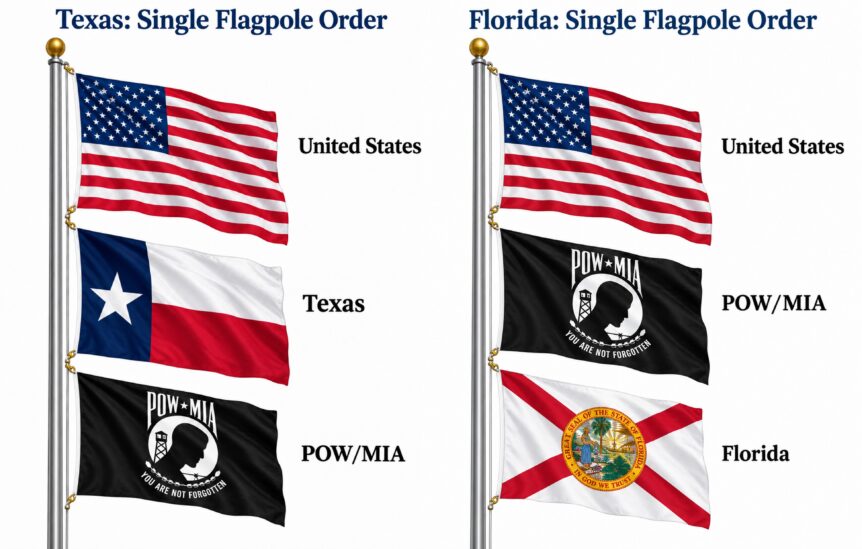
When a Texas municipality asks which flag belongs beneath the American flag, the answer must begin with the governing authority, not organizational preference.
The DrillMaster | October 22, 2026
A Texas firefighter recently contacted me with a flag-display question. His city had purchased POW/MIA flags for its facilities, but the fire station had only one flagpole. The United States and Texas flags were already displayed on that pole. The question was straightforward: Should the POW/MIA flag be placed between the United States and Texas flags, or below the Texas flag?
I researched the applicable Texas statutes and provided the firefighter with the relevant citations. He appreciated the information. Unfortunately, the municipality subsequently accepted the recommendation of a local Veterans of Foreign Wars (VFW) post commander and directed that the flags be displayed in this order: United States, POW/MIA, Texas.
The issue deserves examination because it illustrates a recurring problem in flag protocol: an organization’s preferred practice can become mistaken for governing authority.
What Texas Law Actually Says
Texas does not leave the display of its state flag entirely to custom. Chapter 3100 of the Texas Government Code establishes standards for its description, use, and display.
Section 3100.054, titled “Display on Flagpole or Flagstaff With Other Flag: In General,” states:
“A flag or pennant, other than the flag of the United States, displayed with the state flag:
(1) should not be above the state flag; or
(2) if the other flag or pennant is at the same height as the state flag, should not be, from the perspective of an observer, to the left of the state flag.”
Section 3100.055(a) provides the corresponding standard for displaying the United States and Texas flags on one flagpole:
“If it is necessary for the state flag and the flag of the United States to be displayed on the same flagpole or flagstaff, the United States flag should be above the state flag.”
These provisions establish a clear Texas display standard. The American flag occupies the upper position, and flags other than the American flag should not be displayed above the Texas flag.
The POW/MIA flag is not identified as an exception in § 3100.054.
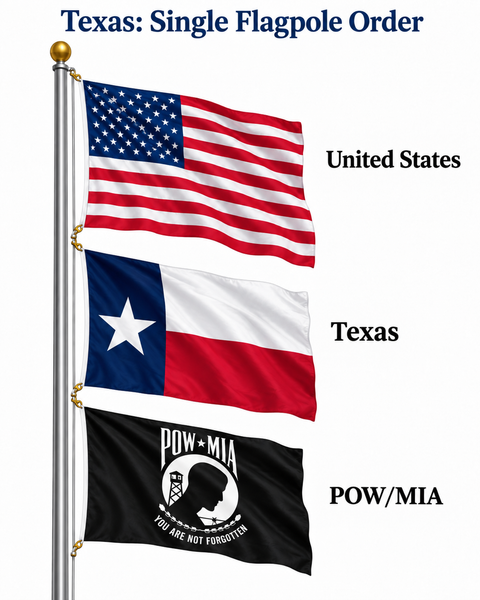
Accordingly, applying these Texas provisions to the fire station’s single flagpole produces the following arrangement:
- United States flag
- Texas state flag
- POW/MIA flag
Notice the legislature’s use of the word “should.” These are codified display standards, but the language should not be misrepresented as an absolute statutory prohibition carrying an identified penalty. A requirement expressed as “shall” would raise a different question of legal obligation. Nevertheless, the standards are plainly relevant to a municipal government’s flag-display decision. The Office of the Texas Governor reinforces this point in its published flag-display guidance, directing municipalities, counties, and political subdivisions to Chapter 3100 for questions concerning the Texas flag.
Florida Establishes a Different Standard
Florida provides an instructive contrast because its government expressly recognizes a different order of precedence when the POW/MIA flag is displayed.
Florida Statutes § 256.12 requires qualifying state-owned buildings displaying the United States flag to display the POW/MIA flag when one is available free of charge and its display conforms to applicable federal laws and regulations. This statute establishes the display obligation but does not itself prescribe the flags’ relative positions.
The controlling distinction appears in Florida Statutes § 256.015, which directs the Governor to adopt a protocol for displaying the Florida state flag. Subsection (2) expressly authorizes the Governor to adopt, repeal, or modify rules or customs concerning its display.
Exercising that statutory authority, the Florida Governor’s Executive Office published its National and State Flag Policy, which states:
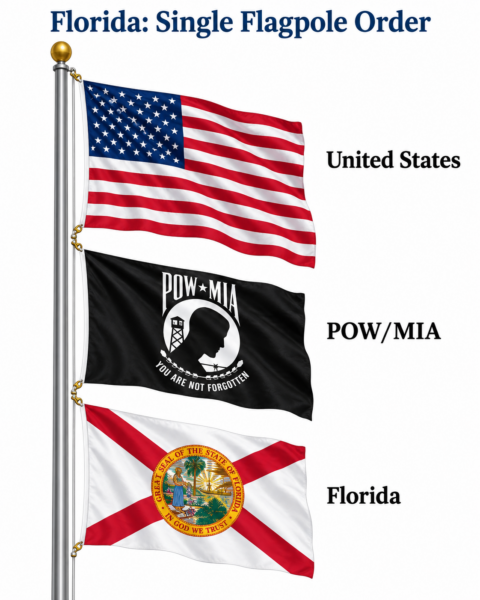
“The State flag should, unless being flown with the National Flag, always be flown above other flags. However, the State flag will take third position when a foreign visitor is being honored in Florida by an agency or department of the United States Government or when POW/MIA flag is being displayed.”
The Florida Department of State confirms this arrangement in its published flag-display guidance.
Therefore, Florida’s official precedence arrangement when all three flags are displayed is:
- United States flag
- POW/MIA flag
- Florida state flag
Compare that with Texas Government Code § 3100.054, which provides that a flag other than the United States flag should not be displayed above the Texas flag. Texas does not expressly establish the POW/MIA exception found in Florida’s official protocol.
The distinction is significant. Florida has a statute authorizing the Governor to establish state-flag protocol, and the Governor’s published protocol expressly provides for POW/MIA precedence. Texas has a codified display standard favoring the Texas flag over flags other than the United States flag.
The two states have therefore established different approaches through their respective governmental authorities.
A Florida official displaying the POW/MIA flag above the Florida flag can point to the Governor’s published protocol. A Texas official choosing the same arrangement cannot simply cite Florida’s protocol, federal administrative guidance, or a veterans organization’s practice as though those sources supersede Texas Government Code § 3100.054.
This is precisely why flag-display questions require jurisdiction-specific research. An arrangement recognized by one state may conflict with the published standards of another.
The issue is not whether the POW/MIA flag deserves recognition. Both states recognize its importance. The issue is which authority establishes the precedence of the flags being displayed.
What Federal Law Actually Says
The National League of Families POW/MIA flag is recognized by federal law under 36 U.S.C. § 902. It symbolizes the nation’s commitment to obtaining the fullest possible accounting of American prisoners of war and personnel missing in action. The National POW/MIA Flag Act of 2019 expanded the display requirement at specified federal properties to all days on which the United States flag is displayed. That statute addresses the locations and occasions for displaying the POW/MIA flag. It does not establish a universal precedence rule requiring the POW/MIA flag to be placed above every state flag at municipal facilities.
There is, however, federal administrative guidance recommending that the POW/MIA flag fly directly beneath the United States flag when displayed on a single flagpole. The Defense POW/MIA Accounting Agency publishes that guidance and describes the POW/MIA flag as generally occupying second precedence during designated national observances. This guidance must be acknowledged. It helps explain why many veterans and government organizations display the POW/MIA flag immediately below the American flag.
But we must distinguish the scope of that guidance from a statute governing Texas state-flag displays. A federal agency’s recommended arrangement does not, by itself, repeal a state display provision or establish an overriding municipal requirement.
What the VFW Actually Says
There is an especially important distinction within the VFW’s own published guidance. On its national website, the VFW addresses the question of whether the POW/MIA flag or a state flag should take precedence beneath the American flag.
The VFW acknowledges: “There is no definitive answer or protocol established in writing or codified in law.” The organization then identifies its position as VFW protocol, explaining that it treats the POW/MIA flag as a federal banner and gives it precedence over other flags beneath the American flag. That statement is significant. The VFW has established a protocol for its own purposes. That protocol reflects the organization’s commitment to POW/MIA recognition and remembrance. It is a legitimate expression of organizational policy.
However, VFW protocol is not federal law, Texas law, or automatically binding municipal policy. Further, the VFW’s statement about the absence of a universally codified precedence rule must be read alongside the Texas provision that specifically addresses the relative position of the Texas flag and other flags.
A post commander may provide valuable advice regarding the display of flags. Military service and leadership within a veterans organization deserve respect. Neither, however, automatically confers authority to override a municipality’s applicable statutory display standards. The question is not whether the VFW’s recommendation is sincere. The question is what authority governs the particular display.
Texas Has a Special POW/MIA Provision at Its Capitol
Another Texas statute warrants attention because it demonstrates how carefully we must examine the scope of a particular law. Texas Government Code § 443.024(d) addresses the display of the POW/MIA flag at the Texas Capitol. It provides that, when the POW/MIA flag is flown, it and the United States flag are displayed above the Capitol’s south door, while the Texas flag is displayed separately above the north door. This is a special statutory arrangement for a specific building. It does not establish a statewide rule authorizing every municipality to place the POW/MIA flag between the American and Texas flags on a single flagpole.
Texas Government Code § 2165.006 also requires POW/MIA flag display at state office buildings on six specified observances. That provision establishes display occasions, not a general precedence exception. The distinction matters. A rule governing the Texas Capitol cannot simply be transferred to a municipal fire station without examining its applicability.
Respect Does Not Determine Precedence
Some may interpret placing the POW/MIA flag beneath the Texas flag as a statement that the missing and captured Americans represented by that flag are somehow less important. That interpretation misunderstands flag precedence.
Precedence is not a measurement of personal sacrifice, patriotism, or respect. It is an ordering system established by the authority governing a particular display. The POW/MIA flag represents an extraordinary national commitment. Its position in a display does not diminish the service members it honors. We do not improve ceremonial respect by disregarding applicable standards. We improve it by understanding why the standards exist and applying the proper authority.
What Municipal Officials Should Do
When a municipality receives conflicting advice, officials should identify the source and scope of each instruction. Is it federal law? State law? A federal agency’s administrative guidance? An organizational protocol? A locally adopted policy? Those are different forms of authority. They should not be treated as interchangeable.
For a Texas municipal fire station displaying the American, Texas, and POW/MIA flags on one flagpole, the Texas Government Code provides a direct standard favoring the American flag first, the Texas flag second, and the POW/MIA flag third. Federal POW/MIA display guidance and VFW protocol support another arrangement, but neither has been shown to create a mandatory exception to Texas Government Code § 3100.054 for this municipal display. If a city chooses another arrangement, its officials should identify the governing authority or adopted municipal policy supporting that decision and explain how they have reconciled it with the Texas display standard.
The objective should be a properly supported decision, rather than an assumption that a respected individual or organization necessarily possesses the controlling answer.
The principle is simple: When flag-display practices conflict, establish the governing authority before deciding which protocol to follow.
Respect for the American flag, the Texas flag, and the POW/MIA flag requires nothing less.
References
- Texas Government Code, Chapter 3100, §§ 3100.054–3100.055, Display of State Flag. https://statutes.capitol.texas.gov/Docs/GV/htm/GV.3100.htm
- Office of the Governor of Texas, Flag Status and General Instructions on the Proper Display of the Flag. https://gov.texas.gov/flag-status
- Texas Government Code § 2165.006, Display of POW/MIA Flag. https://statutes.capitol.texas.gov/Docs/GV/htm/GV.2165.htm
- Texas Government Code § 443.024, Display of the Texas and United States Flags. https://statutes.capitol.texas.gov/Docs/GV/htm/GV.443.htm
- 36 U.S.C. § 902, National League of Families POW/MIA Flag. https://uscode.house.gov/us/usc/119-120/t36/s902/
- 4 U.S.C. § 7, Position and Manner of Display. https://uscode.house.gov/us/usc/119-118/t4/s7/
- Veterans of Foreign Wars, Flag Etiquette, POW/MIA Protocol. https://www.vfw.org/community/flag-etiquette
- Defense POW/MIA Accounting Agency, History and Display Rules. https://www.dpaa.mil/About/History/
- Florida Statutes § 256.015, Display of State Flag; Protocol. https://www.flsenate.gov/Laws/Statutes/2026/0256.015
- Florida Statutes § 256.12, Display of POW-MIA Flags. https://www.flsenate.gov/Laws/Statutes/2026/0256.12
- Executive Office of the Governor of Florida, National and State Flag Policy, page 2. https://www.flgov.com/eog/sites/default/files/pdf/2022-EOG-Flag-Protocol.pdf
- Florida Department of State, Flag Protocols and Display. https://dos.fl.gov/about-the-department/flag-and-seal-protocol/flag-protocols-and-display/