
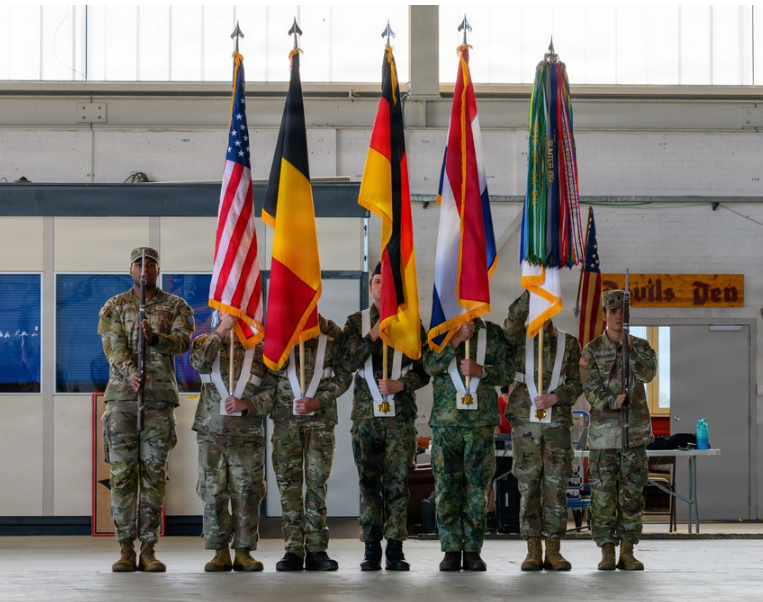
Military ceremonies often share the same visible elements.
There may be a formation, a color guard, music, honors, commands, narration, distinguished guests, and a carefully planned sequence of movements. To an audience, one ceremony may look much like another. But similar appearance does not mean identical purpose.
A retirement ceremony, a retreat ceremony, and an oath ceremony may use many of the same ceremonial tools and symbols, yet each communicates something fundamentally different. A retirement ceremony recognizes the completion of a period of service. It honors an individual’s contribution, acknowledges the transition from active service, and places that service within the continuing history of the institution.
A retreat ceremony marks the end of the official duty day and includes honors to the national flag. When used to recognize departing leaders, it may also provide an appropriate setting for farewell and public acknowledgment, but the underlying meaning of retreat remains tied to the flag and the close of the duty day.
An oath ceremony is different again. Its central act is the acceptance of an obligation. The individual or group is not merely being recognized. They are entering into, renewing, or publicly affirming a legal and moral commitment. These ceremonies may all include colors/flags, music, formations, and honors, but those elements do not carry the same message in every setting.
The purpose of the ceremony determines what each element means
A formation may represent institutional order in one ceremony, collective witness in another, and unit cohesion in a third. Music may create solemnity, render honors, signal movement, or connect the event to service tradition. Colors may represent national authority, organizational identity, or continuity of service.
The elements are not interchangeable decorations, they are entrusted symbols and actions that must be used for the purpose they were designed to serve. This is where ceremonial stewardship becomes essential.
Those who plan and perform ceremonies do not own the formations, colors, honors, or traditions they use. They receive them temporarily and are responsible for applying them accurately. Their personal preference must give way to the meaning of the event. Precision alone is not enough.
A formation may be perfectly aligned. Commands may be strong. Movements may be synchronized. The music may begin at exactly the right moment.
But if the ceremony communicates the wrong authority, uses symbols without regard to their proper purpose, or combines ceremonial elements merely because they are impressive, then the ceremony has failed. It may be polished, but it is not accurate.
Ceremony is structured communication (yes, I am saying it yet again). The planner must first identify what is actually taking place.
- Is service ending?
- Is authority being transferred?
- Is an obligation being accepted?
- Is the flag being honored?
- Is an individual being recognized?
- Is the organization affirming continuity?
Once the purpose is clear, the formation, sequence, symbols, honors, and narration can be selected to support it. Without that foundation, ceremonial planning becomes little more than assembling familiar parts. That is not stewardship. It is imitation.
The best ceremonies may share common elements, but each is built around a distinct purpose. The responsibility of the ceremonial planner is not merely to make the event look military.
It is to ensure that every element communicates the correct meaning.
The Change of Command
Change-of-command ceremonies provide an important interservice example.
In Army ceremonies, the organizational color or unit guidon is commonly passed from the outgoing commander to the presiding officer and then to the incoming commander. The Department of the Air Force follows the same general procedure for Air Force and Space Force organizations, frequently using the unit guidon. The Marine Corps similarly exchanges the organizational colors.
The Navy and Coast Guard use the naval verbal exchange: “I relieve you.” “I stand relieved.”
The visible procedures differ, but the underlying purpose is the same. The assembled command witnesses the formal relief of one commander and the assumption of command by another.
The reading of orders is common to these ceremonies because the orders establish the official authority behind the transition. The exchanged color, flag, or guidon provides a tangible representation of that transition in the Army, Air Force, Space Force, and Marine Corps. The verbal exchange identifies the decisive moment in the Navy and Coast Guard.
Therefore, it would be incorrect to assume that every valid change of command must include the same physical exchange.
A Navy color guard may parade the colors during a change of command without those colors serving as the instrument through which command is visibly transferred. Conversely, an Army unit guidon may be central to the symbolic transfer even though the guidon itself has no power to appoint the incoming commander.
The ceremonial language is service-specific. The underlying authority is not.
This is why ceremonial elements cannot be copied from one service to another merely because they are visually effective. Each service uses its own established form to communicate the same institutional fact: lawful command has passed from one individual to another.
Responsibility Does Not Equal Command
A second distinction is equally important: a change of responsibility is not a change of command.
The Army and Marine Corps have long-established ceremonies for senior enlisted succession. The Army commonly calls the event a change of responsibility. The Marine Corps generally uses the term relief and appointment. The Air Force and Space Force are also beginning to conduct change-of-responsibility ceremonies for command chiefs and command senior enlisted leaders.
These ceremonies may resemble a change of command. They may include a formation, music, colors, narration, official remarks, and the commander’s participation.
But the authority involved is different.
A commander possesses lawful command authority over the organization. A senior enlisted leader serves as the commander’s principal enlisted advisor and may exercise substantial responsibility for standards, discipline, readiness, welfare, development, and communication with the enlisted force.
That responsibility is significant, but it is not command.
The distinction becomes especially important when ceremonial symbols are selected.
The organizational color, flag, or guidon represents the organization and is closely associated with the commander’s authority. In a change of command, its passage can visibly represent the outgoing commander’s relinquishment and the incoming commander’s assumption of command.
The same object does not automatically become an appropriate symbol for senior enlisted succession.
A senior enlisted leader may carry, safeguard, supervise, or be entrusted with the organizational guidon. That custody does not make the guidon the symbol of the senior enlisted office. Passing the commander’s guidon between outgoing and incoming senior enlisted leaders may visually suggest that command authority is being transferred, even when the event is correctly titled a change of responsibility.
The commander remains in command throughout the ceremony.
The outgoing senior enlisted leader is relieved from an advisory and leadership position. The incoming senior enlisted leader assumes the duties, delegated authority, and accountability associated with that position. Neither individual relinquishes or assumes command through the ceremony.
The Marine Corps offers a useful contrast. In some relief-and-appointment ceremonies, the Sword of Office is transferred as a symbol specifically associated with the sergeant major’s billet. The object represents the senior enlisted office without appropriating the organizational colors that represent the command.
This is the standard ceremonial planners should pursue: the symbol must accurately represent the office involved.
A change of command and a change of responsibility may share many visible elements. They do not communicate the same transfer of authority.
When the same script, language, or central symbol is used for both, the ceremony may be precise in execution while inaccurate in meaning.
Ceremonial similarity must never be allowed to erase institutional distinction. A commander assumes command. A senior enlisted leader assumes responsibility for the duties of an enlisted office. Both transitions deserve recognition, but they must not be made to look as though they transfer the same authority.
Download ICS DCS 10-103 Change of Command: Authority, Orders, and Ceremonial Symbolism, here.