
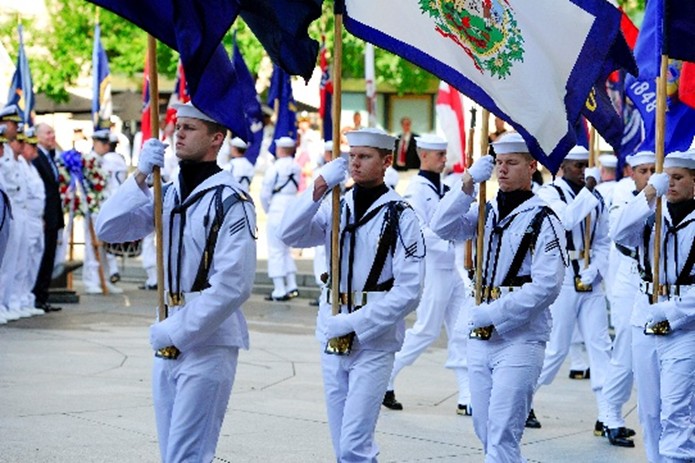
At the Boot Camp training base, RTC Great Lakes, and at the Navy Ceremonial Guard in DC, Sailors carry the states and territories in one or two massed formations.
Recruit Training Command Great Lakes and the Navy Ceremonial Guard both routinely display massed State and Territory flags in one or two large formations carried by Sailors. These are Flag Display Teams.
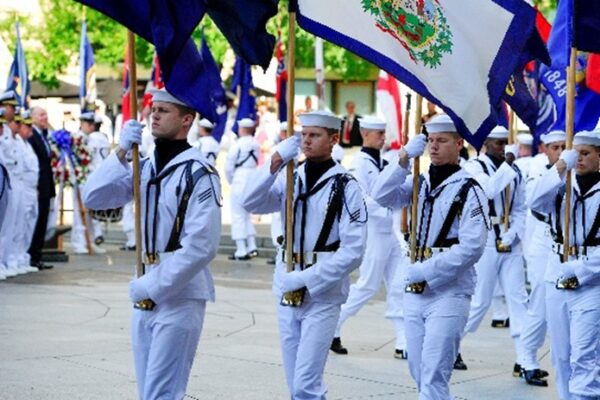
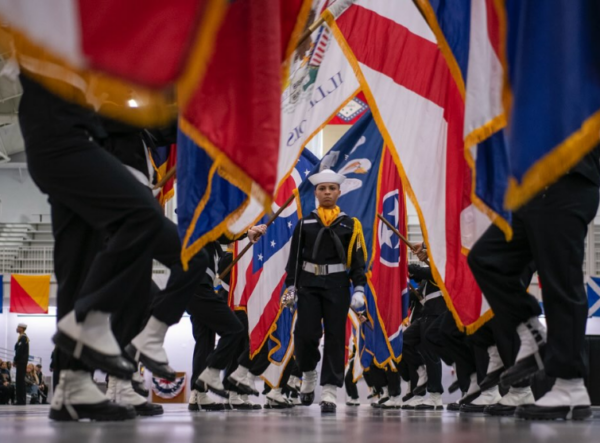
These are not color guards, and they are not intended to function as such.

This is a color guard. This is the Joint Armed Forces Color Guard in Washington DC
The Sea Services Cannot Carry State and Territory Flags
…in a color guard formation. Marine Corps, Navy, and Coast Guard color guards cannot carry state and territory colors because the Department of the Navy does not allow it.
The Core Reason
State and territorial flags are not “colors” in the military sense. They are representational flags, not command symbols.
Because of that:
- They cannot form a color guard
- They cannot flank or accompany the National Color
- They cannot assume positions of honor
- They must be displayed in a neutral, subordinate, collective manner
The Navy solved this problem correctly by creating massed formations.
Why State & Territory Flags Cannot Be in a Sea Service Color Guard
A color guard exists for one purpose:
To protect and render honors to colors that represent sovereign authority, command, or service identity.
Authorized military colors:
- National Color (U.S. flag)
- Service Colors
- Command / Organizational Colors (when authorized)
State and territory flags:
- Represent civil jurisdictions
- Do not convey military command authority
- Have no position of precedence inside a military unit
- Are never listed as colors in Navy doctrine
Putting them into a color guard would:
- Artificially elevate them
- Create false precedence conflicts
- Violate the purpose of the color guard itself
1. Collective Representation, Not Individual Honor
The intent is symbolic inclusion, not honor rendering.
Each flag represents:
- Where Sailors come from
- The breadth of the nation
- Unity through diversity
No single state is honored over another.
Massing prevents:
- Implied precedence
- Ranking conflicts
- Visual hierarchy errors
2. Visual Neutrality
In a massed formation:
- All flags are equal
- All staffs are identical
- No flag is placed “in honor”
- No flag escorts another
This visually reinforces:
“These flags represent people, not authority.”
3. Doctrinal Cleanliness
The Navy avoids doctrinal contamination by:
- Not calling these colors
- Not forming a color guard
- Not mixing them with National or Service Colors
Instead, the formation functions as a ceremonial tableau, not a tactical or honor-bearing element.
4. One vs. Two Formations
This is purely logistical and visual, not doctrinal.
Factors include:
- Number of flags
- Available space
- Camera framing
- Marching distance
- Symmetry
Both formations preserve:
- Equality
- Neutrality
- Subordination to official colors elsewhere in the ceremony
The Key Distinction (This Is the Line People Miss)
| Concept | Color Guard | Massed State Formation |
| Purpose | Render honors | Represent inclusion |
| Authority | Sovereign / command | None |
| Precedence | Required | Eliminated |
| Escorts National Color | Yes | Never |
| Salutes/Present Arms | Yes | No |
| Terminology | “Colors” | “Flags” |
This is why the Navy’s method is not a workaround — it is a purpose-built solution.
Why This Matters (Especially for First Responders & Cadets)
Many civilian and uniformed organizations:
- See these formations
- Copy the appearance
- But not the logic
That’s how we end up with:
- State flags flanking the U.S. flag
- “State color guards” (fine for National Guard and first responders)
- Incorrect honor rendering
- Invented precedence rules
The Navy’s approach is actually a model of restraint.
Bottom Line
State and territorial flags may be displayed but never honored as colors.
Massed formations allow representation without violating the purpose of the color guard.
That is why:
- They are grouped
- They are separated
- They are never integrated into a color guard formation
Governing Principle — Representational Flags vs. Colors
State and Territory Flags Are Not Colors
State and Territory flags are representational flags, not military colors. They symbolize civil jurisdictions and the geographic origins of personnel; they do not convey sovereign authority, command authority, or service identity. As such, they are not authorized to be carried within a color guard formation.
A color guard exists for the specific purpose of protecting and rendering honors to colors—symbols of national sovereignty, service identity, or command authority. Only those flags designated as colors may assume positions of honor, receive salutes, or establish precedence relationships within a formation.
Authorized Method of Display (Carrying)
When State and Territory flags are displayed by military or military-type organizations, they must be presented in a manner that preserves doctrinal clarity and avoids implied authority. The correct method is a Flag Display Team, in which all flags are treated equally, and no hierarchy, escort relationship, or position of honor is created.
Massed formations:
- Emphasize collective representation, not individual honor
- Eliminate precedence conflicts
- Prevent the elevation of civil flags to color status
- Preserve the doctrinal integrity of the color guard
This approach is exemplified by U.S. Navy ceremonial units, which deliberately separate representational flags from official colors to avoid doctrinal contamination.
Prohibited Practices
The following practices are doctrinally incorrect:
- Integrating State or Territory flags into a color guard
- Placing State flags in escort positions alongside the National Color
- Assigning positions of honor or precedence to State flags
- Rendering salutes or honors to State or Territory flags as if they were colors
Governing Rule
State and Territory flags may be displayed in stands, but they may never function as colors.
Representation does not equal authority.
Exception: Army, Air Force, and Space Force Allowance for State & Territory Colors
The prohibition against integrating State and Territory flags into a color guard applies fully to the sea services (Marine Corps, Navy, and Coast Guard).
However, the United States Army, United States Air Force, and United States Space Force operate under a different doctrinal framework that allows State and Territory flags to be carried as colors within a color guard.
This allowance is not incidental, aesthetic, or ceremonial improvisation—it is explicitly rooted in land-service organizational doctrine.
State Flags as Organizational Colors (Land Services)
In the Army, Air Force, and Space Force, State and Territory flags may be designated and treated as organizational colors under specific circumstances. This is most commonly seen in:
- National Guard units
- State Defense Forces
- Cadet and ROTC programs aligned with land-service doctrine
- Ceremonial representations where state affiliation is part of unit identity
In these contexts, the State or Territory flag:
- Represents command affiliation, not merely geography
- Functions as a unit-identifying color
- Is authorized to assume a position within a color guard
- May establish a subordinate precedence relative to the National Color
This fundamentally changes the flag’s status from representational to organizational.
Limitation for Land Services: State & Territory Colors Do Not Replace Military Organizational Colors
While the United States Army, United States Air Force, and United States Space Force may authorize the inclusion of a State or Territory flag within a color guard, this authorization is additive—not substitutive.
A State or Territory color may be added to a color guard only when the military organizational color is also present. It may never replace the service, command, or unit color required by doctrine.
Required Color Guard Structure (Land Services)
When operating under land-service doctrine, a properly constituted color guard includes:
- The National Color, and
- The military organizational color (Service, command, or unit), when authorized
A State or Territory color, when permitted:
- Is carried in addition to the required military color
- Assumes a subordinate role within the formation
- Does not supersede or displace military authority
The military organizational color represents command identity and authority.
A State or Territory color represents affiliation or origin.
These functions are not interchangeable.
Why Replacement Is Prohibited
Allowing a State or Territory flag to replace a military organizational color would:
- Remove the visual representation of command authority
- Misidentify the unit being represented
- Reduce the color guard to a symbolic display rather than a doctrinal one
- Create inconsistency with military precedence and purpose
Land-service doctrine permits State colors only because they supplement identity—not because they redefine it.
Common Error (Observed in Cadet & Civil Programs)
A frequent mistake occurs when a color guard carries:
- The National Color, and
- A State or Territory flag,
- But omits the military organizational color
This formation is incomplete and doctrinally incorrect for land services when a unit or service color is authorized.
Governing Clarification
State and Territory colors may supplement a land-service color guard, but they may never replace the required military organizational color. Authority precedes affiliation.
Instructor Enforcement Note
If a unit claims authorization to carry a State or Territory color, the instructor should ask one question:
“Where is your military organizational color?”
If it is absent, the formation is incorrect. Why: each colors section of the three drill and ceremonies manuals clearly explains and shows that the basic color guard is two rifle guards, an NCO to carry the national colors, and a junior enlisted member to carry the service departmental/organizational color.
Why This Works for Land Services but Not Sea Services
The difference lies in how authority and identity are structured.
Land services:
- Are territorially organized
- Maintain permanent command relationships tied to states
- Recognize state affiliation as a component of command identity
Sea services:
- Are federally commissioned and operationally mobile
- Do not derive command authority from states
- Do not recognize state identity as a color-bearing authority
As a result:
- A State flag may function as a color in land-service doctrine
- The same flag remains a representational flag only in sea-service doctrine
This is not a contradiction—it is doctrinal alignment with organizational reality.
Practical Implications for Color Guard Design
Because of this distinction:
- A color guard operating under Army, Air Force, or Space Force doctrine may include a State or Territory color when authorized.
- A color guard operating under Marine Corps, Navy, or Coast Guard doctrine may not, regardless of appearance or precedent elsewhere.
Mixing these rules across doctrinal boundaries is incorrect.
Governing Clarification
A State or Territory flag may function as a color only when the governing service doctrine explicitly recognizes it as an organizational symbol of command or identity.
Absent that recognition, the flag remains representational and may not be carried in a color guard.
The same flag may be authorized as a color in one service and prohibited in another. This does not create a conflict—it reflects different command structures and doctrinal purposes.