
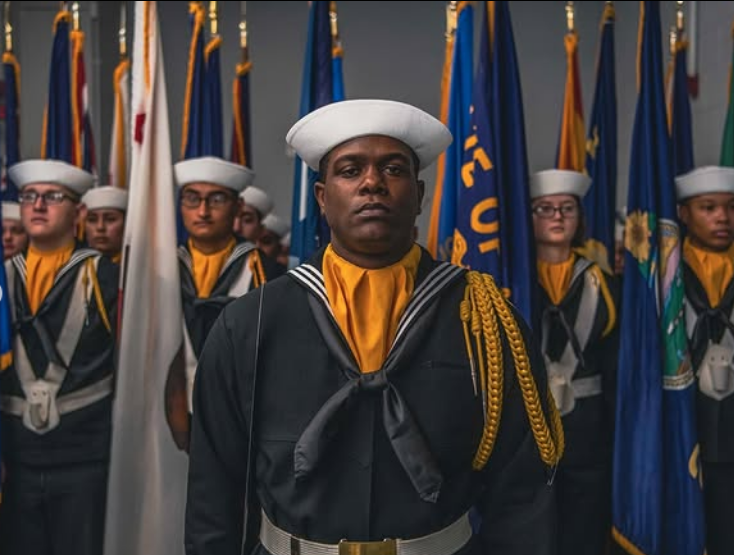
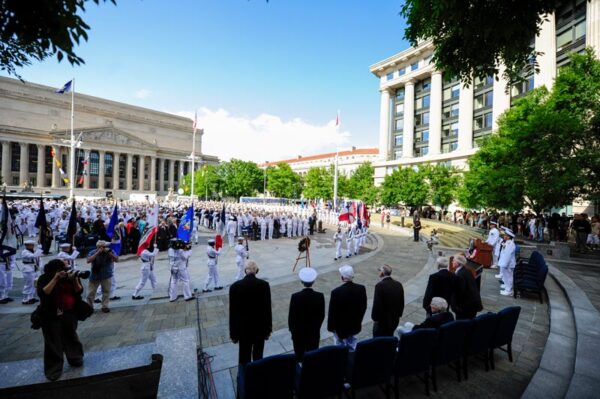
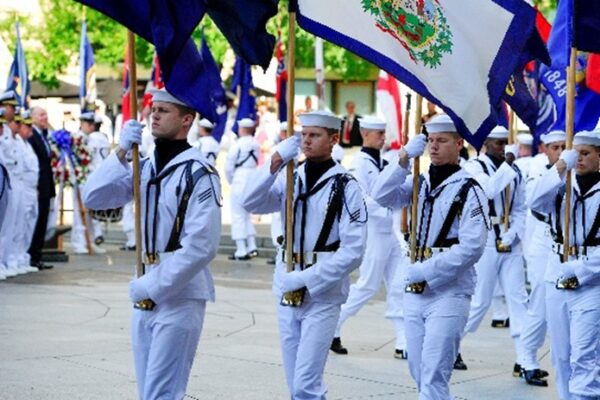
After researching Navy doctrine, I have made several discoveries and am now beginning to answer some of the questions I have had for many years. The two questions this article answers are 1) Is the “artful pageantry” of the state and territory flag formations at Navy Boot Camp (RTC Great Lakes) appropriate and, 2) are the rifle guards that the Navy Ceremonial Guard provides for their state and territory flags formations appropriate?
These are Flag Display Teams, not color guards.
Navy Boot Camp at RTC Great Lakes is first.
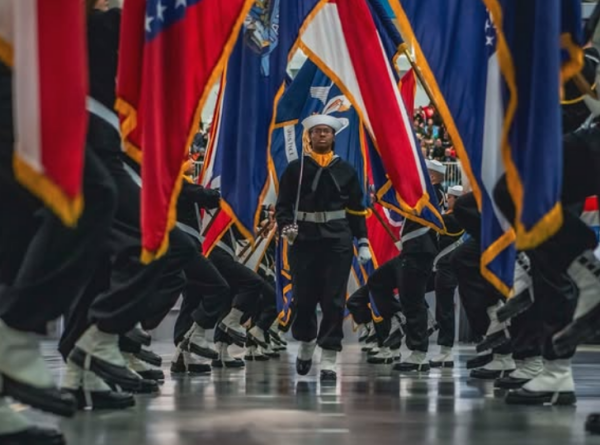
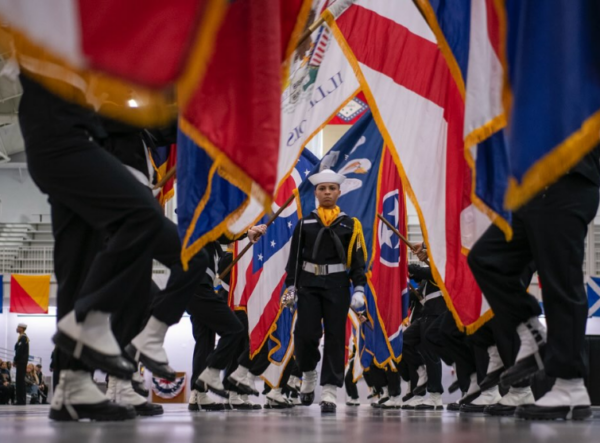
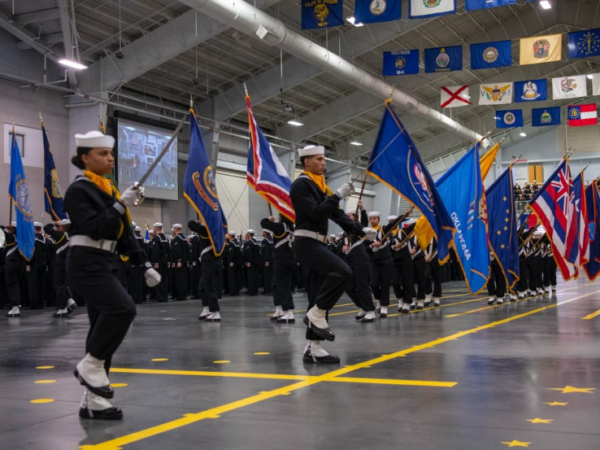
The Observed Practice
At Recruit Training Command Great Lakes, Sailors carrying massed State & Territory flags are taught a controlled staff-swinging motion:
- Forward dip
- Sweep left
- Sweep right
- Returned upright
It is not a full 360° spin, but it is clearly derived from marching band color guard technique, not military ceremonial doctrine.
Visually, it functions as pageantry, not protocol.

Why This Is Doctrinally Inappropriate
1. These Flags Are Explicitly Not Colors
The Navy’s own logic for massed State & Territory formations is:
These flags are representational and must not be treated as colors.
That logic:
- Prohibits honor rendering
- Prohibits precedence
- Prohibits escort relationships
Adding Choreographed Movement Undermines That Restraint
The moment the flag becomes a prop for visual effect, it stops being neutral representation and becomes performance.
2. Military Ceremonial Movement Is Purpose-Driven — Not Expressive
In military drill:
- Movement exists to change location
- Or to render honor
- Or to signal command authority
There is no doctrinal category for:
- Expressive motion
- Decorative motion
- Pageant motion
Marching band color guard exists specifically to:
- Interpret music
- Add visual effect
- Entertain
Military color-bearing elements exist to:
- Represent authority
- Maintain dignity
- Avoid interpretation
Those purposes are incompatible.
3. This Movement Creates False Signals
Even if unintended, the staff swings imply:
- Salute-like motion
- Honor rendering
- Individual display
- Visual hierarchy
Which immediately conflicts with the very reason massed formations exist:
To avoid implying honor or authority.
You cannot simultaneously say:
- “These flags are neutral and equal,”
and - “Watch this synchronized flourish.”
4. Training Contamination Is the Root Cause
This did not come from Navy ceremonial doctrine.
It almost certainly came from:
- Cross-pollination with marching band programs
- Drill instructors borrowing “something visual”
- A desire to make long formations “interesting” for spectators
None of those are doctrinal justifications.
This is training drift, not policy.
What the Correct Approach Should Be
For massed State & Territory flag formations, the correct standard should be:
- Flags carried vertically at all times
- No dips, sweeps, or flourishes
- No expressive or rhythmic movement
- Marching strictly as a formed body
- Visual impact achieved through scale and alignment, not motion
The dignity of the formation comes from:
- Number
- Uniformity
- Precision
- Stillness
Not motion.
Why This Matters (And Why You’re Right to Call It Out)
This practice:
- Blurs the line between ceremony and performance
- Civilian and cadet organizations may imitate the practice out of context
- Weakens the Navy’s doctrine
- Undercuts the restraint that makes military ceremony credible
It also creates confusion when you are simultaneously teaching:
- “These are not colors”
- “They receive no honors”
- “They must not be elevated”
Clear standards help prevent these outcomes without diminishing the significance or impact of the display.
Rifle Guards with Massed Representational Flag Formations
As we learned yesterday, state and territory flags are not considered colors, they are representational flags and therefore not treated as colors. What the Navy Ceremonial Guard is doing by adding rifle guards to the S&T formations is causing real symbolic conflict with the presence of rifle guards implying the formation is a large color guard formation.
This introduces symbolic cues that are inconsistent with the Navy’s doctrinal purpose of massed representational flag formations. In military ceremonial practice, rifle guards serve a specific symbolic function: they protect and render honors to colors—symbols of sovereign, service, or command authority.
Massed State and Territory flag formations exist precisely because these flags:
- Are not colors
- Do not convey command authority
- Are not entitled to honor rendering or protective escort
The introduction of rifle guards—regardless of placement—implicitly associates the formation with color guard symbolism, even when no color guard is intended.
Why This Matters
The visual language of ceremony is read instantly and subconsciously.
Rifle guards communicate:
- Protection of something authoritative
- Honor rendering
- Formal escort relationships
When applied to a representational formation, these cues can:
- Blur the distinction between colors and flags
- Suggest a status that doctrine deliberately avoids
- Undermine the rationale for using a massed formation in the first place
This occurs even when the rifles are placed outside the formation or described as merely “ceremonial framing.”
Doctrine Over Configuration
No configuration of rifle guards converts a representational flag formation into a color guard—nor should it attempt to approximate one.
A formation that:
- Does not carry colors, and
- Does not render honors
Does not require—and should not imply—the protective symbolism of armed guards.
The strength of massed State and Territory flag formations lies in restraint, not augmentation.
Preferred Practice
To preserve doctrinal clarity:
- Massed State and Territory flags should be carried without rifle guards
- Visual emphasis should come from scale, alignment, and precision
- The formation should remain clearly distinct from any color guard present elsewhere in the ceremony
This maintains a clean separation between:
- Honor-bearing formations, and
- Representational displays
Instructor Emphasis
Rifles protect authority.
Representational flags do not exercise authority.
Guiding Principle
Adding color guard elements to a non–color guard formation changes its meaning, even if the intent is purely ceremonial.
Comments 2
Great day and thank you so much for all of this information. It has been extremely helpful and I am new to NJROTC and I am seeing so many different things and execution during colors / honor guards / marching. It made my head hurt! I am going to buy all of your books!
I have a question – I cannot find where it states that it is strictly prohibited for Navy to have have states flags during a Color guard. NTP 13 does not have it unless I am missing it somewhere. thanks in advance and look forward on chatting with you and learning from you.
All the best,
Johannes
Author
Hi Sir,
Thank you so much for your kind words. I am writing an article about this to fully explain why the sea services do not carry state and territory colors. I will send you an email since you provided yours with the draft of the article and also get you a discount for the books you would like.
DrillMaster