
Accurate flag folding depends on understanding the mechanics of each movement, not the age of the instructor or the technique.
I have been teaching military drill and ceremonies for decades, and one of the most frustrating things I encounter is the assumption that because someone learned a particular technique recently, that technique must somehow be superior to what was taught previously.
Recently, an individual informed me that my flag-folding techniques were outdated. He even offered to have me visit his training facility so he could show me the latest methods. Another individual told me that there is no why behind each fold. You just do it.
Both comments demonstrate a problem that reaches far beyond flag folding: the failure to distinguish between knowing a procedure and understanding it. Let’s examine what that means.
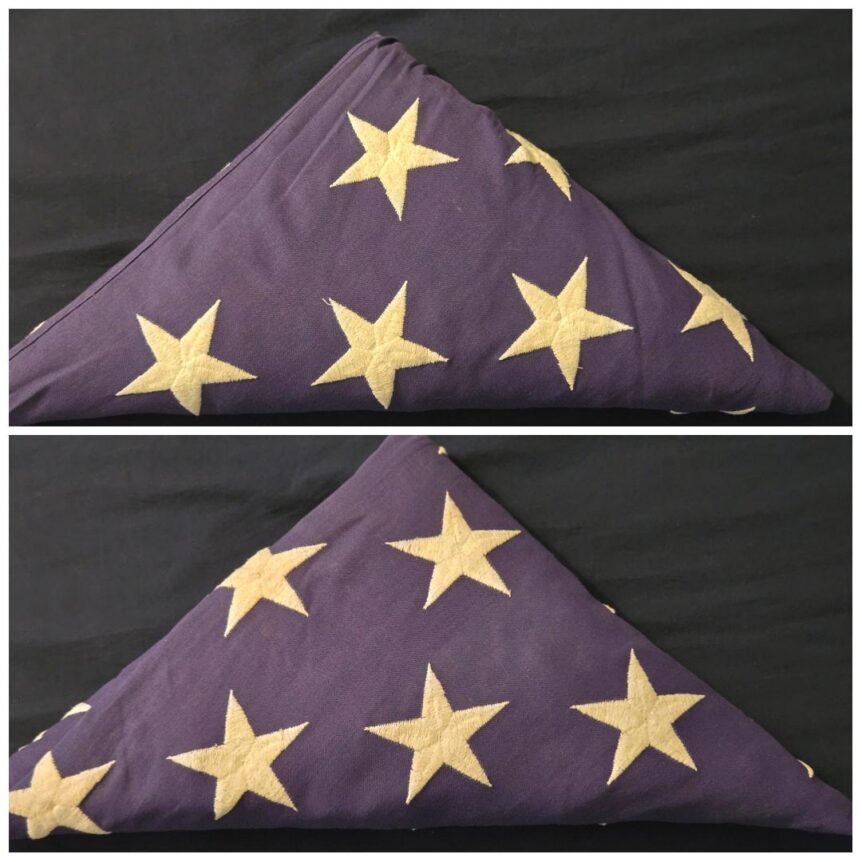
The image at the top: There is nothing wrong with a 1-3, 2-4, but it’s best to strive for a 1-3-5, 2-4, meaning, the stars that show on each side.
Every Fold Has a Purpose
Please understand this has nothing to do with the meaning of the thirteen folds of the flag. This is about the geometric process of the folds.
Flag folding is a cumulative process. Each fold establishes the position of the material for the next fold. The angle, alignment, placement of the tip, and control of the material all affect what happens afterward. An error introduced during one fold can remain unnoticed until several movements later, when the material no longer lies where it should. This is why I teach the reason behind each fold.
It is not sufficient to tell someone to place the material in a particular position. I want that person to understand why that position matters and what will happen if the material is placed incorrectly. The photographs accompanying this article demonstrate exactly what I mean.
Example One: The Position of the Tip

The first set of four photographs shows two comparisons of the same folding stages. In the upper photographs, notice the position of the tip in relation to the outside edge. One position allows the tip to extend too far toward or beyond that edge, while the other provides better control of the material. That difference matters because the following folds depend on how this material is positioned.
The lower photographs demonstrate an equally important consideration. The lower-left example positions the material inward so that the red corner will be concealed by the next fold. In the lower-right example, the material is not angled inward sufficiently, and that corner will remain exposed. These are not random differences in appearance. They are predictable results of how the material was positioned.
When I teach this, I explain what the next fold must accomplish and how the current fold prepares the material for it.
The point is not merely to make a triangle. The point is to make the triangle correctly so that the next triangle can also be made correctly.
Example Two: Breaking the Edge

The second set of four photographs illustrates another problem: breaking the edge.
One folding position maintains the proper alignment. The other allows the fold to break the established edge. Once that happens, the problem is carried into the following folds. The material is no longer properly positioned, and the subsequent folds compound the original error.
You cannot solve the underlying problem by continuing to fold and hoping the material will somehow correct itself. You must return to the point where the alignment was lost and correct the technique. This is what accurate repetition requires.
When the person folding understands the relationship between the fold and the edge, the correct position becomes repeatable. When the person simply imitates the movements without understanding that relationship, the results can vary from one attempt to another. There is nothing mysterious about this. It is the geometry of folding material.
My Age Has Nothing to Do With It
Now we come to something that apparently needs to be explained. My age has nothing to do with whether a flag is folded accurately. The age of my instructional video has nothing to do with whether the techniques demonstrated in it produce an accurate fold. And the fact that I learned certain techniques decades ago does not automatically make those techniques obsolete.
A properly aligned edge does not become improperly aligned because the instructor is older. A correctly positioned triangle does not become incorrect because the video demonstrating it was recorded years ago.
The material does not know how old I am. The geometry does not change because a new class of ceremonial personnel has graduated from a training course. The principles of alignment, angle, material control, and accurate repetition remain what they are.
If someone has developed a genuinely better technique, I am interested in understanding it. Show me how it works. Explain why it produces a better result. Demonstrate its consistency and establish that it complies with the governing procedure. That is how we evaluate technique.
But telling me that my instruction is outdated because someone is teaching something “newer” is not an evaluation. It is an unsupported assertion. Newer does not automatically mean better, it actually means “different”. Different is OK. Older does not automatically mean obsolete. Accuracy is not determined by a calendar.
The Difference Between Doctrine and Technique
There is another distinction that must be understood.
Military publications establish procedures. Those procedures govern the personnel and organizations to which they apply. An instructor does not have the authority to disregard an applicable procedure merely because he prefers another way of accomplishing the task.
However, a published procedure does not necessarily explain every mechanical detail that makes its execution accurate and consistent. That is where technical understanding and instructional experience become important.
My folding instruction originated with my Air Force training. Over the years, through ceremonial experience, observation, research, and teaching, I have developed and refined the techniques I use to accomplish the required movements. I did not simply invent movements to make flag folding look different. I examined what each fold needed to accomplish, how the material behaved, and how to achieve the intended result consistently.
I can explain why I teach the placement of the tip, the preservation of the edge, and the adjustment necessary to conceal material during a subsequent fold. The photographs demonstrate the consequences of getting those details right or wrong. That is a technical explanation, not a personal preference.
Experience Is Not the Same as Understanding
I frequently receive comments that begin with some variation of, “I spent three years on such-and-such honor guard, and…”
I respect that experience. Serving on a military honor guard requires training, discipline, and considerable practice. But experience must also be understood in context. Three years performing a procedure within one organization is not necessarily equivalent to decades of teaching, researching, evaluating, and refining that procedure across multiple organizations. The distinction is not simply the number of years. It is the nature, breadth, and depth of the experience.
A person can become highly proficient in a particular procedure without understanding its historical development, the differences among service requirements, or the mechanical reasons behind the movements.
Likewise, longevity alone does not establish expertise. Someone who has performed a task incorrectly for 30 years does not become correct by virtue of repetition. Experience deserves consideration. It does not place anyone’s methods beyond examination.
I do not expect anyone to accept my instruction simply because of my background. I expect them to examine what I teach, consider the explanations, and evaluate the results. I extend that same standard to others. The problem arises when someone presents a few years of experience as conclusive authority while dismissing the accumulated knowledge and work of others without examination. That is not a balanced assessment of expertise. It is an assumption that one’s own training represents the limits of what there is to know.
There Is Always a Why
The statement that there is no reason behind the folds, that one simply performs them, is particularly concerning. Of course there is a reason.
- Why must the tip remain in a particular position?
- Why must the material be angled inward?
- Why must the edge remain intact?
- Why does one incorrectly positioned fold cause the following folds to deteriorate?
These are legitimate technical questions, and they have answers. An instructor who cannot answer them has a gap in his understanding. That does not necessarily mean he cannot perform the procedure. It means his ability to explain, diagnose, and correct the procedure is limited.
When I teach, I want the student to know more than the sequence of movements. I want the student to recognize when the material is beginning to drift out of alignment and understand what adjustment is necessary. This produces more consistent execution and creates personnel who can identify and correct their own errors. It also produces better instructors.
Memorizing a sequence teaches you what to do. Understanding the sequence teaches you why it works. That is not a distinction we should dismiss in military ceremonial instruction.
Show Me the Error
If someone believes my technique is incorrect, demonstrate the error. Identify the governing publication and the specific requirement my technique violates, if that is the objection. If the objection concerns technical accuracy, explain why the placement or movement is wrong. Show how the alternative produces a more accurate and repeatable result. I welcome that kind of examination.
But do not dismiss decades of instructional development by announcing that you have learned the “latest techniques,” as though the date of your training settles the question.
The two sets of photographs accompanying this article illustrate specific mechanical relationships that can be observed, tested, and repeated. They show why alignment matters, why placement matters, and why an error made during one fold affects those that follow. That is what I teach.
My methods are not correct merely because I have taught them for decades. They are not incorrect merely because I have taught them for decades, either. Evaluate the technique. Examine the result. Understand the reason.
If the only criticism you can offer is that my instruction is old, then you have not identified a problem with my instruction. You have demonstrated that you do not understand what makes a technique correct in the first place.
There is a reason behind every fold. I intend to keep teaching it.