
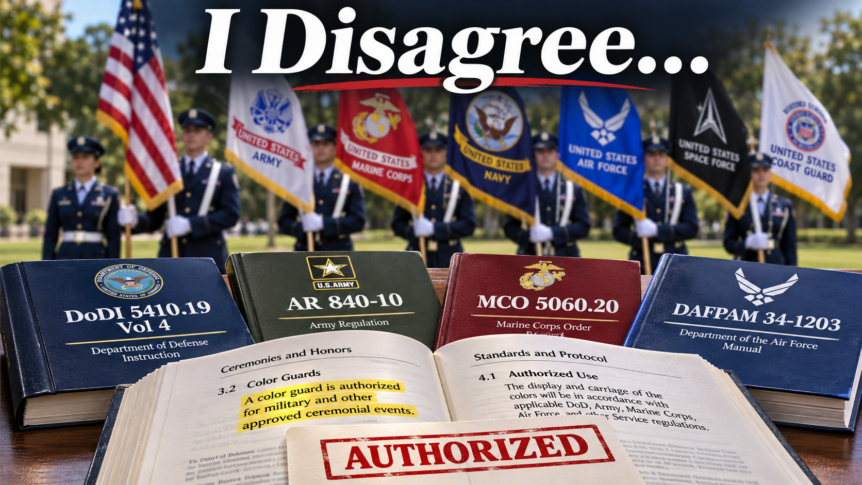
Understanding Authority, Military Service Colors, and Cadet Color Guards
I recently shared two posts explaining why cadet organizations are not authorized, under the established military color guard requirements, to carry the official colors of all six military services.
The posts generated considerable disagreement. One individual presented several quotations from military and AFJROTC publications, arguing that an AFJROTC color guard may carry the state flag, all six military service colors, its organizational color, and the POW/MIA flag.
The argument sounded authoritative. It included publication numbers, paragraph references, and statements about flag precedence.
But quoting a regulation is not the same as correctly interpreting its authority and application.
This article examines those claims, one at a time, using the actual publications. Although the original argument focused on AFJROTC, the issue involves Army, Marine Corps, and Department of the Air Force standards, along with the Department of Defense instruction governing the Joint Armed Forces Color Guard.
I also want to establish something at the outset. I fully support the desire for cadets to honor all six military services during special patriotic occasions. I have proposed a formal policy that would authorize this type of cadet formation under defined conditions. What I do not support is treating the desire to conduct a ceremony as sufficient authority to conduct it.
The Fundamental Issue: What Is Authorized?
Before examining the individual claims, we must understand how military ceremonial standards establish authorized practices.
Military drill and ceremonies publications prescribe formations, personnel, equipment, positions, movements, and procedures. The governing publication tells us what the authorized formation is. We do not begin by imagining every possible variation and searching for a sentence expressly forbidding each one.
For example, when a manual prescribes two color bearers and two rifle guards, it establishes the formation. Adding three more color bearers does not become authorized simply because the paragraph does not include a sentence specifically forbidding a seven-member formation. The same principle applies to personnel qualifications.
When a service manual prescribes NCO color bearers, a person who does not possess the required military status does not satisfy that qualification simply by knowing how to carry the colors. This is the strict approach to ceremonial doctrine that I addressed in my article, How Cadet Programs Should Interpret Drill and Ceremonies Regulations.
There is also an important distinction between a military color guard and a cadet color guard. Cadet organizations have their own authorized formations, personnel, and institutional colors. Their authorization comes through the governing structure of the cadet program. That is a separate ceremonial category. It does not turn a cadet into a member of the Armed Forces.
When discussing military service colors, I am referring to their official ceremonial carriage in a formed color guard representing the military services. I am not suggesting that a civilian cannot own a commercially available service flag or that a patriotic organization cannot arrange military service flags as a static display. The ceremonial function and the authority to perform it are the issues.
The burden rests on the person claiming authorization to identify the provision that grants it.
Point 1: Carrying the National Color Authorizes Additional Service Colors
The claim:
“If this is an AFJROTC unit, they are authorized to carry the state, service, and JROTC unit colors, as long as they carry the US flag with them.”
The individual cited DAFPAM 34-1203, paragraph 7.32.1.3, which requires the Air Force or Space Force flag to be accompanied by the U.S. flag.
Counterpoint
The paragraph establishes a requirement concerning the relationship between the National Color and the Department of the Air Force service flag. It does not authorize AFJROTC cadets to carry every military department’s ceremonial colors. The argument reverses the meaning of a conditional requirement.
The pamphlet requires the National Color to accompany the Air Force or Space Force flag. It does not say that anyone carrying the National Color is consequently authorized to carry the Air Force flag. Consider what that interpretation would mean.
If simply carrying the National Color provided authorization to carry additional military service colors, nearly every cadet color guard in the country would have the authority to add whichever military colors its members wanted. That is not how official ceremonial authorization is established. A condition attached to an authorized practice is not an independent grant of authority.
Point 2: What DAFPAM 34-1203 Actually Prescribes
The claim:
The reader cites the Department of the Air Force drill pamphlet as authority supporting cadet carriage of military service colors.
Counterpoint
We need to read paragraph 7.32.1 and its subordinate paragraphs together.
DAFPAM 34-1203, Drill and Ceremonies, dated September 13, 2022, describes the standard Department of the Air Force color guard.
Paragraph 7.32.1 provides for two NCO flag bearers and two experienced Airmen or Guardians serving as guards when practical.
Paragraph 7.32.1.1 states:
“The carrying of the US, Air Force, or Space Force flags is an honor bestowed only on responsible NCOs.”
This language is significant. It identifies the military personnel to whom the flag-bearing responsibility is entrusted.
The phrase when practical in paragraph 7.32.1 addresses the composition of the military formation. It does not establish a general exception allowing cadets to fill military NCO color-bearing positions.
AFJROTC cadets may hold cadet NCO grades, but cadet rank is not military enlisted rank. Their status does not satisfy the personnel qualifications prescribed for the official Department of the Air Force formation.
The pamphlet establishes a military standard. It does not establish an AFJROTC exception authorizing cadets to represent the military departments by carrying their official colors. That authority would have to come from an applicable, competent authority.
Point 3: The AFJROTC Pamphlet Says Service Flags May Be Carried
The claim:
The reader also relies on the AFJROTC Drill and Ceremony Pamphlet dated November 1, 2024.
Paragraph 2.3 states:
“The flag may be joined by the state flag, service flags and organizational flags in the Color Guard.”
Counterpoint
This is the strongest portion of the reader’s argument because the AFJROTC publication expressly mentions service flags. It also creates the most important question about the authority under which the pamphlet was issued.
The paragraph is located under Parades. Its language clearly contemplates the inclusion of service flags in an AFJROTC parade formation. I do not dispute that the language exists. I dispute that its existence, standing alone, establishes sufficient authority to expand the official ceremonial use of the military departments’ colors.
In my February 4, 2026 article, Can a Cadet Program Change Drill and Ceremonies Doctrine?, I addressed the distinction between administrative authority and doctrinal authority.
A cadet-program headquarters can issue implementing instructions, organize training, establish safety restrictions, and explain how authorized military practices are adapted for cadet use. That does not mean it possesses unlimited authority to change the ceremonial requirements established by the military departments.
The relevant questions are therefore:
- What is the source of authority for permitting cadets to carry those colors? I submit to you that authorization does not exist.
- Has competent authority granted a specific exception to the military color-bearing standard?
- Does that authorization extend beyond parades to other ceremonial events?
- Can an Air Force cadet-program publication authorize ceremonial representation of the Army, Navy, Marine Corps, and Coast Guard? (that answer is “no.”)
The pamphlet’s statement does not answer those questions. Neither a flag-precedence chart nor a general reference to service flags establishes that the appropriate military authorities approved an exception.
In the absence of demonstrated authority, my doctrinal assessment is that this AFJROTC provision is insufficient to authorize the claimed practice. I consider its wording inconsistent with the personnel and formation standards prescribed for official military color guards, and I believe headquarters should review and correct or formally substantiate the language.
That is a criticism of the publication and its authorization, not of the cadets who were taught to follow it.
Point 4: TC 3-21.5 Establishes the Movements, So Cadets Can Carry the Colors
The claim:
“Those color must be carried IAW with TC 3-21.05 and the AFJROTC Drill and Ceremony Pamphlet as indicated in AFJROTCI 36-2010.”
Counterpoint
The correct Army publication designation is TC 3-21.5, Drill and Ceremonies, dated May 3, 2021. The AFJROTC Color Guard Pamphlet, paragraph 2.1.1, directs AFJROTC and SFJROTC color guards to use the Army training circular for color guard movements. That provides an instructional reference for procedures (without the authority to mandate AF and SF JROTC units to ignore DAF standards). It does not establish authority to carry additional departmental colors.
And what does TC 3-21.5 itself say?
Paragraph 15-13 states:
“The Color guard consists of two (three) sergeants and two specialists or privates.”
The paragraph then identifies the senior color sergeant as the bearer of the National Color and commander of the formation. These are military personnel qualifications, not cadet grades.
AFJROTC’s adoption of Army color guard movement procedures does not transform AFJROTC cadets into Army sergeants or specialists. Nor does it grant those cadets the Army’s ceremonial authority.
Procedural compliance and authorization are separate requirements.
A formation must be authorized before the question of correctly executing its movements becomes relevant.
Point 5: The Army Specifically Identifies What AJROTC May Carry
The Army provides an especially useful example because its flag authorization regulation directly identifies Junior ROTC. AR 840-10, Flags, Guidons, and Streamers, dated August 19, 2025, contains Table 5-1, Flags Authorized for Army Echelons and Organizations. On page 44, the table identifies separate categories for the National Flag, U.S. Army Flag, institutional color, distinguishing flag, and organizational color.
The AJROTC entry authorizes the National Flag and institutional color. It does not authorize the U.S. Army Flag or Army organizational color. That distinction is explicit. Senior ROTC is listed separately and is authorized the U.S. Army Flag. The Army therefore recognizes that different organizations operating within its broader educational and military structure possess different flag authorizations.
Furthermore, AR 840-10, paragraph 5-49(c), identifies the Army JROTC institutional color. It prescribes the silver-gray field, scarlet fringe, JROTC device, and school identification. The institutional color is not an arbitrary substitute for the Army Color. It is the officially prescribed color representing the JROTC organization.
Army JROTC cadets honor the Army while carrying their own institutional color. Their institutional identity is part of the ceremonial standard. There is no need to replace it with a departmental color for which Table 5-1 does not grant AJROTC authorization. This is one of the clearest examples of the principle I am explaining.
The Army tells us what AJROTC is authorized to carry. We do not expand that authorization merely because an instructor wants to use additional flags.
Point 6: The Marine Corps Establishes Its Own Color Guard Requirements
MCO 5060.20, Marine Corps Drill and Ceremonies Manual, dated May 15, 2019, establishes the composition and procedures of Marine Corps color guards. Enclosure 1, Chapter 7, paragraph 5(a), prescribes a four-member formation with two NCO color bearers and two junior personnel serving as guards. The senior color bearer carries the National Color, and the junior bearer carries the organizational color.
The manual also addresses Navy-Marine Corps and joint military color guards. These are military formations with prescribed personnel and responsibilities. Now consider MCJROTC.
On September 9, 2016, the Director of Marine Corps JROTC issued Policy Letter 9-16, Color Guard and Drill Team Guidance. The policy requires MCJROTC color guards to execute their duties in strict compliance with the Marine Corps drill manual and identifies the MCJROTC organizational flag as the authorized organizational color. That is an important distinction.
The Marine Corps provides the drill system, and the cadet program uses its prescribed institutional identity within that system. The program does not need to redefine a Marine Corps departmental color bearer to create a legitimate cadet color guard. The 2016 letter should be read alongside any subsequent MCJROTC directives, but its express identification of the organizational flag is directly relevant.
As with the Army, the issue is not whether the cadet is capable of handling the departmental color. The issue is whether that position and color are authorized for the cadet formation.
Point 7: Army and Marine Corps Standards Do Not Apply Because This Is AFJROTC
The claim:
“MCO5060.20 and AR360-1 do not apply as this is not a joint service color guard (yes, JROTC units can participate in them).”
Counterpoint
The first statement requires a distinction. An AFJROTC unit is not automatically subject to every administrative requirement imposed on Army and Marine Corps military personnel. However, the present discussion involves the official colors of those military services and a formation resembling the prescribed military Joint Armed Forces Color Guard. We cannot dismiss the standards governing those colors merely by calling the formation an AFJROTC color guard.
The more significant issue is the reader’s assertion that JROTC units can participate in official Joint Armed Forces Color Guards. Where is the authorization? It does not exist.
The governing publication is DoDI 5410.19, Volume 4, Community Outreach Activities: Ceremonial, Musical, and Aerial Event Support, dated September 29, 2021. Section 5.1.a establishes the Joint Armed Forces Color Guard for authorized DoD public programs.
The prescribed nine-member composition is:
- Two Army color bearers carrying the National and Army Colors.
- One color bearer each from the Marine Corps, Navy, Air Force, Space Force, and Coast Guard, carrying the respective service colors.
- One Army rifleman and one Marine Corps rifleman serving as escorts.
The instruction also provides a specific alternative when a Joint Armed Forces Color Guard cannot be formed. Under the stated conditions, a single-service military color guard may carry the additional military service flags. That is an authorized alternative within the military ceremonial framework. It is not a general provision allowing cadets to fill those military service positions.
AR 360-1, The Army Public Affairs Program, dated April 15, 2026, paragraph 7-32, also prescribes the Joint Armed Forces Color Guard. MCO 5060.20, Chapter 7, addresses the joint formation as well. Both publications retain older compositions that predate the addition of Space Force. The current DoD instruction provides the updated joint composition.
None of these publications identifies JROTC cadets as authorized substitutes for military service members in the official JAFCG. A group of cadets carrying flags representing all six services does not become an authorized military Joint Armed Forces Color Guard merely because it resembles one. Nor does calling it a cadet color guard automatically resolve the authority question.
If the proposed formation is a different type of cadet ceremony, its authorization must be separately established. That is precisely why I proposed creating a formal cadet multi-service color guard category.
Point 8: Flag Precedence Makes the Formation Correct
The claim:
“The AFJROTC Drill and Ceremony Pamphlet gives you the order of precedence when carrying those colors. In this case, the service colors are out of order.”
The reader listed the National Color, state flag, six service flags, and POW/MIA flag in his proposed order.
Counterpoint
The order of precedence governs the relative positions of flags when they are appropriately displayed or carried. It does not independently authorize their presence. That difference is fundamental.
A publication may show the order of precedence for numerous military, state, organizational, and commemorative flags. Those flags may be required or appropriate in different settings. The precedence chart does not establish that every organization may carry all of them in one formation.
For an official military Joint Armed Forces Color Guard, DoDI 5410.19, Volume 4, establishes the prescribed composition. That formation does not include a state flag, an organizational flag, or POW/MIA flag among its specified members.
A state (territory) flag may be carried by an Army, Air Force, or Space Force color guard when the appropriate commander authorizes its inclusion for a military ceremony. Both AR 840-10, paragraph 1-8e, and DAFI 90-1201, paragraph 2.12.3, expressly grant commanders this authority. The authorization is discretionary, not automatic, and must be appropriate to the occasion.
Of the three land services, either a single-service or joint formation of two or more are authorized to carry a state/territory color.
But correct placement does not establish permission to add it to a formation. The order of precedence is a procedural matter.
Authorization comes first. Correct arrangement follows.
Point 9: The POW/MIA Flag Is Authorized Because the Event Was Not a Parade or Review
The claim:
“POW/MIA flags are only unauthorized at parades and review, as this is neither, it would [be] an authorized flag.”
Counterpoint
This is another example of interpreting the absence of a specific prohibition as affirmative authorization.
DAFI 90-1201, Protocol, dated October 8, 2024, paragraph 2.6.4, states:
“The POW/MIA flag is not carried or displayed in parades or reviews but may be carried at official military funerals.”
This establishes a restriction for parades and reviews and identifies an authorized circumstance for carriage. The AFJROTC pamphlet, paragraph 2.4, also prohibits the POW/MIA flag in parades and reviews.
A football-game ceremony may not meet the formal definition of a military parade or review, but that does not resolve the authorization question.
If someone claims that the POW/MIA flag is authorized as a carried element of an AFJROTC color guard for that particular ceremony, the appropriate question remains: Which applicable authority grants permission? The answer cannot simply be that the occasion was not a parade.
This is the permission to carry the POW/MIA Flag:
“but may be carried at official military funerals.”
The only time it is carried is as a personal color at the funeral of a former POW. That’s it, no other time. Ever.
The flag may be appropriately displayed, not carried, at the venue without becoming a component of the color guard.
This distinction is especially important because the POW/MIA flag represents a national commitment to those who were prisoners of war or remain missing in action. Its significance deserves proper treatment under established flag protocol. It should not be added to a formation merely because doing so seems patriotic.
Point 10: Veterans Day Changes the POW/MIA Flag’s Precedence
The claim:
“POW/MIA except on 6 very specific days (if this was on Veteran’s Day, it should be the 2nd in precedence).”
Counterpoint
The AFJROTC pamphlet, paragraph 1.4, reproduces guidance from an Air Force instruction dated January 25, 2013. That guidance describes six national observances associated with display of the POW/MIA flag. However, the federal statute has changed.
Public Law 116-67, enacted November 7, 2019, amended 36 U.S.C. § 902. Under the amended law, POW/MIA flag-display days at the designated federal locations are all days on which the U.S. flag is displayed. The earlier six-day statutory list is no longer the controlling federal display requirement.
Furthermore, current DAFI 90-1201, Attachment 12, paragraph A12.18, establishes the POW/MIA flag’s position at the end of a line of displayed flags or immediately below the U.S. flag when displayed outdoors on the same flagpole.
This is display guidance, not an authorization to place the POW/MIA flag second in a color guard formation on Veterans Day or any day. The reader’s argument combines an older statutory provision, flag-display precedence, and ceremonial carriage as though they establish the same requirement.
Veterans Day is an appropriate occasion to honor prisoners of war and missing personnel, but the occasion itself does not grant authority to add a POW/MIA flag to any color guard formation.
Point 11: Cadets Are Not Military Personnel, So Military Requirements Do Not Matter
A recurring response to this issue is that cadets are not members of the military and therefore should not be expected to meet military color guard personnel requirements. That observation begins with a correct fact and reaches the wrong conclusion.
JROTC cadets are not serving military personnel. They do not possess military NCO grades merely because they hold corresponding cadet ranks. That is exactly why they cannot satisfy the military personnel qualifications prescribed for an official military color guard. Their status does not make the qualifications disappear. Instead, they operate within their own authorized cadet ceremonial structure.
Cadet programs have institutional or organizational colors for a reason. Those colors identify the organization represented by the cadets. The cadets can perform military-derived drill and ceremonies correctly while preserving their distinct organizational identity. The National Color and their authorized cadet color provide the appropriate foundation.
If a cadet program wishes to carry official military departmental colors in a different type of formation, the necessary authority must be established. Military affiliation alone does not grant that authority.
Cadet Headquarters Cannot Create Military Doctrine Independently
This issue also involves the limits of subordinate authority.
A cadet-program headquarters can publish instructional guidance within the responsibilities assigned to it. It can clarify procedures, develop training materials, regulate cadet participation, and establish restrictions appropriate to its program. It cannot simply assume the authority to alter a military department’s official ceremonial standards.
In Can a Cadet Program Change Drill and Ceremonies Doctrine?, I explain why administrative responsibility must be distinguished from authority to establish or modify military doctrine. The AFJROTC service-flags provision illustrates the problem.
A sentence in a cadet publication may appear to authorize a practice beyond the standard military formation. Before relying on it, the instructor should be able to identify whether the issuing authority was empowered to authorize that particular practice and whether it is consistent with controlling requirements.
If such permission has been granted by competent authority, it should be documented clearly. If it has not, the publication should not be treated as sufficient authority merely because it contains permissive language.
This is not an argument that cadet headquarters cannot issue legitimate, independent program requirements. It is an argument that those requirements must remain within the authority actually granted to the program. The distinction protects both ceremonial doctrine and the instructors expected to teach it.
Why I Want a Formal Cadet Multi-Service Color Guard Policy
On December 16, 2025, I published Proposal: Cadet Joint Service Colors Policy. I wrote it because I recognize the desire behind these formations. Cadets want to honor the men and women who serve in all six branches of the Armed Forces. Instructors want to offer meaningful ceremonial opportunities. Schools want patriotic presentations during Veterans Day, Memorial Day, Armed Forces Day, and other important occasions. I understand all of that.
I also understand the desire to include more cadets in a color guard. Larger formations provide additional opportunities for participation, responsibility, teamwork, and leadership. Those are worthwhile educational objectives. But worthwhile objectives do not independently establish ceremonial authority.
My proposal offers an alternative: a specifically authorized cadet Patriotic Color Guard, separate from the official DoD Joint Armed Forces Color Guard. Under the proposed framework, participating cadet programs would receive clearly defined permission to carry military service flags during approved patriotic occasions. The authorization would establish the proper composition, eligibility requirements, flags, equipment, training, procedures, and limitations.
The formation would remain a cadet ceremonial organization. It would not claim the status of an official military JAFCG. The proposed policy would require approval by the appropriate governing authorities before implementation. Until approved, it remains a proposal, not an authorization.
I want the opportunity established correctly rather than perpetuating a practice whose authority has not been adequately demonstrated.
The Cadets Deserve Correct Instruction
I do not blame cadets for performing ceremonies according to the instructions they receive. A cadet can practice diligently, execute every movement precisely, and perform with genuine pride while following guidance that requires correction. That does not diminish the cadet’s effort. It places responsibility where it belongs: on the instructors and organizations responsible for establishing and teaching the standards.
Cadets deserve to learn why a particular flag is carried, what it represents, who is authorized to carry it, and why ceremonial formations are structured as they are. They deserve more than the explanation that everyone has always done it that way. They also deserve more than an instructor’s personal interpretation when an authoritative publication establishes something different.
The objective is not to discourage cadet participation. It is to ensure their participation is appropriate, accurately instructed, and supported by applicable authority.
I Disagree…
Disagreement is not inherently a problem. Serious questions and well-supported challenges help refine our understanding of doctrine. But an argument supported by several publication numbers is not necessarily a correct argument. Every reference must be examined according to its actual purpose and applicability.
A requirement that one flag accompany another is not an authorization to carry it. A movement manual is not automatically a flag-authorization directive. A precedence chart does not confer eligibility to carry every flag listed. A cadet pamphlet does not establish authority beyond the powers of the organization issuing it. And a cadet formation does not become an official Joint Armed Forces Color Guard by resembling one.
When evaluating a ceremonial practice, we must first identify what is authorized, who is authorized to perform it, and which governing publication establishes that authority. Only then should we determine how the ceremony is performed.
I want cadets to honor all six military services. I have proposed a legitimate means for them to do so. But I will not confuse the desire for that opportunity with permission that has not been established.
Authority before aesthetics. Doctrine before preference.
Judgment within doctrine.
References
Governing Military Publications
- DoDI 5410.19, Volume 4, September 29, 2021. Section 5.1.a, Joint Armed Forces Color Guard.
- AR 360-1, The Army Public Affairs Program, April 15, 2026. Paragraph 7-32, Color Guards.
- AR 840-10, Flags, Guidons, and Streamers, August 19, 2025. Table 5-1, page 44; paragraph 5-49(c).
- TC 3-21.5, Drill and Ceremonies, May 3, 2021. Chapter 15, paragraph 15-13.
- MCO 5060.20, Marine Corps Drill and Ceremonies Manual, May 15, 2019. Enclosure 1, Chapter 7, Color Guard Composition.
- DAFPAM 34-1203, Drill and Ceremonies, September 13, 2022. Paragraphs 7.32.1–7.32.1.3.
- DAFI 90-1201, Protocol, October 8, 2024. Paragraph 2.6.4 and Attachment 12, paragraph A12.18.
Cadet-Program Guidance
- AFJROTC Drill and Ceremony Pamphlet, Color Guard, November 1, 2024. Paragraphs 2.1.1, 2.3, and 2.4. Publicly distributed copy; issuing authority and current status should be confirmed with HQ AFJROTC.
- MCJROTC Policy Letter 9-16, Color Guard and Drill Team Guidance, September 9, 2016.
Federal Statute
- 36 U.S.C. § 902, National League of Families POW/MIA Flag, as amended by Public Law 116-67, November 7, 2019.
Related DrillMaster Articles
- Proposal: Cadet Joint Service Colors Policy, December 16, 2025.
- Can a Cadet Program Change Drill and Ceremonies Doctrine?, February 4, 2026.
- How Cadet Programs Should Interpret Drill and Ceremonies Regulations, April 30, 2026.