There are two forms of repetition that I want drill instructors and coaches to understand: vertical repetition and horizontal repetition. Both contribute to developing consistent movement mechanics, but they organize practice differently.
The Learning Science Behind Repetition
The concepts of vertical and horizontal repetition have parallels in established learning science, particularly massed practice, distributed practice, and spaced practice.
Massed Practice. Massed practice involves concentrating repetitions of a skill into a relatively short period, with little or no interruption between attempts. For example, a drill team executes Column Right ten consecutive times during a single training block. This approach can be useful when initially teaching or correcting a movement because members receive immediate feedback and opportunities to apply corrections. However, successful execution during one concentrated training period does not necessarily demonstrate long-term retention.
Distributed Practice. Distributed practice involves spreading repetitions of the same skill across separated practice periods rather than concentrating them into one continuous block. For example, the team executes Column Right several times, practices other movements, and returns to Column Right later in the session. The team continues practicing the movement during subsequent rehearsals. These intervals help members retain and reproduce the correct movement mechanics over time.
Spaced Practice. Spaced practice is another name for distributed practice, emphasizing the deliberate intervals between repetitions or training sessions. Rather than practicing Column Right twenty times on Monday and then abandoning it, the team might practice it five times on Monday, Wednesday, Friday, and the following Monday. This repeated exposure across time supports longer-term retention and helps members reproduce the movement after periods without practicing it.
The distinction between massed and distributed practice is particularly relevant to drill instruction. Massed practice provides concentrated opportunities to establish and correct movement mechanics. Distributed or spaced practice provides repeated opportunities to retain those mechanics and execute them consistently over time. Neither approach eliminates the need for the other.
A drill instructor can use immediate, concentrated repetitions to correct a movement and then distribute additional repetitions throughout the current session and subsequent practices. This combination supports the development of reliable movement habits, called muscle memory.
The essential requirement remains the same: Repetition must reinforce correct execution. Practicing the same error repeatedly does not make the movement correct. It makes the error more familiar.
Vertical Repetition
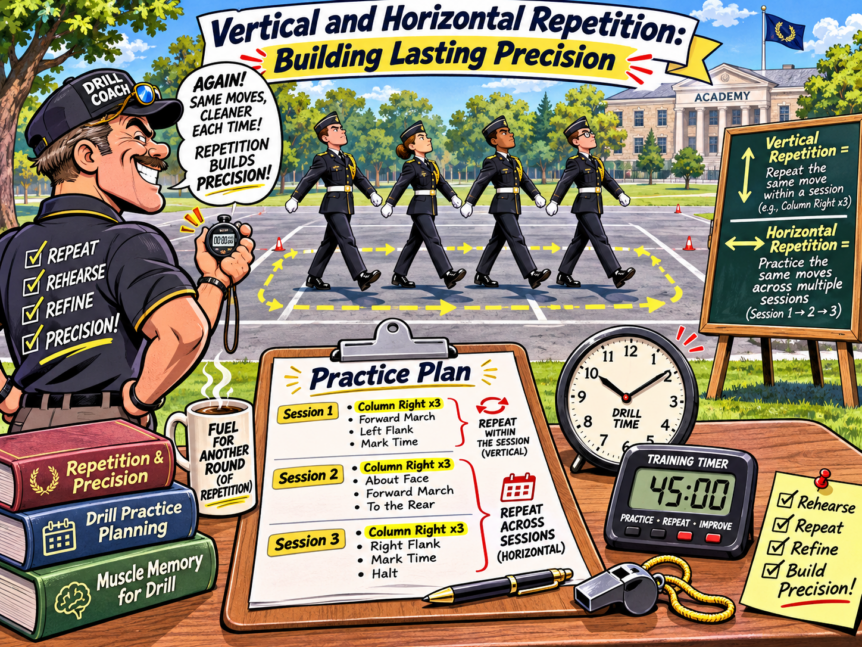
Vertical Repetition means executing a particular movement multiple times within a single practice session. For example, your platoon consistently loses alignment while executing Column Right. Rather than continuing through the entire routine, isolate that movement and practice it repeatedly. Execute Column Right. Halt. Check alignment. Correct the errors. Return to the starting position and execute it again.
This immediate repetition is beneficial because members can apply corrections while the instructor’s feedback and their experience of the previous attempt are still fresh. However, there is an even more effective way to organize these repetitions.
Instead of executing Column Right ten consecutive times and then moving on permanently, practice it several times, work on another part of the routine, and return to Column Right later in the same session. We can call this Session-Based Horizontal Repetition.
You are still using vertical repetition, but now you are distributing the repetitions throughout the practice. I consider this a shortened form of horizontal repetition because the cadets must return to the movement after an interval rather than relying entirely on the immediate repetition of the same action.
That interval matters. It requires members to recall and reproduce the correct mechanics instead of simply repeating a movement that they just completed.
Horizontal Repetition
Horizontal Repetition extends the process across multiple practice sessions. Suppose you practice Column Right several times on Monday. You return to it on Tuesday, Thursday, and again during the following week’s rehearsals. Each session reinforces the movement mechanics established during earlier training.
The important difference is that horizontal repetition develops consistency across time. The team must demonstrate that it can reproduce the correct movement after leaving the training environment and returning later. That repeated retrieval and execution helps strengthen motor learning and long-term retention, commonly described as developing muscle memory.
Consider the difference between executing Column Right twenty times in one afternoon and executing it five times during each of four separate rehearsals. Both approaches provide twenty repetitions. However, the second distributes those repetitions across multiple days, giving members repeated opportunities to retain, recall, and refine the movement.
Research on motor learning generally supports distributed practice for longer-term retention, although the ideal spacing depends on the skill and the learner. This does not mean immediate repetition is unnecessary. Quite the opposite. Immediate repetition helps establish the correct mechanics, while distributed repetition helps make those mechanics more reliable over time.
Vertical repetition develops the movement within a practice. Horizontal repetition reinforces that movement across practices.
There is one essential condition: The repetitions must reinforce correct execution. If your platoon performs Column Right incorrectly twenty times, you have given the members twenty opportunities to reinforce the error.
Identify the problem, correct the mechanics, and then repeat the movement accurately. Remember that your objective is not merely to get the team through the movement. You want each member to execute it correctly, consistently, and eventually with little conscious effort. This is where deliberate repetition begins to produce lasting precision.
Practice makes permanent. The quality, frequency, and distribution of your repetitions determine what you are reinforcing.
Resources
Carnegie Mellon University, Spaced Practice. Explains the relationship between massed, distributed, and spaced practice.
National Academies, How People Learn II. Discusses research on massed and spaced practice, including motor skills.
The DrillMaster. How To Clean Your Drill Team. November 10, 2026.
The DrillMaster. Distance and Alignment Training. March 8, 2016.
The DrillMaster. Practice Makes Permanent. April 26, 2023.
The DrillMaster. Practice Makes Permanent: Shoulders. November 19, 2012.
The DrillMaster. Practice Makes Permanent: Knees and Hips. October 17, 2012.
The DrillMaster. Practice Makes Permanent: Feet. August 8, 2012.
The DrillMaster. Practice Never Makes Perfect. June 2, 2019.
The DrillMaster. The Mechanics of Movement. December 2, 2025.