
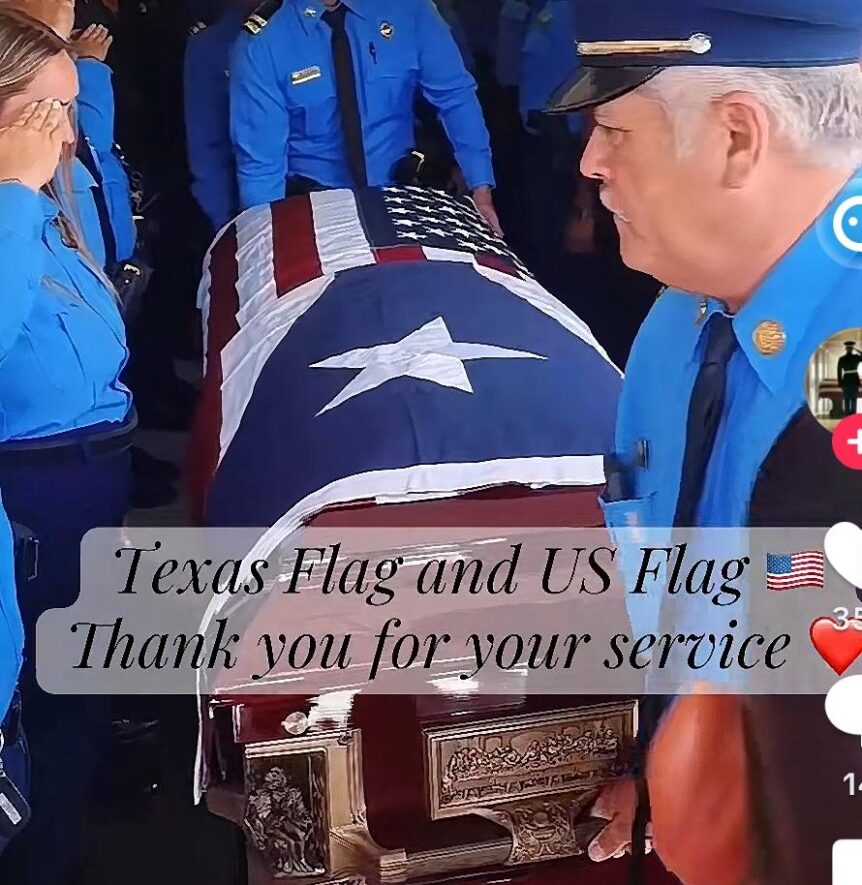
I recently saw an image of a casket with the U.S. flag and the Texas flag folded in half and laid on top together. That is not a minor mistake. It’s a complete breakdown of ceremonial understanding.
Let’s be clear and precise so there’s no confusion moving forward.
Let’s be completely clear: every American is authorized a flag on the casket. Read All About the Flag on the Casket for more. Some veterans actually become indignant when they read this. The Flag Code states:
4 U.S. Code § 7 – Position and manner of display
(n) When the flag is used to cover a casket, it should be so placed that the union is at the head and over the left shoulder. The flag should not be lowered into the grave or allowed to touch the ground.
The bold emphasis in the quote is mine. As you can see, it states “When the flag” and does not discriminate who receives the honor of the flag draping the casket.
The First Problem: Two Flags on One Casket
We do not combine flags on a casket. Not the U.S. flag with a state flag. Not the U.S. flag with a department flag. Not the U.S. flag with anything.
There is one flag authorized to drape a casket, and that is the United States flag.
This is not a preference or a stylistic choice. It is grounded in established protocol found in documents like the U.S. Flag Code and reinforced through military doctrine such as TC 3-21.5 Drill and Ceremonies.
The flag represents the nation. It is not part of a layered display or a visual tribute stack. If you want to simultaneously honor the state, the department, or the individual’s affiliations, there are appropriate ways to do that:
- Place those flags on separate stands
- Position them near the casket, not on it
- Maintain clear separation of symbols
Once you put multiple flags on the casket, you’ve already stepped outside of any recognized standard.
The Second Problem: The Flag Was Folded in Half
Even if there had only been one flag, the way it was presented would still be wrong.
A flag used in a funeral has only two authorized conditions:
- Fully draped
- Fully folded
That’s it.
There is no “in-between” state where the flag is folded in half and laid across the casket. That is not ceremonial. That is improvised.
When the flag is draped:
- It covers the casket properly
- The union is positioned at the head and over the left shoulder
When the flag is removed:
- It is folded into the triangular ceremonial fold
- It is then presented
Folding it in half:
- Distorts the union and stripes
- Removes the clarity of the symbol
- Creates a visual that has no meaning within any standard
This is exactly what happens when teams don’t understand sequence.
Why This Keeps Happening
This isn’t about people trying to be disrespectful.
It’s about people trying to “add meaning” without understanding the system.
They think:
- “Let’s include the state flag to honor where they’re from.”
- “Let’s fold it this way so both flags are visible.”
The intention might be good. The execution is not.
Ceremony is not built on intention alone. It is built on established structure.
When you step outside that structure, you don’t enhance the ceremony—you break it.
This Is an Authority Problem, Not a Performance Problem
This is where leadership has to take responsibility.
When a team places two flags on a casket or folds a flag incorrectly, that is not a small training issue. That is a failure to:
- Identify the correct authority
- Interpret that authority correctly
- Apply it in practice
In other words, it’s an AIP failure:
- Authority ignored
- Interpretation invented
- Practice incorrect
Your team will not fix this by “trying harder.”
They fix it by learning what governs the action.
The Standard (Simple and Non-Negotiable)
- One casket = one flag (U.S. flag only)
- Flag condition = fully draped or fully folded
- All other flags = separate display, never combined
There is no gray area here.
What If the Family Requests a Different Flag?
The United States flag is authorized to drape a casket, but it is not mandatory. If the wishes of the deceased or next of kin are to have a state, territorial, tribal, or organizational flag drape the casket, that is entirely acceptable. However, that choice replaces the U.S. flag—it does not supplement it.
The standard still applies: one casket, one flag, properly displayed.
There is one important distinction for military funerals. The ceremonial folding and presentation performed by a military honors detail is specific to the United States flag. If another flag is used to drape the casket, it will not be folded and presented as part of military honors. If the family desires both, the correct approach is to use the U.S. flag for the honors sequence and display the alternate flag separately after military honors are finished. This preserves both the family’s wishes and the integrity of the ceremony.
Final Thought
If you feel the need to “add” something to the casket display, stop, because you will start venturing into the Honor By Dishonor Fallacy Part I and Part II. The system is already complete. Don’t make things “ceremonialer”.
The U.S. flag, properly displayed, is not lacking anything.