
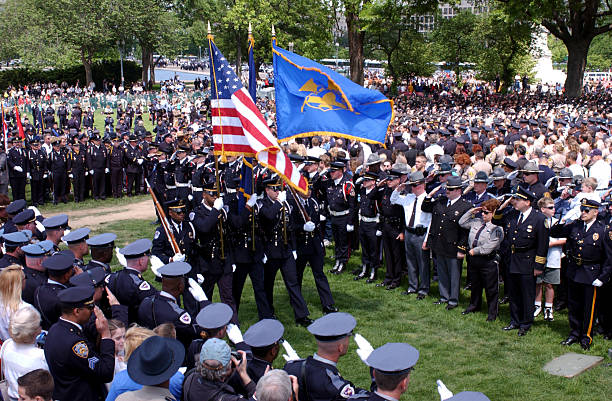
The term “Joint Civic/Armed Forces Color Guard” sounds official. It sounds inclusive, cooperative, and appropriate for a major public event.
It is none of those things.
There is no color guard officially established by the Department of Defense under that name. There is no DoD definition authorizing a single formation composed of military personnel, police officers, firefighters, emergency responders, or other civilian public-safety personnel. There is no recognized doctrine that allows military service colors to be inserted into a state or local law-enforcement color guard simply because an event organizer wants several institutions represented at once.
The phrase appears to be an invented combination of legitimate ceremonial terminology. It borrows the authority of the words joint, Armed Forces, and color guard while adding civic to create something that sounds plausible.
Plausibility, however, is not authority.
What “Joint” Actually Means
Within military doctrine, the word joint has a specific meaning. It refers to participation by two or more military departments or services. It does not mean a general mixture of uniformed organizations.
A Soldier and an Airman together may constitute limited joint military representation. A Soldier, an Airman, and a state police officer do not become a joint formation merely because all three wear uniforms.
The police officer does not become part of the Armed Forces. The service members do not become members of the police agency. Their uniforms represent different legal authorities, institutional identities, missions, chains of command, and systems of ceremonial doctrine.
Calling such a mixture “joint” does not resolve those differences. It conceals them.
The Joint Armed Forces Color Guard
The governing DoD publication is DoDI 5410.19, Volume 4, Community Outreach Activities: Ceremonial, Musical, and Aerial Event Support.
Paragraph 5.1.a. establishes the Joint Armed Forces Color Guard. When available, the formation consists of:
- two Army bearers carrying the national and Army colors;
- one bearer for each of the Marine Corps, Navy, Air Force, Space Force, and Coast Guard colors;
- one Army rifleman and one Marine Corps rifleman serving as escorts.
When the complete Joint Armed Forces Color Guard cannot be formed, the instruction permits a single-service color guard to carry the military service flags. It also directs the formation to follow Army Training Circular 3-21.5 when the senior member of the senior service carries the national color. (ESD)
That is an actual joint color guard.
Every member is serving in a military capacity. Every organizational color represents a branch of the Armed Forces. The formation has an established order of precedence, command relationship, equipment standard, and drill foundation.
Nothing in Paragraph 5.1 establishes a “Joint Civic/Armed Forces Color Guard.”
Nothing in that paragraph authorizes civilian public-safety personnel to be integrated into the Joint Armed Forces Color Guard.
Nothing authorizes military service colors to be carried by a state police color guard.
The Invented Definition
The following explanation has circulated as though it were an official definition:
“In public, military, and law enforcement ceremonies, a Joint Civic Color Guard—sometimes referred to in DoD policy as a Joint Civic/Armed Forces Color Guard or Composite Color Guard—is a specialized ceremonial unit composed of both federal military service members and civilian public safety personnel.”
That statement has several problems.
First, it claims that the term is used in DoD policy. It is not used in DoDI 5410.19, Volume 4, where the Department of Defense specifically establishes and describes the Joint Armed Forces Color Guard.
Second, it claims that a “specialized ceremonial unit” exists without identifying the issuing authority, publication, paragraph, governing service, command structure, or drill standard.
Third, it combines several real but unrelated terms. “Joint Armed Forces Color Guard” is legitimate. “Composite” may be used descriptively in some contexts. The DoD instruction also mentions a “local composite marching band element” when discussing military participation in civic parades. That provision concerns bands—not a civic-military color guard. (ESD)
The result is a manufactured definition that sounds official because it contains familiar official words.
This is increasingly common. An internet search or artificial-intelligence system can assemble convincing ceremonial language from unrelated sources. The resulting paragraph may sound polished and authoritative while having no doctrinal foundation whatsoever.
A quotation is not a source merely because quotation marks have been placed around it.
The proper response is always:
Please identify the publication, issuing authority, paragraph number, and effective date.
If those cannot be provided, the supposed standard does not govern anyone.
A Color Guard Is Not a Collection of Uniforms
A color guard is a formation, not a display rack for institutional representation.
Its composition communicates identity.
An Army color guard represents the Army. A Marine Corps color guard represents the Marine Corps. A police color guard represents its police agency. A fire department color guard represents its department. A Joint Armed Forces Color Guard represents the Armed Forces according to an established military order of precedence.
Combining unrelated personnel within one formation does not necessarily communicate unity. More often, it communicates confusion.
Who commands the formation?
Which manual governs its movement?
Which organization determines intervals, cadence, commands, facing movements, staff positions, colors movements, and salutes?
Which equipment standard applies?
Which agency assumes responsibility for correcting a ceremonial error?
Can a police commander give military drill commands to a Soldier or Airman?
Can a military representative order state police personnel to change their equipment or ceremonial procedures?
Does the presence of military personnel place the entire formation under military doctrine?
Does the presence of police officers place the service members under police-agency ceremonial policy?
There is no coherent answer because the formation itself has no coherent institutional basis.
Good ceremony depends on clearly assigned authority. An invented mixed formation begins by making that authority uncertain.
Military Service Colors Are Not Generic Symbols
The Army, Marine Corps, Navy, Air Force, Space Force, and Coast Guard colors are not decorative flags representing broad public appreciation for military service.
They are military organizational colors.
Their placement within a Joint Armed Forces Color Guard reflects the official precedence of the Armed Forces. Their bearers represent the services whose colors they carry. The formation is constructed according to DoD policy, not according to the preferences of a stadium producer, corporate event planner, host committee, or outside protocol representative.
A state police color guard carrying the Army and Air Force colors would visually suggest that the police agency represents those military services or that the military service colors have been placed under the control of the police formation.
Neither message is correct.
Adding a Soldier and an Airman does not cure the problem. It instead creates a formation containing two military members who belong to separate chains of command, inserted into a state law-enforcement element whose commander and members are not governed by military drill doctrine.
This is not a partial Joint Armed Forces Color Guard. It is a state police color guard with military personnel and military colors attached to it without an established doctrinal structure.
The Personnel or the Flags send the Same Message
The problem remains the same whether military personnel are physically integrated into the formation or whether a law-enforcement (for instance) color guard carries the military service colors without them. In either case, the formation communicates an authority and institutional relationship that do not exist. A police color guard does not gain authority to represent the Armed Forces merely by carrying Army, Marine Corps, Navy, Air Force, Space Force, or Coast Guard colors, and the presence of individual service members does not convert a police formation into an authorized military or joint color guard.
One version improperly assigns military colors to a civic formation; the other improperly merges military personnel and civic personnel into a single element without a recognized command structure or governing doctrine. Neither arrangement is authorized, and both send the misleading message that separate institutions, chains of command, and ceremonial authorities have been combined into one official formation.
Nonmilitary Flags and Military Personnel
DoDI 5410.19, Volume 4 also places restrictions on the flags carried by military personnel acting officially.
Outside narrowly defined circumstances involving foreign national flags, service members in uniform and acting in an official capacity must not carry the flags of foreign nations, veterans’ organizations, or other nonmilitary organizations at public programs or ceremonies. (ESD)
That provision reinforces an important principle: military ceremonial participation is not an unrestricted exercise in combining flags and uniforms for visual effect.
Institutional identity matters.
Military personnel represent the Armed Forces. Civilian agencies represent their own governments and communities. Cooperation between them does not require merging their ceremonial identities.
The Flagstaff Problem
A state or local public-safety color guard is not automatically governed by military equipment standards.
Military doctrine governs military formations. It does not grant a military representative authority over the equipment selected by an independent police or fire department.
A public-safety agency may voluntarily adopt military techniques or use military-style equipment. Many agencies do. However, voluntary adoption is not the same as subordination.
A police color guard may establish its own authorized flagstaffs, finials, harnesses, weapons, uniforms, and ceremonial procedures. Those choices remain subject to the agency’s own leadership and policy.
An event organizer may establish reasonable logistical requirements concerning safety, dimensions, access, rehearsal schedules, or presentation time. It may request a particular visual appearance. It cannot transform that preference into military authority over a state agency.
Likewise, a military representative may explain the requirements governing military personnel and military colors. That representative may not impose military flagstaff requirements on nonmilitary personnel simply because military members have been proposed for inclusion.
The problem is not that one type of flagstaff is inherently better than another. The problem is the unsupported assertion of jurisdiction.
“Unity” Is Not a Sufficient Justification
Mixed civic-military formations are often defended with language about unity, cooperation, shared service, or honoring all who protect the public.
The sentiment may be sincere. The method is still wrong.
Ceremony communicates through distinction as much as through combination. The Armed Forces, law enforcement, fire service, and emergency medical services can stand together without pretending to be one organization.
Uniformity is not the same as unity.
Unity can be demonstrated by separate formations operating in coordination. That approach preserves each organization’s identity while presenting a larger collective message.
Forcing unlike organizations into one improvised color guard does the opposite. It removes clarity, weakens standards, and turns ceremonial representation into visual symbolism detached from institutional reality.
Better Alternatives
There are several appropriate ways to represent military and civic organizations at the same event.
A Proper Joint Armed Forces Color Guard
When broad military representation is desired, organizers may request a Joint Armed Forces Color Guard through the appropriate military channels. The formation should be composed and equipped according to DoD and service requirements.
The Joint Armed Forces Color Guard regularly supports nationally visible sporting and public events. Official military reporting describes its participation at events such as the College Football Playoff National Championship, the NFL Pro Bowl, the NFL Draft, the MLB All-Star Game, and the Super Bowl. These formations represent the Armed Forces through military personnel and military service colors—not through a mixture of military and civic agencies. (JTF NCR)
A Single-Service Military Color Guard
When the full joint formation is unavailable, DoDI 5410.19, Volume 4 permits a single-service military color guard to carry the military service colors.
This maintains military command and doctrinal integrity even when every service cannot provide a bearer.
A Public-Safety Color Guard
A police, fire, or combined public-safety color guard may present the national flag with the appropriate state, municipal, departmental, or organizational flags according to the policies governing that formation.
This is civic representation. It should remain civic.
Separate Coordinated Formations
A military color guard and a public-safety color guard may participate in the same event as separate elements.
They may enter sequentially, stand in separate designated positions, or take part in a larger massed-colors presentation. Each element retains its own commander, personnel, equipment, and identity.
This is the proper way to communicate cooperation without manufacturing a nonexistent formation.
Massed Colors
When numerous organizations must be represented, a carefully designed massed-colors ceremony may be appropriate.
Massed colors do not require everyone to be absorbed into one color guard. The participating organizations remain separate elements assembled within a larger ceremonial arrangement (not a formation).
That distinction is essential.
Event Importance Does Not Create Authority
Large international sporting events create enormous pressure. Organizers may be concerned with television framing, sponsor expectations, political representation, rehearsal time, and the desire to include several organizations.
None of that creates doctrine.
The size of the audience does not authorize an invented formation. The international stature of an event does not allow military service colors to be assigned according to production convenience. A deadline does not give one organization authority over another.
In fact, the greater the event’s visibility, the greater the obligation to get the ceremony right.
A major event is not the place to experiment with institutional identity.
The Standard
The standard is straightforward.
There is a Joint Armed Forces Color Guard, established by Department of Defense policy and composed of military personnel carrying the national and military service colors.
There are public-safety color guards established and governed by their respective agencies.
There may be coordinated ceremonies involving both.
There is no officially established Joint Civic/Armed Forces Color Guard that combines military members and civilian public-safety personnel within one color guard.
It should not be created merely because someone found or generated a convincing paragraph describing it.
When military and civic organizations participate together, they should do so through coordination—not ceremonial invention.
Preserve the identities. Preserve the chains of authority. Preserve the standards.
That is how unity is properly demonstrated.