
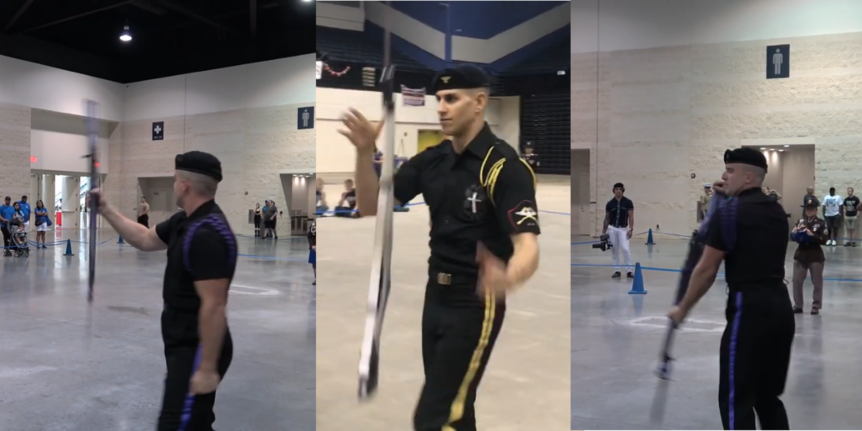
Armed exhibition drill has been part of military drill for decades. It is exciting, demanding, and when performed well, it shows timing, confidence, coordination, control, and strength.
But we need to address the health aspect of an 8.5-pound rifle repeatedly slamming into a teenage body because that is what the activity often rewards.
That is the problem.
The M1903 rifle, whether real or replica, is around 8.5 pounds. It is the go-to rifle for the vast majority of drillers because it is sleek, well balanced, and can be modified slightly to create additional visual impact without losing its classic profile.
Other rifles, such as the M1 Garand and M14, are also used in exhibition drill. The M1 is close in weight to the M1903 and is probably the second most common choice, although it is somewhat bulkier. The M14, with an average weight of around 10 pounds, presents a different challenge. Because its upper handguard does not extend as far forward toward the front sight, the rifle can create an awkward stability issue during certain spins, stops, and tosses.
For an adult, that weight may not sound like much. For a teenager who is still growing, it is a different issue entirely.
Regulation Drill and Colors
Fully weighted and undecorated rifles should remain the standard for armed regulation drill phases of a drill meet and for appropriate ceremonial performances. Regulation drill, and even ceremonial drill, requires the solid, grounded appearance expected of a disciplined armed performance.
Lightweight or visually modified rifles may have a place in exhibition drill, but regulation and color guard work should present the traditional look, weight, and bearing of the rifle as it is intended to be carried.
Rifle Manipulation Beyond the Manual of Arms
In exhibition drill, we are not talking about minimal rifle movement. We are talking about spinning, tossing, catching, stopping, and repeating those movements over and over again during training, practice, competition, and performance.
When spinning a rifle at speed, the driller must manage the force generated by the rotation. One method is a controlled deceleration stop. The driller catches the rifle just before the final stopping point, such as around the 2 o’clock position, and immediately guides it into the desired 12 o’clock position. This still requires control and timing, but it spreads the force over a short deceleration path instead of allowing the rifle to slam directly into the hand at the stop point.
That matters.
The catch is where much of the impact begins.
When a rifle is tossed, it comes down with more force than a basic spin. That force is received first by the hands, then travels through the wrists, elbows, shoulders, upper back, and neck. One catch may not seem like a problem. Hundreds or thousands of catches over a season are something else entirely.
The Body Absorbs the Effect
In drill, we tend to look at the rifle. We look at the catch. We look at the stop. We look at whether the performer showed control.
What we do not always look at is what the body had to absorb to create that effect.
The American Academy of Pediatrics states that overuse injuries can result from repetitive stress without sufficient recovery, causing accumulated musculoskeletal damage. That is exactly the kind of risk we need to recognize in armed exhibition drill. The damage does not have to come from one dramatic injury. It can build slowly through repeated impact.
Young performers are not small adults. Their bodies are still developing. Growth plates, bones, tendons, ligaments, and joint structures do not respond to stress the same way adult structures do. The American Academy of Orthopaedic Surgeons (https://aaos.org/) warns that repetitive stress on a growth plate can be painful, can impair growth, and, if it continues, may permanently damage the growth plate.
That should get our attention.
Your Attention Please
For years, we have praised the immediate stop. The rifle spins, the performer catches it, and the rifle freezes. It looks impressive. It has high effect. It is often treated as the best test of skill.
But an immediate stop also sends a significant amount of force into the performer’s body.
There are other ways to stop a rifle. Some spins can be brought down through a controlled wind-down or deceleration before the final stop. It may not have the same aggressive visual punch as an immediate stop, but it is often better for the body.
We need to be honest about what we are rewarding.
If judges, instructors, and senior cadets only reward the hardest catch and the most abrupt stop, cadets will continue training for impact. They will keep slamming heavy rifles into their hands and joints because that is what the system values.
Then, when pain shows up, we call it weakness, lack of conditioning, or poor technique. Sometimes it is poor technique. Sometimes it is also poor equipment choice, poor training design, too many repetitions, and not enough recovery.
The American Family Physician (http://www.aafp.org/afp) review on youth overuse injuries points out that many sports-related overuse injuries in children and adolescents occur at relatively weaker growth centers. A pediatric upper-extremity review also addresses common injuries involving the shoulder, elbow, wrist, and hand—the same areas that receive and transmit force during rifle tosses and abrupt catches.
That does not mean every cadet who spins rifle will be injured. It does mean we have enough information to stop acting as if this is not a real risk.
The Lighter M1903-Style Rifle
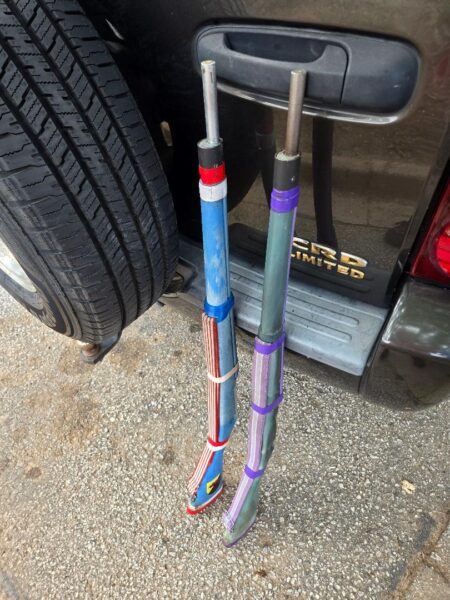
A relatively new company has begun designing and building lighter M1903-style rifles around 7.5 pounds. This is not a gimmick, and it is not watering down the activity. It is an intelligent response to a real health concern.
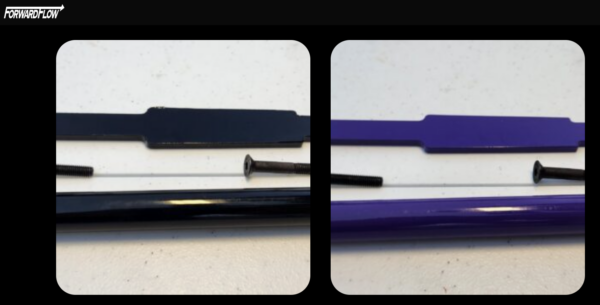
Images 1 and 2 above show the light and even lighter versions of the Helix rifle. An incredible step forward in armed exhibition drill. Drillers are using them, almost exclusively.
- Helix 1 – about 7 lbs
- Helix 2 – about 5 lbs
Neriah Guerin, former US Air Force Honor Guard Drill Team member, created Forward Flow (https://forwardflow.com/). His work is at the cutting edge of armed exhibition drill because it offers a safer alternative while preserving the look and intent of the rifle.
A lighter rifle can maintain the tradition and visual identity of armed exhibition drill while reducing the impact load on the performer. That matters, especially for high school and even middle school cadets.
The Forefront of Rifle Part Engineering
I need to add here that Andres Ryan also has a business that is making strides. The innovation of what Andres has done is beyond measure and every exhibition driller needs to know about and understand the application of these incredible parts that can be retrofitted to you 1903 rifle.
Another innovator who needs to be recognized is Andres Ryan, who has developed and now produces rifle parts that are making significant strides in exhibition drill safety and design. His work is not simply about modifying a rifle for appearance. The innovation is in creating parts that can be retrofitted to the M1903-style rifle while preserving the rifle’s sleek, traditional profile.
That matters. Exhibition drillers do not want awkward equipment. They need equipment that looks right, feels right, and performs safely under the demands of spins, tosses, catches, and stops. Andres has designed parts that are incredibly safe, clean in appearance, and not bulky or distracting. Every exhibition driller should know about this work and understand how these parts can be applied to improve both performance and long-term safety.
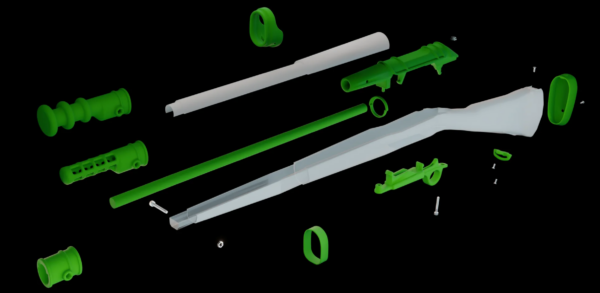
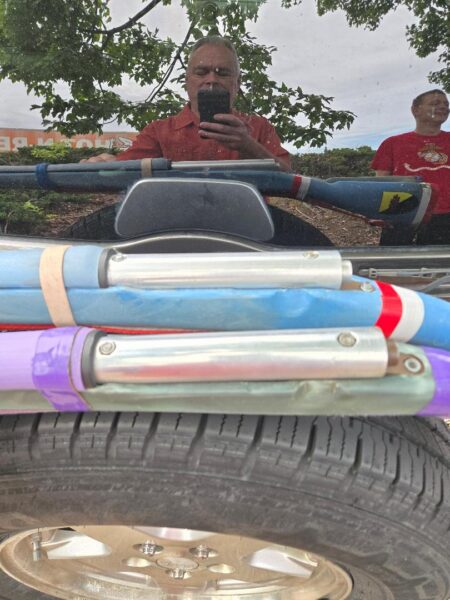
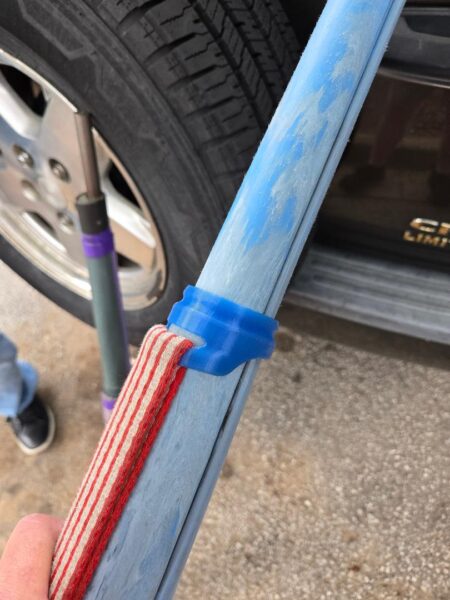
Image 3 above shows a truly amazing creation, an upper sling swivel band and swivel- without the swivel, without the potential for injury. High speed, low drag.
A Quick Note
For years, I have worked to educate people about rifle weight while defending both marching band color guard and military armed exhibition drill. Both activities spin rifles. Both require training, control, timing, strength, and body awareness.
Some in the exhibition drill world are under the delusion that because marching band color guard members spin a 2-pound rifle on the football field, it is somehow “less” than military armed exhibition drill. That is the wrong framing.
The weight of the rifle matters, but weight alone does not define the demand of the activity. What matters is how the rifle is used.
Taking a lighter rifle and pretending that it functions the same way as an 8.5-pound M1903 is disingenuous. It does not give us an accurate understanding of the performance demand, the training requirement, or the risk involved.
A lighter rifle can be tossed higher, moved faster, and whipped around the body at extreme speeds. That creates its own kind of demand and its own kind of risk. The heavier rifle does not usually move the same way, but it can still be used in a highly aggressive manner with significant impact on a performance.
These are different tools used in different performance environments. One is not automatically “less” just because it weighs less. The question is not simply, “How heavy is the rifle?”
The better question is: What is the rifle doing to the performer’s body, and what is the performer required to do with the rifle?
Not the Same Thing
The mindset: “Use the real rifle. That is how we did it.”
Better: “Use the right rifle for the performer, the training phase, and the long-term health of the driller.”
Those are not the same thing.
In Addition
I am fully in favor of allowing 6-pound rifles for exhibition drill, especially when it opens the door for more female drillers to participate and progress. That may not be a popular position in some parts of the exhibition drill world, but it is a practical one.
In general, male and female cadets do not enter the activity with the same average upper-body strength. That is not an insult, and it is not a limitation on ability. It is simply a designed physical reality that instructors and rule-makers need to consider when setting equipment standards.
Many female cadets already perform extremely well with standard-weight rifles, and that should be recognized. The point is not that they cannot do it. The point is that a lower rifle-weight allowance could give more cadets access to the activity, reduce unnecessary impact, and allow performers to develop greater control, variety, and confidence with the rifle.
A 6-pound rifle does not make exhibition drill easy. It still requires timing, strength, coordination, discipline, and skill. What it does is create a more appropriate equipment option for more performers, especially those who may be technically capable but physically limited by an 8.5-pound rifle before they ever have the chance to develop.
Lowering the weight restriction is not lowering the standard. It’s widening access while preserving demand.
Back to the Topic
A teenage cadet should not have to trade lifelong wrist, elbow, shoulder, neck, or back problems for a trophy, a medal, or a moment of applause.
Exhibition drill should build discipline, coordination, strength, confidence, and performance ability. It should not quietly damage the body of the performer while everyone praises the catch.
We can keep the tradition, skill, and demand. But we need to stop pretending that equipment weight and impact do not matter. They do.
Instructors should evaluate rifle weight, limit high-impact repetitions, teach controlled deceleration, monitor pain, and build recovery into training. Judges should stop treating the hardest stop as automatically superior. Parents should understand that rifle spinning is not just “marching with a prop.” It is a repetitive upper-extremity activity involving load, speed, impact, and force absorption.
The future of exhibition drill should include better equipment alternatives, smarter instruction, safer progression, and a judging system that recognizes control without requiring unnecessary damage.
Rifle spinning is not the enemy, just like impact in any other sport is not the enemy.
Uncontrolled impact is.
Download
Download the Institute for Ceremonial Standards Doctrine Clarification Statement here:
ICS DCS 19-012 Rifle Spinning, Tossing, and Adolescent Upper-Extremity Impact Risk