
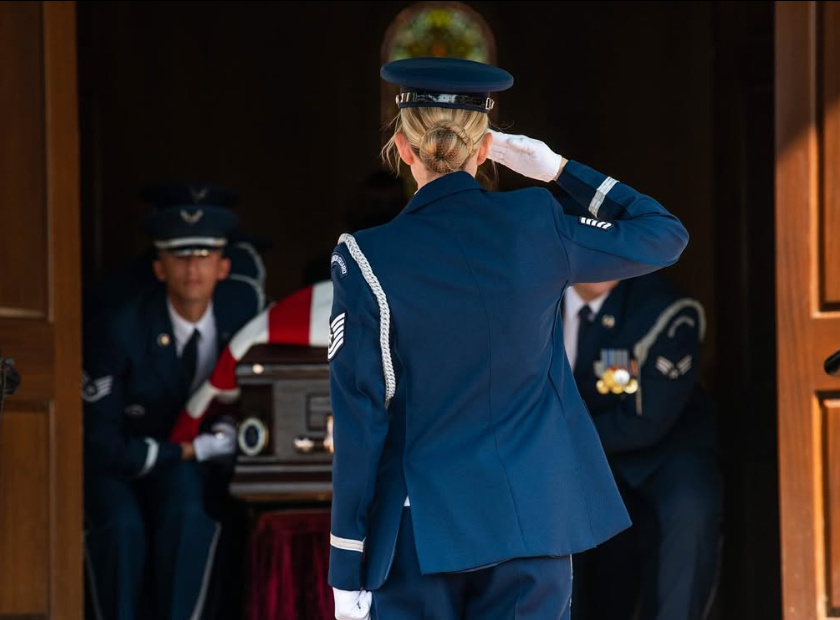
A military honor guard arrives at a cemetery prepared to perform funeral honors. The team has trained pallbearers available, but cemetery personnel refuse to let them carry the casket. Instead, the cemetery requires (forces) the casket to remain on a church truck.
What should happen?
The answer is more nuanced than declaring that a church truck is either right or wrong.
A church truck is a wheeled support used to move a casket through a funeral home, chapel, cemetery, or committal area. Its use is not automatically improper. Army funeral doctrine expressly recognizes that pallbearers may either carry a casket or push it on a church truck during certain movements associated with a chapel service.
There are also times when the device is clearly the responsible choice. Ice, snow, steep grades, excessive distance, confined spaces, damaged casket handles, unusual weight, or limitations affecting the pallbearers may make carrying unsafe.
Safety must never be sacrificed merely to preserve a ceremonial appearance.
The problem arises when use of the church truck is imposed as an inflexible local rule and trained military pallbearers are prohibited from carrying any casket under any circumstances.
Pallbearers Are Not Merely Transportation
A military casket team does more than move weight from one place to another.
The team receives the flag-draped casket, bears or guides it with controlled movement, positions it for the ceremony, protects the flag, and maintains continuity between the arrival of the remains and the rendering of military honors.
That movement communicates something important. Members of the deceased’s military service are physically carrying one of their own to the final place of honors.
Replacing that action with a wheeled device may sometimes be necessary, but the two actions do not carry identical ceremonial meaning.
The church truck is equipment. The pallbearers are representatives of the Armed Force.
What Federal Law Actually Guarantees
Federal law establishes a minimum military funeral honors ceremony for an eligible veteran. It requires the folding and presentation of the United States flag and the playing of Taps. The detail must include at least two uniformed military members, including at least one representative of the veteran’s parent service.
The law does not guarantee every veteran a military casket team.
That distinction matters. A cemetery’s refusal to allow military pallbearers may not violate the statutory minimum honors owed to the veteran. We should not claim authority that the law does not provide.
However, when a military service assigns a casket team as part of the honors authorized for the deceased, those personnel are performing an official military function. Their work should not be dismissed as optional labor that civilian administrators may remove solely because a local shortcut is more convenient.
A Church Truck Can Be Used Correctly
Military pallbearers and a church truck are not mutually exclusive.
Depending on the location and the service procedure, pallbearers may:
- Carry the casket for part of the route.
- Guide the casket while it is supported by the church truck.
- Receive it from the funeral director or hearse.
- Escort it at a ceremonial pace.
- Position it at the committal shelter or lowering device.
- Maintain custody and flag orientation throughout the movement.
Army doctrine specifically provides for pallbearers either to carry the casket or push it on a church truck during movement from the front of a chapel to the exit.
The important issue is therefore not the mere presence of the equipment. The issue is whether it supports the ceremony or unnecessarily replaces the military team.
Under Air Force doctrine, people who actually carry the casket are pallbearers or body bearers. Those who move it on a church truck are honorary pallbearers. Requiring the church truck is therefore not simply choosing one transportation method over another. It removes the assigned pallbearers from their defined ceremonial role.
Informaiton in AFI 34-515
Cemetery Authority Has Limits—and So Does Military Authority
Cemetery officials have genuine responsibilities. They control access, scheduling, vehicle routes, facility use, protection of cemetery grounds, and many safety matters.
An honor guard cannot arrive on someone else’s property and simply disregard a legitimate restriction involving ice, terrain, structural limitations, or public safety.
At the same time, cemetery administrators should not assume that control of the property gives them authority to redesign the military honors ceremony. Team composition, commands, flag handling, ceremonial sequence, and service-specific casket-team procedures remain military responsibilities.
The proper relationship is coordination, not domination by either party.
A cemetery identifies genuine facility and safety limitations. The military determines how its honors can be rendered within those limitations.
The cemetery has legitimate safety and property authority, but it does not have an unrestricted right to convert Air Force pallbearers into honorary pallbearers as a matter of standing local preference.
“The Other Services Do It” Is Not a Standard
One of the most damaging arguments in these situations is that the other military services have already accepted the cemetery’s procedure.
That establishes only that the other teams complied.
It does not establish that the procedure is doctrinally required, ceremonially preferable, or binding upon another service. The military branches do not perform every funeral sequence identically. A local accommodation by one service does not amend the standards of another.
When every visiting team quietly accepts a restriction, however, the local practice gradually acquires the appearance of authority. The service that eventually objects then looks difficult, even when it is the only organization asking the correct questions.
Repeated deviation is still deviation unless it has been properly evaluated and authorized.
Do Not Fight the Dispute in Front of the Family
The funeral is not the place for an institutional argument.
When cemetery personnel impose a restriction, the military detail leader should determine the immediate reason, consult the funeral director, and identify the most dignified safe alternative. The ceremony should proceed without exposing the family to disagreement among the organizations involved.
Afterward, the incident should be documented and elevated.
A recurring blanket prohibition should be addressed by the honor guard program manager, installation leadership, mortuary or casualty affairs personnel, cemetery administration, and service headquarters as appropriate. Individual Airmen, Soldiers, Marines, Sailors, Guardians, or Coast Guardsmen should not be left to renegotiate institutional authority at every funeral.
The family should see coordinated professionals honoring the deceased—not competing organizations defending their territory.
The Correct Standard
Military pallbearers should never carry a casket when doing so would create an unreasonable risk.
A cemetery should not prohibit them from carrying merely because a church truck is easier or has become the local custom.
Every decision should protect:
- The deceased.
- The family.
- The pallbearers and other participants.
- The authorized military honors.
- Legitimate cemetery and facility requirements.
- Clear responsibility for the casket and flag.
The question is not, “Do we always carry?” Nor is it, “Do we always use the church truck?”
The correct question is: What method is safe, authorized, coordinated, and appropriate to the military honor being rendered?
For the complete institutional analysis and recommended standard, download ICS DCS 17-020, Military Casket Teams, Church Trucks, and Cemetery Control of Funeral Honors, from the Institute for Ceremonial Standards.