
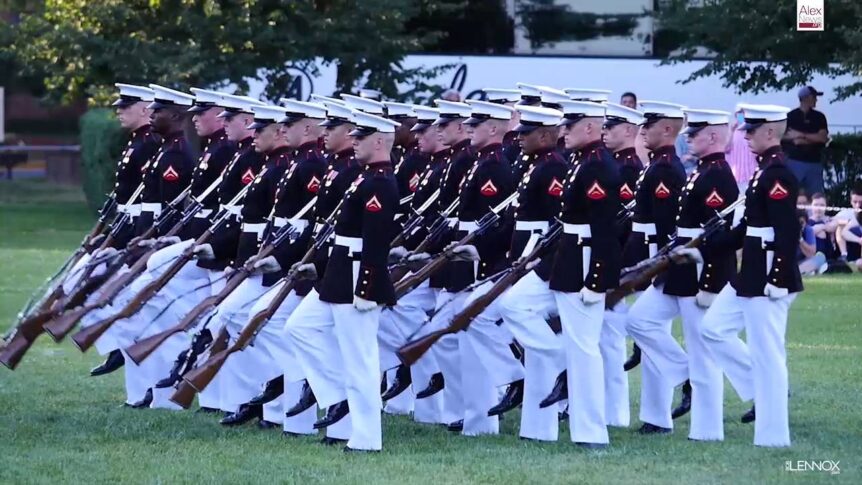
Just a couple of days ago, I was asked if the Silent Drill Platoon would fall into the classification of pageantry. It would not. Todays’ article goes along with yesterday’s, just a little different approach.
In recent decades, military drill teams—particularly those performing exhibition drill—have increasingly adopted visual elements commonly associated with pageantry arts. Audiences often see this overlap and assume the two are functionally equivalent. They are not.
While exhibition drill may borrow ideas from pageantry disciplines, it does not—and cannot—become pageantry. The distinction is not a matter of taste or tradition; it is a matter of authority, responsibility, and purpose.
Understanding this difference is essential for designers, instructors, judges, and audiences alike.
At a surface level, exhibition drill and pageantry arts may appear similar. Both involve:
- Coordinated movement
- Timing and musical alignment
- Spatial design
- Equipment manipulation
- Audience-facing performance
These similarities are real—but they are structural coincidences, not evidence of shared identity.
The two operate inside entirely different frameworks.
Authority: Created vs. Inherited
Pageantry arts—such as marching band, winter guard, indoor percussion, dance teams, and step teams—derive their authority from artistic convention and adjudicative consensus. Their standards evolve through rule sets, innovation, and stylistic change. Authority is created within the activity itself.
Military drill teams derive authority from military doctrine, regulation, and historical continuity. That authority exists before a single movement is performed. Even in exhibition drill, the team operates under inherited institutional legitimacy.
Pageantry creates authority.
Military drill inherits authority.
This distinction governs everything that follows.
Purpose: Expression vs. Responsibility
Pageantry arts prioritize expression. Their purpose is to explore mood, narrative, abstraction, and emotional impact. Audience response is not only encouraged—it is the goal.
Military drill teams prioritize responsibility. Their purpose is to demonstrate:
- Discipline
- Control
- Cohesion
- Credibility
Audience engagement is welcomed, but it is never the governing principle. Military exhibition drill must remain readable, recoverable, and authoritative at all times.
Expression is optional in military drill.
Responsibility is not.
Movement Vocabulary: Expansion vs. Replacement
Pageantry movement vocabulary is expansive by design. It freely incorporates techniques from dance, theater, athletics, and contemporary performance. Posture, alignment, and symmetry may be broken intentionally for effect.
Military exhibition drill expands movement vocabulary cautiously. Stylization is permitted, but it must remain subordinate to:
- Military bearing
- Vertical alignment
- Ensemble accountability
Borrowed movement is acceptable only when it is fully absorbed into military structure rather than layered on top of it.
Pageantry evolves outward.
Military drill expands from a fixed center.
Equipment: Expressive Tool vs. Disciplined Object
In pageantry arts, equipment is an expressive extension of the performer. Risk, variety, and innovation are rewarded, and loss of control may be tolerated if recovered artistically.
In military drill, equipment—particularly the rifle—is a disciplined object. It represents control, uniformity, and responsibility. Difficulty is secondary to recoverability, timing, and ensemble clarity.
Pageantry uses equipment to decorate motion.
Military drill uses equipment to demonstrate control.
Evaluation: Impression vs. Accountability
Pageantry adjudication embraces subjectivity. Emotional response, creativity, and innovation are expected drivers of evaluation.
Military exhibition drill evaluation is bounded. Judges assess:
- Clarity of authority
- Structural responsibility
- Control under expansion
- Consistency across the ensemble
Interpretation exists, but it operates within defined limits. The goal is not to reward novelty, but to confirm credibility.
Pageantry rewards impression.
Military drill rewards accountability.
Representation and Consequence
A pageantry ensemble represents itself.
A military drill team represents something larger:
- A service
- An institution
- A tradition
Because of this, military exhibition drill cannot abandon hierarchy, bearing, or ensemble responsibility without losing credibility. When those elements erode, the performance no longer reads as military—regardless of technical proficiency or crowd response.
The Boundary, Clearly Stated
Military drill teams may borrow from the pageantry arts.
They may not replace military structure with pageantry convention.
Exhibition drill expands military vocabulary—it does not dissolve it.
Understanding this boundary does not limit creativity. It protects identity, ensures consistent evaluation, and preserves the authority that makes military drill distinct in the first place.
Exhibition drill is not pageantry performed in uniform. It is military authority expressed through expanded movement—always subordinate to structure, responsibility, and control.