
Speech given by John K. Marshall, The DrillMaster, at the 2026 US Air Force Honor Guard Leadership Summit in Orlando, FL. The complete prepared speech and supporting documentation. The version delivered at the Summit was condensed to meet the allotted 30-minute speaking time.
I hope to upload the recording of the abbreviated version right away. This article published at 5:00am on August 8, 2026. I give my speech at 10:30.
I also used NotebookLM to create an explainer video based on this speech and the supporting material. The video provides a concise overview of the central concerns addressed here, including institutional memory, local invention, publication errors, ceremonial authority, and the need to restore professional ownership of the Base Honor Guard mission. It is not a substitute for the complete speech or the source documentation, but it offers another way to understand the argument and share it with others. The video will be published on The DrillMaster YouTube channel on Saturday.
Here is the Special Episode edition for this speech on the DrillMaster Deep Dive podcast.
The Speech
Good morning.
I want to begin by thanking the United States Air Force Honor Guard and the organizers of the Worldwide Honor Guard Summit for inviting me to speak.
I want to mention my gratitude for our Lord and Savior, Jesus Christ, for the opportunities He gives me each day. Without Him, I can do nothing.
I understand that I have been given an unusual opportunity. I am retired, I am outside the current chain of command, and I can raise concerns that active-duty personnel may recognize but may not be in a position to express publicly.
I intend to use that freedom responsibly.
I am not here to attack Airmen, Guardians, Base Honor Guard managers, or leaders who are trying to accomplish an increasingly difficult mission. I am here because I care deeply about that mission, because I have spent most of my adult life involved in drill and ceremonies, and because silence does not protect a standard that is already eroding.
I began marching in 1979. I began teaching and judging in 1986. I became involved in honor guard work in 1990. Over the years, I have participated in, taught, observed, or evaluated several thousand ceremonies on two continents and multiple countries.
And after all that time, I have reached a simple conclusion: An honor guard can execute every movement and still fail the mission. That sounds contradictory, but it isn’t.
The members can step together. The commands can be audible. The uniforms can look good. The flag can be folded. Taps can be sounded. The ceremony can begin and end at the appointed time. The task can be completed. But completion is not the same as meaning.
Performance is what the audience sees. The mission is what the performance communicates. That is why I have titled this presentation Beyond Performance: Restoring Meaning and Standards to the Honor Guard Mission.
Today, I want to talk about going through the motions—not just at the individual level, but at every level.
- A Guardsman can go through the motions.
- A Base Honor Guard can go through the motions.
- A wing can go through the motions.
- A publication office can go through the motions.
- An entire institution can go through the motions.
Activity continues. Ceremonies are completed. Reports are submitted. Documents are published. Metrics are gathered. But gradually, meaning, history, authority, and professional understanding disappear. Every movement in a ceremony communicates something.
- When a formation moves as one, it communicates discipline, unity, and common purpose.
- When a color guard enters, the four people in that formation represent far more than themselves. They represent the United States, a military service, an organization, its history, and generations of service and sacrifice.
- When a funeral detail folds and presents the flag, the detail is not simply completing a sequence. It is visibly fulfilling the nation’s final promise to a veteran and that veteran’s family.
The family may not know every technical requirement. They may not recognize the difference between an authorized movement and an invented one. They may never know whether a detail followed the manual precisely.
But we know. And that matters.
Standards do not become optional because the audience cannot identify the error. Integrity means being correct even when no one in the audience knows enough to correct us. Ceremonial Guardsmen therefore need more than movements. They need understanding.
We must teach not only what to do, but why the action exists, what authority supports it, what it communicates, and what changes when it is performed incorrectly.
A person who knows only the movement can repeat it. A person who understands the movement can preserve it. That distinction is vital because every honor guard member is temporarily entrusted with something that does not belong to him or her.
We do not own the colors. We do not own the ceremonies. We do not own the traditions. We do not own the authority that comes with the uniform.
We receive these things temporarily. Our responsibility is to understand them, use them correctly, preserve their meaning, and pass them forward without diminishing them. That is stewardship. Precision is not merely performance. It is evidence of faithful stewardship.
The most visible form of going through the motions occurs at the individual level.
A Guardsman learns a sequence, practices it repeatedly, and becomes capable of completing it on command. That is necessary, but it is only the beginning. The danger comes when repetition is separated from education.
- Why is the flag held this way?
- Why is this person positioned here?
- Why does the organizational color dip?
- Why do national colors remain upright in our culture?
- Why is this command given at this moment?
- Why is one action appropriate at a funeral but not at a retirement?
Too often, the answer is: “That is how I was taught.” Or: “That is how we do it at this base.” Neither answer establishes authority.
“That’s how we do it at this base.” That statement epitomizes the failure to achieve one of the original purposes of the Base Honor Guard program.
In the mid-1990s, Chief Master Sergeant Timmothy Dickens championed the development of a unified Base Honor Guard system. Before that effort, installations often assembled funeral details from locally available personnel, and methods varied widely from one base to another. That is where I began my honor guard career, under that disarray. The program was intended to replace that inconsistency with one Air Force ceremonial standard.
The objective was simple: everyone performing the same ceremony, the same way.
Nearly thirty years later, “That is how we do it at this base” remains a common explanation for unauthorized movements and local procedures. That statement is not evidence of professional identity. It is evidence that personal preference has displaced service identity.
Some local differences result from facilities, staffing, mission requirements, or other unavoidable limitations. Procedures may occasionally need to be adapted to circumstances. But adaptation does not allow us to invent a new standard.
Far too often, local variation is driven by ego. A new manager wants to leave a mark on the program. An instructor prefers the method learned at a previous installation or one he created. A senior member believes a movement looks better another way. Someone changes a procedure without researching why the established method exists. The change is taught to the next rotation, repeated often enough to become familiar, and eventually defended as tradition.
But it is not Air Force tradition. It is local habit.
The Base Honor Guard uniform does not represent an individual installation’s ceremonial philosophy. It represents the United States Air Force. A family should not receive one version of Air Force honors in Florida, another in California, and a third overseas because three program managers held three different opinions.
Professional standardization requires humility. It requires every manager, trainer, and Guardsman to recognize that the ceremony is not a personal canvas. Our responsibility is not to place our individual signature upon it. Our responsibility is to perform the authorized standard faithfully and pass it to the next generation without inserting ourselves into it.
The irony is difficult to ignore. The Base Honor Guard program was created under the leadership of the Air Force Honor Guard to eliminate local inconsistency. Yet divided authority, conflicting publications, incomplete institutional oversight, and personal reinvention have allowed the very problem the program was created to solve to persist.
When someone says, “That is how we do it at this base,” the proper professional response is: “Is that how the United States Air Force does it?” If the answer is no, then local familiarity does not make it correct.
Local practices are not automatically standards. Repetition does not transform an invention into doctrine. A technique does not become correct merely because several generations of Guardsmen have repeated it.
When members do not know the origin and purpose of their actions, they become dependent on whoever trained them last. Every permanent change of station can become a change of doctrine. Every new manager can reinvent the program. Every confident instructor can create a new tradition. That is how standardization collapses.
I want to be clear about something, however: the individual ceremonial Guardsman is usually not the central problem. The system expects excellence from Airmen and Guardians who are not always given sufficient time, staffing, leadership, resources, conditioning, education, or doctrinal clarity.
We cannot hand a young Airman an incomplete manual, provide limited training, place that Airman under an overworked program manager, and then act surprised when local practices begin filling the gaps.
We cannot continually reduce staffing and rank authority, treat the honor guard as an additional duty, send members to the program because someone believes “Honor Guard ‘ll fix ‘em,” and still demand national-level ceremonial excellence.
The mission deserves better than that. And the Guardsmen deserve better than that.
The Air Force has always had a strong culture of innovation. That culture is one of the service’s great strengths.
Junior and senior Airmen have been encouraged to challenge assumptions, improve processes, develop new technology, and find better ways to accomplish the mission. That approach has produced extraordinary achievements in aviation, space operations, logistics, communications, maintenance, medicine, and countless other fields.
The Air Force has never been afraid of a better wheel. But a strength applied without judgment can become a weakness. A ceremony is not a weapons system. A color is not a software platform. A military tradition is not an inefficient office process. Continuity is part of the value.
There is a tendency in the Air Force to treat inherited practices as though they must continually justify their existence while treating change as though it is inherently progressive. It is not.
Some change is necessary. Some traditions should be reexamined. Some procedures can and should be improved. But before changing a ceremonial standard, we must know what we are changing.
Innovation asks whether something can be improved. Stewardship first asks whether we understand it.
Not everything inherited is inefficiency. Not every longstanding practice is an obstacle. Some practices exist because they form a common military language that extends across units, services, and generations.
The Air Force sometimes behaves as though it has no tradition older than the latest revision date. That may be an exaggeration, but it is a necessary one.
We have repeatedly left our own history on the shelf. The people responsible for writing, reviewing, and approving guidance do not always consult the earlier manuals, historical records, design specifications, heraldic authorities, or ceremonial experts.
The publication process is completed, but the professional question is never answered: Is this correct?
AFI Example
AFI 90-1201 provides a serious example. The current instruction makes the 3×5 foot flag the organizational, positional, and individual flag size. It then identifies the traditional 3×4 foot size as a substitute. That reverses generations of Air Force practice.
The 3×4 organizational color was not an arbitrary preference. It was part of an established military system of flag proportions, staff lengths, joint compatibility, and ceremonial design.
A 3×5 foot Air Force or Space Force color creates a different visual proportion from the organizational colors traditionally used by the other services, specifically the Army. That matters when the services must appear together. It matters when equipment must match. It matters when a service color is supposed to represent continuity rather than the preference of the latest publication team.
The instruction also begins its indoor flag guidance by saying those flags will “normally” be manufactured with fringe. Later paragraphs prescribe fringe on particular categories of flags. Why introduce uncertainty?
A ceremonial color either requires fringe, or it does not. “Normally” turns a standard into a choice and invites organizations to omit a defining part of the color because someone finds it cheaper, easier, or more convenient.
These may appear to be small equipment decisions. They are not. The people who wrote the language may have seen only fabric dimensions and decoration. But those dimensions and that fringe carry history, design authority, service identity, and joint consequences.
The service flag is not merely blue cloth with an emblem. It is the physical representation of a military service established by Congress and expressed through approved heraldry.
Changing its traditional dimensions without demonstrating knowledge of the history behind them is not modernization. It is institutional forgetfulness. A young service cannot afford to be careless with its history. It has less institutional memory to lose.
POW/MIA in a Color Guard
There is another example that demonstrates why professional language and historical understanding matter.
Air Force guidance states that the National League of Families POW/MIA flag is not carried or displayed in parades or reviews, although it may be carried at official military funerals. That is the wording of the current AFI 90-1201, but when it was AFI 34-1201, the restriction was that the flag cannot be “paraded”.
Several years ago, a certain organization made up of 8Gs included the POW/MIA flag in a color guard at an indoor ceremony. The justification was that the formation was indoors and was not in most people ordinarily call a parade. But that interpretation misunderstands ceremonial language.
In military usage, to parade a color does not mean only to carry it down a street before spectators or on a parade field. A color is paraded when it is brought forward, carried, and exhibited ceremonially. A colors presentation indoors is still a ceremonial parading of the colors.
More importantly, the current instruction does not merely say that the flag will not be “paraded.” It says the POW/MIA flag is “not carried.”
The location does not change the meaning of the word. Calling the event a colors presentation rather than a parade does not create authority to place the flag in the formation.
The POW/MIA flag is a congressionally recognized symbol of national concern and commitment. It is properly flown and displayed according to law and regulation. But recognition for display does not convert it into a military departmental, organizational, or governmental color authorized for inclusion in a military color guard.
The funeral exception is just that—an exception. It does not authorize routine inclusion of the flag in a colors presentation. I understand that this example might be especially uncomfortable because of those seated in this room.
I have argued throughout this presentation that ceremonial authority should reside with ceremonial experts. That does not mean ceremonial experts are incapable of error. It means they must be willing to recognize an error, correct it, and teach why it was wrong.
Authority does not eliminate accountability. Expertise does not excuse convenient interpretation.
When an instruction states that a flag will not be paraded—or, as the current instruction now makes even clearer, that it will not be carried—we should not search for a semantic pathway around the restriction. We should understand the professional meaning of the words, obey the restriction, and understand the reason behind it.
BHGs Buying USAF Emblem as a Flag
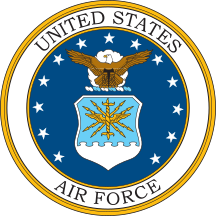
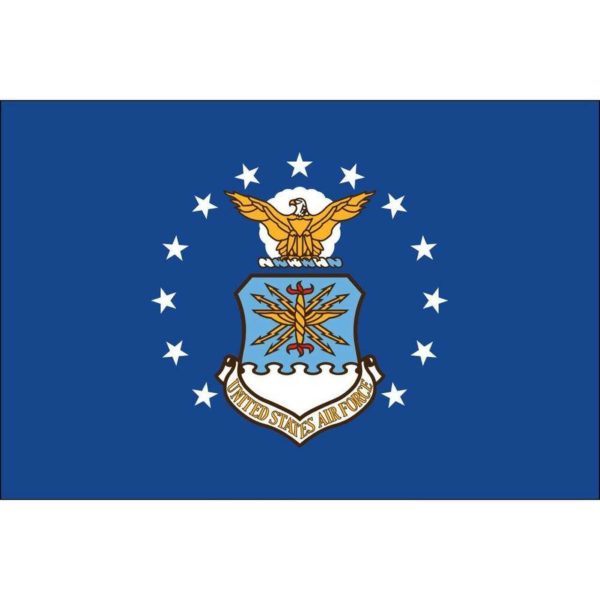
The POW/MIA example is not the only time that recognition has been mistaken for authorization.
Several Base Honor Guards have purchased what they believed was the United States Air Force flag. It was not.
The flag displays the Air Force coat of arms surrounded by a broad white circle bearing the words ‘United States Air Force.’ That design is the Air Force Emblem.
The emblem may be familiar. It may appear official. It may be appropriate for certain graphic, informational, or headquarters-approved representational uses. But it is not the United States Air Force departmental or organizational color and printing it on blue fabric does not transform it into one.
The official Air Force departmental color has a specific design: an ultramarine-blue field; the Air Force coat of arms; thirteen white stars surrounding the coat of arms; and the words ‘United States Air Force’ on the scroll beneath the shield.
Those distinctions are not matters of taste. They are matters of heraldic identity and official authority.
Yet Base Honor Guards have spent government funds, placed the emblem flag on a staff, and carried it in official color guards because someone searched for an ‘Air Force flag,’ found a commercially available product that looked convincing, and purchased it without comparing it to the governing instruction. One incorrect flag in an official Air Force color guard is one too many.
But again, I do not place all responsibility on the young Airman who ordered it or the Guardsman assigned to carry it. Where was the guidance? Where was the approved equipment list? Where was the inspection? Where was the training that taught the difference among a seal, an emblem, a logo, a coat of arms, and a service color?
The current instruction itself says that official departmental flags are heraldic items and warns against ordinary commercial purchase. These are not generic decorations that should be selected because an online image looks close enough.
A color guard does not carry something merely because it represents the Air Force generally. It carries the specific colors authorized to represent the Air Force ceremonially.
Looking official is not the same as being official. Recognition is not authorization. And close enough is not a ceremonial standard.
AFPAM Example
The color guard section of AFPAM 34-1203 provides an even clearer example of what happens when a publication process becomes separated from professional understanding.
I am going to give you a technical example, but the technical detail is not the real issue. The issue is how an error entered an official photograph, remained through review, and was later converted into written policy rather than corrected. That process can happen in any career field.
Historically, the color bearer held the staff with the right hand at the position of Carry. What we know in the ceremonial drill world as Right Shoulder. That was shown and described through decades of Air Force drill guidance that was handed down from the Army.
Then, in the 2013 edition of the drill manual, a photograph appeared showing the color bearers holding their staffs with the left hand—even though the written instruction still required the right hand. The photograph and the words contradicted one another.
That should have resulted in the photograph being corrected. Instead, in the 2018 revision, the written instruction was changed to agree with the erroneous photograph. The mistake became the standard.
The current AFPAM 34-1203 continues to direct the flag bearer to grasp the staff with the left hand at Carry. The same chapter directs the color guard to form at close interval while its illustrations have repeatedly failed to depict that requirement accurately.
Think about the process. A photograph was selected. The document was reviewed. The discrepancy remained. A later publication team saw the difference between the photograph and the words and instead of asking which one was historically and technically correct, the words were changed to match the photograph.
The document was staffed. It was approved. It was published. The process worked. The standard failed.
The Air Force Honor Guard has continued to preserve its established ceremonial method rather than adopt this left-hand change. That creates an extraordinary situation.
The organization responsible for representing the Air Force standard has had to disregard part of an Air Force publication in order to remain ceremonially correct. A service cannot call that standardization.
This is not fundamentally an argument about the left hand versus the right hand. It is evidence that the people who understand ceremonial practice do not exercise sufficient control over the publications governing ceremonial practice.
The publication has authority without mastery. The Honor Guard has mastery without sufficient authority. That division is unsustainable.
That brings me to the most difficult institutional issue I need to address.
AFMAO
The Base Honor Guard program’s professional ownership has been separated from the Air Force Honor Guard.
This is not merely an honor guard disagreement. It is what happens whenever an organization with administrative responsibility gradually acquires professional authority over a field whose expertise resides somewhere else.
I want to make an important distinction. The Air Force Mortuary Affairs Organization, or “AFMAO”, performs a vital and solemn mission. The recovery, care, identification, preservation, transportation, and dignified transfer of our fallen require extraordinary technical competence. Mortuary policy, funeral eligibility, reporting, coordination, logistics, funding, and support are serious responsibilities.
Nothing I say should be interpreted as diminishing that mission or the Airmen who perform it. But Mortuary Affairs and the Honor Guard are not the same profession.
They meet at the funeral. They serve the same family. They contribute to the same national promise. But they bring different expertise.
Mortuary Affairs ensures that the deceased and the family receive proper care, coordination, entitlements, and support. The Honor Guard defines and executes the ceremonial act. One manages mortuary requirements. The other carries the colors, bears the casket, fires the volleys, sounds Taps, folds the flag, presents it, and visibly represents the United States Air Force.
The mistake was not involving AFMAO in the Base Honor Guard program. The mistake was allowing administrative support and mortuary policy responsibility to expand into ownership of ceremonial policy, training oversight, standards, and professional identity.
AFI 34-160 was recently changed to assign the Air Force Mortuary Affairs Organization, responsibility to establish Base Honor Guard policy, oversee training, act as the office of primary responsibility for ceremonial procedures and honor guard uniform wear, manage program areas of responsibility, and serve as the career-field manager. The same instruction places the Air Force Honor Guard in a coordinating role and even makes some of its assistance dependent on an AFMAO request.
At the same time, the Air Force Honor Guard publicly identifies its Base Honor Guard Training Program as the means by which ceremonies are standardized across the Air Force, including manuals, uniforms, history, traditions, and ceremonial procedures. The Air Force Honor Guard is also publicly described as the lead organization for support, training, and standardization of Base Honor Guard programs worldwide. Those two pictures do not align.
The Base Honor Guard manager is expected to receive ceremonial expertise from the AF Honor Guard while operating under program authority centered elsewhere. That is serving two masters. Airmen adapt because Airmen have always adapted.
Program managers find workarounds. Trainers develop relationships. Good people cooperate across organizational lines and keep the mission moving. But the ability of dedicated people to survive a poor structure does not prove that the structure is sound.
An institution can go through the motions too. It can maintain databases, collect statistics, conduct inspections, approve funding, publish policy, and report mission completion. All of those actions may be necessary. But none of them creates ceremonial mastery.
An organization can administer a profession without being qualified to define that profession.
When administrative authority becomes detached from operational expertise, the mission may continue on paper while its identity and standards erode in practice.
This is not a turf war. It is not about personalities. It is not about whether AFMAO personnel are dedicated. It is about placing professional authority where professional competence resides.
The AF Honor Guard should be the functional owner and central authority for Base Honor Guard ceremonial standards, training, curriculum, uniforms, evaluations, and standardization.
AFMAO should remain the authoritative partner for mortuary policy, eligibility, reporting, logistics, resources, and administrative support. The missions should cooperate closely. But cooperation does not require confusion about ownership.
Support does not require control. Coordination does not require the ceremonial standard-bearer to ask permission to maintain the ceremonial standard.
The Base Honor Guard program belongs professionally under the Air Force Honor Guard. That relationship must be restored.
Guardians
This issue extends beyond the Air Force. It should be of special concern to every Guardian in this room. The United States Space Force is creating its institutional identity now.
Its ceremonies, customs, symbols, uniforms, language, and traditions are still developing. The first generations of Guardians are making decisions that will shape how future generations understand their service.
The current DAFPAM 34-1203 applies its drill and ceremonies guidance to both Airmen and Guardians. The first Space Force ceremonial Guardsmen graduated from the USAF Honor Guard’s technical training pipeline in 2024. That partnership offers tremendous potential. It also creates a danger.
If the Space Force inherits the Air Force’s culture of forgetting history, it may institutionalize Air Force errors before it has enough independent institutional memory to recognize them.
What the Air Force may dismiss as a recent editorial mistake can become, for the Space Force, an original tradition.
Once an error is taught to the first generation, photographed, placed into a manual, and repeated at official ceremonies, it begins to look authentic.
Future Guardians may say, “This is how the Space Force has always done it,” when “always” means only a few years. The Space Force should create intentionally, not inherit accidentally. Being a new service does not mean beginning without foundations.
It means having the opportunity to study the military traditions that came before, understand their purpose, and make conscious decisions about what should be retained, adapted, or created.
The Space Force should not simply copy the latest Department of the Air Force publication because it is available.
It should ask:
- Where did this standard originate?
- Who has the authority to establish it?
- Is it compatible with joint-service practice?
- What does it communicate?
- What will be lost if it is changed?
- Is this a deliberate Space Force tradition—or merely an Air Force error we inherited?
Today’s decisions will become tomorrow’s traditions. Guardians must be especially careful about what they allow to become permanent.
Fixing
The problems I have described are serious, but they are not impossible to correct. We can fix them by following three requirements.
The first requirement is intellectual honesty
We must be willing to admit when a publication is wrong. We must be willing to distinguish official-looking language from historically and technically sound guidance.
We must be willing to say that an organizational structure is failing even when good people are working hard within it. We must stop treating criticism of a standard as disloyalty. Accuracy is loyalty. Correction is stewardship.
The second requirement is professional ownership
Ceremonial standards must be written, reviewed, taught, and evaluated by ceremonial experts.
The AF Honor Guard must have clear authority over the professional Base Honor Guard mission. AFMAO must be respected and supported within its proper mortuary and administrative responsibilities. The relationship should be complementary, not competitive—and not confused.
The third requirement is historical review
AF PAM 34-1203 and AFI 90-1201 need a complete ceremonial and historical examination. That review should not be limited to the office currently responsible for the publication.
It should include representatives from the AF Honor Guard, experienced Base Honor Guard managers and trainers, Air Force and Space Force historians, heraldic experts and the Institute of Heraldry where appropriate, joint-service ceremonial specialists, and people willing to examine the full historical record rather than only the previous edition.
The question cannot be merely, “What wording should we use?”
The questions must be:
- What was the original standard?
- Why was it established?
- What authority supports it?
- What has changed?
- Who approved the change?
- Was the change intentional?
- What are the joint-service consequences?
- And does the new wording preserve or weaken the meaning?
The fourth requirement is education
Every Guardsman should be taught the meaning behind the movement. Every trainer should be able to identify the source of the standard. Every program manager should know the difference between doctrine, policy, tradition, local procedure, and personal preference.
Every leader should understand that the honor guard is not ornamental manpower. It is a military mission. And every person involved must be able to answer the most basic professional question: Why do we do it this way?
I am not calling for a return to the past merely because it is the past. I am calling for institutional memory. I am not arguing that nothing should ever change. I am arguing that change must be informed. I am not asking every Guardsman to become an historian. I am asking the institution to stop changing historical standards without consulting history. I am not asking for performance alone. I am asking for meaning.
- A family deserves more than a completed funeral detail. The colors deserve more than people assigned to carry them. Airmen and Guardians deserve more than incomplete publications and conflicting authorities.
- Base Honor Guard managers deserve a clear professional chain. The AF Honor Guard deserves the authority necessary to fulfill the role it was created and trained to perform.
- The Space Force deserves the opportunity to build its traditions intentionally and correctly.
- And the nation deserves ceremonial Guardsmen who understand what they represent.
Wrap-up
When you return to your units, do not merely perform better. Understand more. Teach more deeply. Read the source. Ask the difficult question. Challenge unsupported local practice respectfully. Preserve what was entrusted to you.
Do not allow convenience to become doctrine. Do not allow repetition to become authority. Do not allow a published mistake to become tradition. Do not allow management to replace mastery. And do not allow the motion to continue after the meaning has been lost.
The honor guard mission is not ours to reinvent casually. It has been placed in our hands temporarily. Our responsibility is to carry it faithfully, correct what has been damaged, strengthen what has been neglected, and pass it forward undiminished.
We must restore understanding to the performer. We must restore history to the standard. We must restore expertise to the authority. And we must restore stewardship to the institution.
That is how we move beyond performance.
To Honor With Dignity