
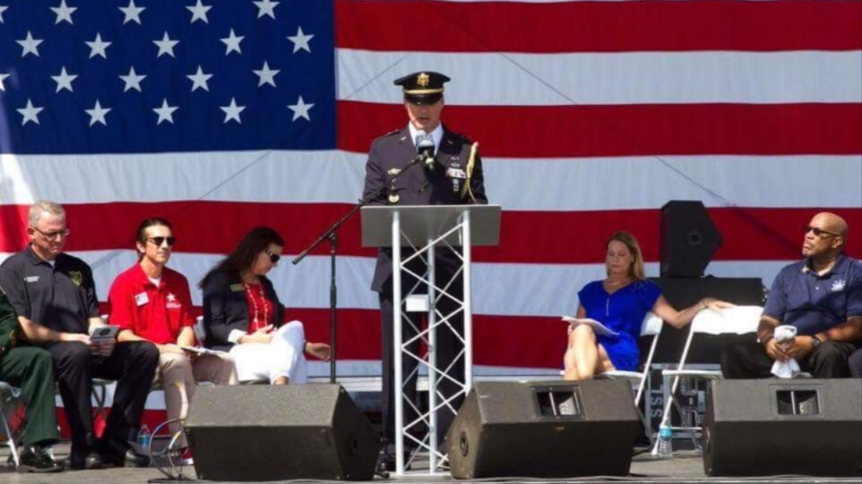
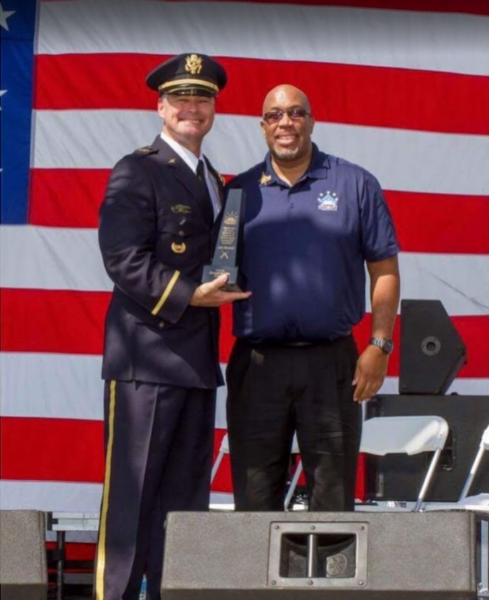
Don Crutch, founder of Honor Guards of America, designated July as the month in which ceremonial guardsmen would be recognized through Honor Guards Day. The first—and only—celebration was held in 2017. This article remembers the man, the observance, and the mission that remains worthy of continuing.
A personal note: I have been a manager of the Honor Guards of America Facebook page since Don created it, and Don remained its owner. My permissions have been limited to basic maintenance, however, and posting there gradually became little more than duplicating material from The DrillMaster page. Consequently, I have not posted there for quite some time. I mention this to clarify my connection: I helped Don maintain the page, but Honor Guards of America was his creation and vision.
In 2017, I had the privilege of speaking at the inaugural Honor Guards Day celebration. It was also the final celebration.
Mr. Crutch created Honor Guards of America and established Honor Guards Day to recognize the men and women who accept an additional responsibility beyond their ordinary duties: rendering ceremonial honors for others. He understood that this service is often performed quietly, after hours, and without recognition.
Two years later, Mr. Crutch died. The annual observance did not continue. But that does not mean Honor Guards Day failed.
A worthy idea does not cease to matter merely because the person who first carried it is no longer here to advance it. Mr. Crutch saw a community whose work was frequently invisible and believed that its members deserved to be recognized—not because they sought attention, but because they routinely gave it to others.
Those Who Render Honors
Military personnel, law enforcement officers, firefighters, emergency medical service personnel, and other public servants already perform demanding work. Their daily responsibilities may involve danger, physical hardship, emotional strain, and great personal sacrifice.
Some of these same men and women then volunteer for ceremonial duty.
He was the first one to bring the NYC Sanitation Department Honor Guard to light and wanted to include recognition for them. Thiers’ is a long history.
They practice after completing their normal shifts. They train during evenings and weekends. They surrender holidays and personal time. They report in extreme heat, bitter cold, rain, and wind. They stand motionless for long periods and repeat movements until every detail can be performed correctly.
Then, when called, they carry the casket of a fallen colleague. They fold and present the flag. They serve on the color guard, firing party, honor cordon, or caisson team. They guard monuments and memorials. They participate in ceremonies that mark retirement, remembrance, public service, sacrifice, and death.
The public usually sees only the ceremony. It does not see the hours of practice that preceded it. It does not see the guardsman polishing equipment late at night, preparing the uniform after a full day of work, reviewing procedures, correcting mistakes, or silently rehearsing the next movement.
It does not see the personal burden of standing beside a grieving family while remaining composed enough to perform every movement with precision. That hidden commitment is what Honor Guards Day was created to recognize.
An Additional Obligation
Ceremonial service is sometimes described as an additional duty. Administratively, that description may be accurate. It does not adequately express the weight of the responsibility.
The ceremonial guardsman stands between an institution and the people it serves. During a funeral, that guardsman also stands between the institution and a grieving family. The family may know little about drill, flag protocol, pallbearer procedures, or the sequence of military or first-responder honors. They may not know the terminology, but they understand what they see and feel.
They recognize care. They recognize discipline. They recognize whether the people entrusted with honoring their loved one treated that responsibility seriously.
A funeral cannot be repeated for the family because the team later discovers that its procedure was wrong. A flag presentation cannot be withdrawn and performed again after someone realizes that the words were incorrect. Ceremonial errors occur during moments that may remain permanently fixed in the memories of those present.
That is why good intentions are not enough. Honor must be supported by knowledge, preparation, and disciplined execution.
Education, Practice, and Performance
In my 2017 address, I said:
Education is the foundation for practice, and practice is the foundation for every performance.
I believed that then, and I believe it even more strongly now.
Practice is essential, but practicing an incorrect procedure only makes the error more consistent. Before a team can rehearse effectively, it must have access to reliable standards, accurate instruction, and a clear understanding of why each element of the ceremony exists.
For many years, first-responder honor guards did the best they could with limited educational resources. Teams borrowed procedures from military drill manuals, neighboring departments, local traditions, academy instructors, and whatever videos they could find. Some developed excellent programs. Others unknowingly combined incompatible procedures or perpetuated mistakes because no authoritative alternative was available.
Military ceremonial units have not been immune to the same problem. Regulations may be incomplete, contradictory, poorly written, or misunderstood. Local preference can gradually displace governing standards. Eventually, “This is how we have always done it” becomes the only explanation anyone can provide.
Ceremonial guardsmen deserve better than inherited guesswork. The people they honor deserve better as well.
The Mission Continued
When I spoke at Honor Guards Day in 2017, I explained that the military drill world was my mission field. My purpose was to provide ceremonial guardsmen and cadets with the education and training necessary to render honors correctly.
At that time, I could not see everything that mission would eventually become.
Since then, the work has continued through books, articles, videos, critiques, courses, training clinics, and direct assistance to military, first-responder, veteran, and cadet organizations. In 2026, that mission took institutional form through the creation of the Institute for Ceremonial Standards.
The Institute exists to preserve knowledge, clarify standards, improve ceremonial education, and build systems that can survive beyond any one instructor or organization. In that sense, its work continues the purpose Mr. Crutch recognized in 2017: ceremonial service matters, and the people who accept its responsibilities must be properly prepared and supported.
Honor Guards Day lasted for a single observance. Its underlying mission did not. It survives every time an instructor refuses to pass down an unsupported procedure. It survives every time a team replaces local habit with an established standard. It survives every time a ceremonial guardsman remains after everyone else has left so that one more sequence can be practiced correctly. It survives whenever a family receives honors performed with dignity, precision, and genuine care.
Remembering the Founder’s Vision
Mr. Crutch created Honor Guards Day to recognize those who go beyond their everyday duties to honor others. Although he is no longer here to continue that work, those of us within the ceremonial community can continue it for him.
We do that through more than remembering a date. We educate. We train. We preserve the standards and traditions entrusted to us. We prepare the next generation to carry them forward. Above all, we render honors correctly, faithfully, and selflessly.
Those who render honors may rarely be the focus of the ceremony. That is precisely as it should be. Ceremonial service is not about drawing attention to the guardsman. It is about directing the attention of everyone present toward the person, symbol, sacrifice, or institution being honored.
Still, there is value in pausing to recognize those who willingly assume that responsibility. Honor Guards Day was celebrated only once, but its purpose remains worthy. The man who created it should be remembered, and the mission he began should continue.
Semper ad Honorem.
Always for Honor. Thanks, Don.