
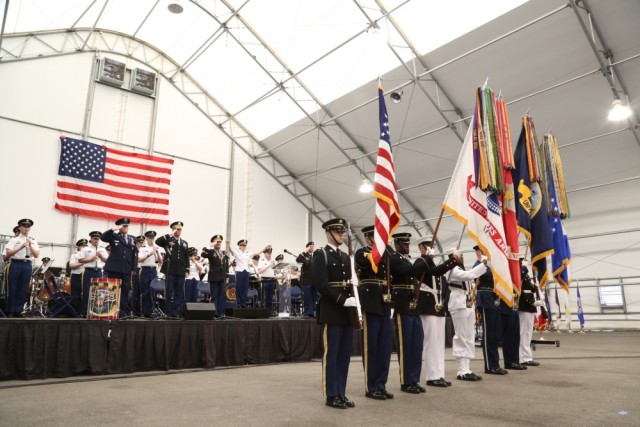
Should the Invocation Come Before or After the National Anthem?
I receive this question often enough that it deserves a clear answer:
In the most common sequence for a DoD-style ceremony, the invocation comes after the National Anthem.
That may surprise some people because many civic meetings, banquets, and local organizational events begin with an invocation. That is common in a meeting-agenda format. But a formal military ceremony is not simply a meeting with patriotic elements added to it. It has a ceremonial structure, and that structure matters.
The Common Military Ceremony Sequence
For most DoD-style ceremonies, the opening sequence looks like this:
- Opening narration or call to order
- Arrival of the official party, if used
- Presentation or posting of the colors
- National Anthem
- (Posting the colors and) Color guard departure
- Invocation
- Welcoming remarks
- Official remarks
- Main ceremonial event
- Benediction, if used
- Closing, departure, service song, or retiring of the colors, depending on the event
This is not the only possible sequence for every ceremony, but it is the common and logical sequence for most formal military ceremonies.
From DA PAM 600-60, Protocol
Note that the text says, “examples”.
7–1. Ceremony sequence of events
The following are examples of sequence of events for standard ceremonies. For more details, please refer to the TC 3–21.5.
a. A standard ceremony with troop movement:
(1) Pre-review concert.
(2) Formation of troops.
(3) March on.
(4) Arrival of the reviewing official.
(5) Invocation.
(6) Honors (National Anthem).
(7) Sound off.
(8) Inspection.
(9) Honors to the Nation.
(10) Presentation of award, promotion, retirement.
(11) Remarks.
(12) March in review.
b. A standard promotion ceremony:
(1) Official party is announced.
(2) National Anthem.
(3) Invocation.
(4) Remarks by host.
(5) Promotion orders read.
(6) Rank insignia pinned.
(7) Flag presentation.
(8) Reaffirmation of oath.
(9) Remarks by honoree.
(10) Presentations by honoree.
(11) Army song.
Why the National Anthem Comes First
The National Anthem is not merely “opening music.” It is a formal act of national honor.
When the anthem is played, everyone present has a required ceremonial response. Federal law identifies The Star-Spangled Banner as the national anthem and describes the expected conduct during its playing, including the military salute by those in uniform from the first note to the last note. (U.S. Code)
That moment belongs to the nation, the flag, and the formal rendering of honors. It establishes the national and military context of the ceremony before the spoken portions begin.
That is why the usual sequence is:
Colors. Anthem. Invocation. Remarks.
The colors are presented or posted. The National Anthem is played. Honors are rendered. Then, with the national ceremonial framework established, the chaplain or designated speaker delivers the invocation.
The Invocation Is Not the Opening Honor
The invocation is important, but it is not the same type of ceremonial act as the National Anthem.
The invocation is a prayer, solemn reflection, or spiritual opening. It asks for blessing, guidance, wisdom, remembrance, or reverence. It supports the ceremony, but it does not replace the formal rendering of honors to the nation.
Putting the invocation before the anthem can make sense in a church service, a civic meeting, or a banquet. But in a military ceremony, the anthem normally comes first because the ceremony opens by rendering national honors before moving into the spoken and reflective portions of the program.
What About Events That List “Invocation and National Anthem”?
You may see programs that list the invocation before the anthem. That does not automatically mean the ceremony is invalid or disrespectful. It often means the event was built from a civilian meeting format rather than a military ceremonial format.
You may also hear a narrator say:
“Ladies and gentlemen, please rise for the presentation of the colors, the National Anthem, and the invocation.”
That is perfectly acceptable. The audience remains standing through the whole opening sequence. But the internal order should normally remain:
Presentation of the Colors
National Anthem
Invocation
The narration can group the actions together. The sequence should still be correct.
Note: I highly suggest the color guard leave before the invocation
DoD Public Events and Patriotic Openers
DoD public event guidance also reflects the idea that patriotic or ceremonial openers are designed to establish the formal patriotic tone of the event. DoDI 5410.19, Volume 1 describes a patriotic opener as a ceremony involving a color guard or musical unit that honors the nation with the formal presentation of the American flag, and notes that sequencing may include patriotic music, presentation of colors, National Anthem, retiring of colors, and service medley.
That is important because it shows the National Anthem belongs to the national-honor portion of the event. The invocation belongs after that opening honor sequence unless the host organization has a specific reason to structure the event differently.
The Practical Answer
For most DoD ceremonies: The invocation should be delivered after the National Anthem, but there is nothing set in stone.
A clean sequence is:
Present/Post the Colors
National Anthem
Invocation
Remarks
Ceremonial Event
For non-DoD civic meetings, banquets, or local programs, the host may choose a different sequence. But when the event is being run as a military ceremony, the better and more common sequence is clear:
Render honors to the nation first. Then deliver the invocation.