
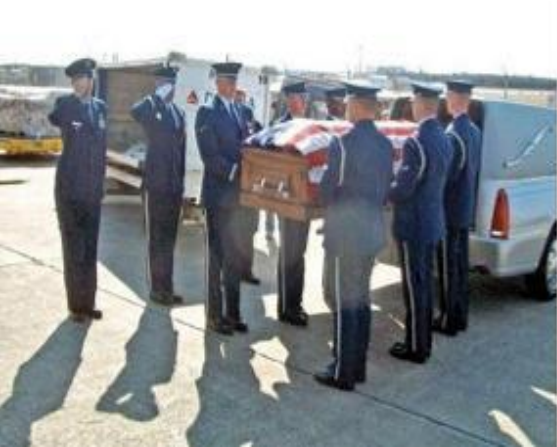
The Department of the Air Force has released DAFMAN 34-165, Honor Guards, establishing ceremonial guidance and standards for the United States Air Force Honor Guard and Department of the Air Force Base Honor Guard (BHG) programs. This is an important publication for the Air Force and Space Force honor guard communities. However, it is equally important to understand what this manual is, what ceremonial system it governs, and who is authorized to operate under that system.
The manual states on its title page:
“It provides history, guidance and procedures on customs, drill, honors and ceremonies; and dress and appearance standards of Department of the Air Force (DAF) honor guards. It applies to United States Space Force, Regular Air Force, the Air Force Reserve, and the Air National Guard individuals assigned to and/or augmenting a DAF Honor Guard program.”
(emphasis mine) That applicability statement matters.
DAFMAN 34-165 is not another general-purpose drill manual from which organizations may select movements, formations, and procedures simply because they look impressive. It governs a specialized ceremonial drill system developed for designated Department of the Air Force honor guard programs. That system serves missions, functions, and ceremonial requirements that differ from those of ordinary military and cadet formations operating under regulation drill.
The Restriction Plainly Stated
The difference in applicability between DAFPAM 34-1203, Drill and Ceremonies, and DAFMAN 34-165, Honor Guards, is both deliberate and significant. DAFPAM 34-1203 states, “This publication applies to the United States Space Force, Regular Air Force, the Air Force Reserve, and the Air National Guard.” Its applicability is service-wide, without restricting its provisions to personnel assigned to a particular ceremonial program. DAFMAN 34-165, however, contains the critical qualification: “individuals assigned to and/or augmenting a DAF Honor Guard program.” Those words establish the boundary between the two systems. DAFPAM 34-1203 provides the Department of the Air Force’s general drill and ceremonies guidance, while DAFMAN 34-165 establishes specialized procedures for personnel serving in designated honor guard programs. Membership in the Air Force or Space Force does not, by itself, place someone within the applicability of the honor guard manual. Likewise, Airmen and Guardians not in the BHG program, cadets in the Air Force Academy, AFROTC, AFJROTC, Air Explorer, and Space Force Cadet Corps cannot claim authority to adopt DAF honor guard procedures simply because the manual is publicly available. The governing distinction is not which military service an individual represents, but whether that individual is assigned to or augmenting an authorized DAF Honor Guard program.
The distinction is between regulation drill and ceremonial drill. Both have legitimate purposes, but they are separate systems. Procedures prescribed for an established military honor guard cannot automatically be transferred into regulation drill or adopted as an organization’s governing standard. A publicly available military publication is not a universal authorization to perform its procedures.
I addressed this in my article, “They’re Not Just Doing It Wrong. They’re Using the Wrong System.” The article explains why borrowing visually appealing procedures from a specialized ceremonial system can create problems when those procedures are performed outside their intended organizational and doctrinal context.
When Regulation Drill Already Provides the Answer
When Regulation Drill Already Provides the Answer
One of the most common mistakes in color guard instruction is adopting a ceremonial drill movement when regulation drill already provides an established procedure for accomplishing the same task. The existence of a movement in a specialized honor guard manual does not make that movement available for general use. Regulation drill and ceremonial drill are separate systems, and the authority to perform procedures from one system does not automatically extend to personnel operating under the other.
Consider the Colors Turn On and Colors Turn Off used in ceremonial color guard systems. These movements allow a color guard to rotate into or out of its presentation formation through coordinated sequences. They are visually effective and provide a smooth transition between marching and presenting the colors. However, regulation drill already provides the necessary procedures. A color guard entering to present the colors halts, executes Left Face, and proceeds with the presentation. Following the presentation, the team executes a Right Face and Forward March to depart. There is no reason to replace these established regulation movements with specialized ceremonial techniques simply because the latter look more impressive or appear to provide a smoother transition.
Civil Air Patrol provides a particularly useful example of why this distinction matters. CAP cadets operate under regulation drill standards unless they have completed the prescribed Honor Guard Academy training and are authorized to perform the specialized ceremonial drill system. That authorization applies to a properly qualified honor guard team, not to individual academy graduates who introduce ceremonial movements into an otherwise unqualified cadet color guard. Every member of the team must complete the required training before the team may perform those honor guard techniques. The appearance of Colors Turn in a CAP honor guard publication does not authorize its use by CAP cadet color guards generally. A specialized publication governs its designated program; it does not supersede the regulation drill standards applicable to everyone else.
There are circumstances in which regulation drill publications do not provide a specific movement for accomplishing an unusual color guard entry or formation transition. For example, a color guard entering from the audience’s left, or stage right, needs to move from column formation into line formation while maintaining the required precedence and position of the United States flag. A technique such as Every Left On provides a coordinated method of accomplishing this transition. The right rifle guard establishes the initial position, and the remaining members sequentially move behind that position to establish the proper line formation, with the National Color occupying its prescribed position of honor. This technique addresses a movement problem that ordinary regulation drill instructions may not specifically explain.
The distinction is important. When a regulation drill procedure already accomplishes the required task, that procedure governs. When the applicable publication does not address a necessary maneuver, an organization may develop an appropriate solution within its governing standards and authorization requirements. Such a solution should be limited to the movement problem being addressed. It is not permission to introduce unrelated ceremonial drill movements or adopt an entire specialized honor guard system. A color guard can also use conventional marching movements to maneuver into the correct position without adopting a ceremonial technique.
The same principle applies beyond color guards. Regulation drill and applicable military ceremonial publications already establish procedures for pallbearers, firing parties, honor cordons, wedding cordons, and other ceremonial functions. There is no justification for disregarding those established procedures in favor of specialized honor guard adaptations simply because an instructor prefers their appearance. DAFMAN 34-165, Honor Guards, governs personnel assigned to or augmenting Department of the Air Force Honor Guard programs. It is not an alternative drill manual for military personnel, cadets, or civilian organizations outside that defined population.
The governing principle is straightforward: Use the prescribed regulation drill procedure when one exists. When the governing publication does not address a necessary movement, an appropriately authorized solution may be developed without abandoning the regulation drill system. Specialized ceremonial drill procedures remain within the authority and applicability of the programs for which they were established.
Standards are not optional preferences, and a visually impressive technique does not establish authority to use it. The question is not whether a ceremonial movement looks better or works more smoothly. The question is whether the personnel performing it are authorized to operate under that ceremonial system.
The release of DAFMAN 34-165 provides an excellent opportunity to reinforce that distinction.
Before adopting any procedure from a military manual, determine who the publication governs, what system it establishes, and whether your organization has the authority to use it.
Authority before aesthetics. Doctrine before preference. Judgment within doctrine.
References:
DAFMAN 34-165, Honor Guards. Available through the Department of the Air Force E-Publishing system.