
Marching is often taught as a series of positions: attention, step off, halt, face, flank, and so on. That is necessary, of course, because drill manuals describe movement in counts and commands. But beneath every command is something more basic: the human gait cycle.
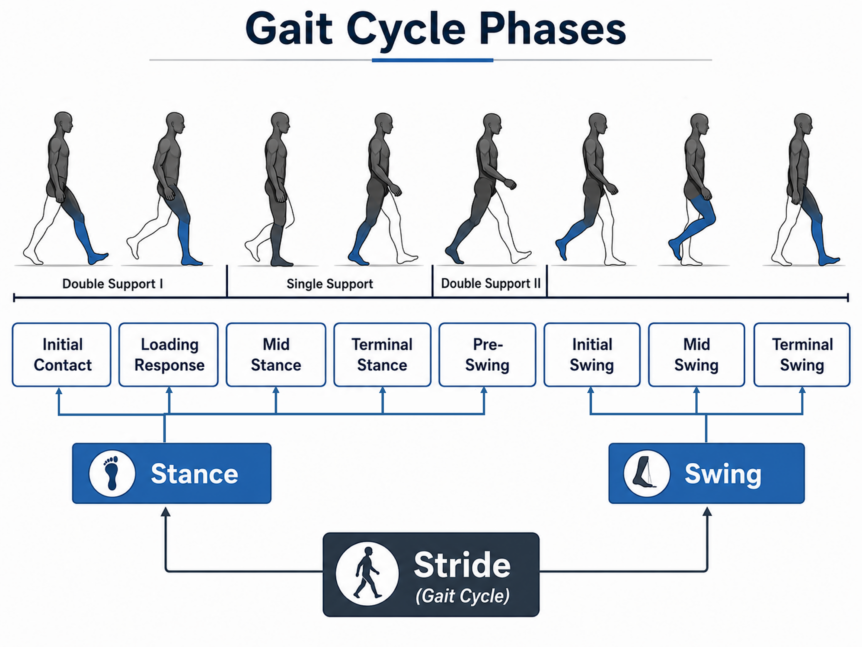
The gait cycle is one complete stride. It begins when one heel contacts the the marching surface and continues until that same heel contacts the marching surface again. In normal walking, that cycle is divided into two major parts: stance and swing and we can apply that to marching.
The stance phase is when the foot is in contact with the marching surface and supporting the body. The swing phase is when that foot leaves the marching surface and moves forward to prepare for the next heel strike.
For drill and ceremonies, this matters because command execution depends on timing, balance, and predictable foot placement. A formation does not simply “move.” Each member is constantly transferring weight, accepting load, passing the torso over the supporting foot, pushing off, and preparing the next step.
The Stance Phase
The stance phase begins with Initial Contact, commonly understood as the heel strike. In drill, this is the moment we often reference when we say a command is given “as the left foot strikes the marching surface” or “as the right foot strikes the deck.”
Next is Loading Response, when the foot comes flat to the surface and begins accepting the body’s weight. The foot is still forward of the torso, but weight is transferring onto it.
Then comes Mid-Stance, where the torso is centered over the supporting foot. This is the point of greatest vertical support and balance over that foot.
After that is Terminal Stance, where the body has moved past the supporting foot and the heel rises. The foot is now on the forefoot platform: the ball of the foot and everything forward.
Finally, Pre-Swing begins the transition out of stance. The foot is preparing to leave the surface, and the opposite foot has accepted the body’s weight.
The Swing Phase
The swing phase begins with Initial Swing, when the foot leaves the marching surface. The toe is lifted off the surface and the leg begins moving forward.
In Mid-Swing, the foot passes under the body. The moving foot is off the surface and approximately centered beneath the torso.
Then comes Terminal Swing, where the leg extends forward and prepares for the next heel strike. This sets up the next gait cycle.
Why This Matters for Marching Commands
This is where gait analysis becomes useful for drill instruction.
When a manual says a command is given as a foot strikes the marching surface, it is referring to a specific moment in the gait cycle: initial contact. That heel strike gives the commander a visible and audible timing reference.
This is one reason command timing must be consistent. When a leader gives Platoon on the left foot and then HALT on the next left foot, the formation receives the command in a predictable rhythm. The body is already cycling through weight transfer, stance, and swing. The command fits into that system.
When command timing becomes inconsistent, especially in cadet formations or developing units, the body has to solve an unnecessary problem. The members are not only listening for the command; they are also adjusting balance, foot placement, and reaction timing.
That is why I recommend using the left foot as the default command foot unless the manual specifically requires otherwise. It builds a consistent command-response relationship and this is crucial for competitive marching.
The Practical Drill Connection
Every step in marching is controlled through the gait cycle.
That does not mean marching is the same as casual walking. Marching imposes cadence, posture, step length, arm swing, alignment, and command response onto the natural walking system. But the body still has to obey the mechanics of gait. Marching is walking at Attention.
Understanding the gait cycle helps instructors explain why commands are timed to heel strikes, why some commands require a specific foot, and why consistency matters. It also helps cadets understand that marching is not just “left, right, left.” It is coordinated movement through balance, support, transfer, and recovery.
A clean formation starts with clean timing. Clean timing starts with understanding what the feet are doing.