
In recent years, an increasing number of Air Force color guard performances—particularly within Technical School, the United States Air Force Academy, and Air Force Reserve Officer Training Corps—have shown a consistent pattern: movements that appear deliberate and “ceremonial,” yet are fundamentally incorrect within their training environment.
At first glance, these performances are often dismissed as issues of execution—improper technique, lack of precision, or insufficient training. However, a closer examination reveals a more significant and systemic problem: personnel are not simply performing incorrectly—they are performing from the wrong doctrinal system.
The distinction between regulation drill and ceremonial drill is not widely understood, nor is it consistently taught. As a result, Airmen and cadets frequently adopt techniques observed from honor guard units, assuming these methods represent a higher standard of performance. In reality, these techniques are restricted, purpose-built, and authorized only for specific units operating under separate governing doctrine.
This article clarifies that distinction. It defines the difference between regulation and ceremonial drill, explains why the two systems are not interchangeable, and establishes the importance of applying the correct standard within the correct environment. More importantly, it addresses the root cause of the issue: the absence of clear doctrinal separation in instruction.
Understanding this separation is not optional—it is essential for maintaining standardization, preserving instructional integrity, and ensuring that performance reflects proper authority rather than perceived style.
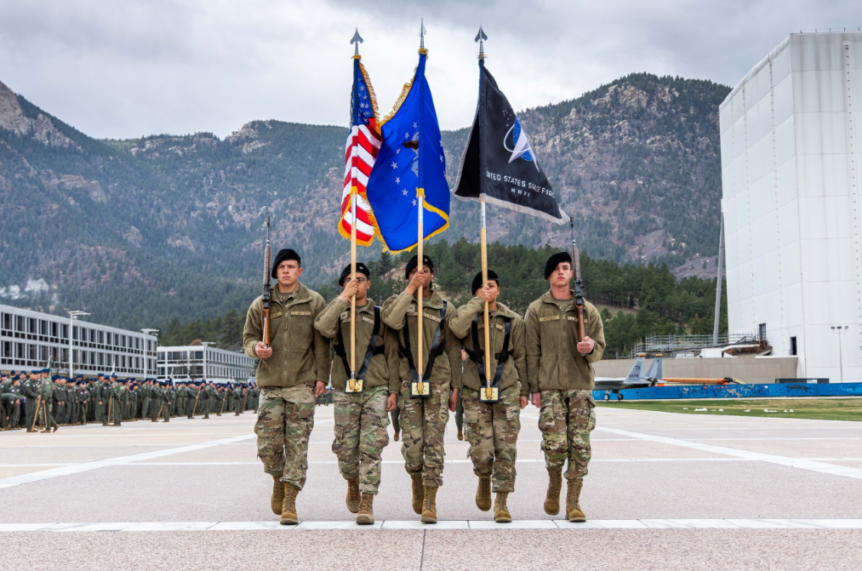
The Image at the Top
The US Air Force Academy color guard looks great here. They are showing a high level of excellence using ceremonial technique. How do we know this is not regulation drill. There are two telling details:
- They are marching shoulder-to-shoulder
- Hand positions on the staff
This isn’t inherently wrong; they are technically correct. However, the cadets do not meet the requirements to perform ceremonial technique.
Videos Showing Poor Training
Recently, I was sent links to performances by Airmen in what the USAF calls Tech(nical) School, where Airmen learn their job right after Basic Training. These Airmen were trained to present the colors using ceremonial technique as you can see in the video below.
My YouTube channel was hijacked- I’m working to get it back.
What you see here is probably the worst training ever put forth for Airmen in the history of the USAF. Barely anything here is correct—just the order of the colors in Column and Line Formation. Literally everything else is wrong and it’s not the fault of the Airmen.
At the end of the video is a third segment of “exhibition guidon staff” which can be effective for a drill team’s exhibition performance but is never authorized at any other time.
There are two immediate reactions when watching a poorly executed color guard:
- “That’s wrong.”
- “They need better training.”
Both are true—but incomplete.
What’s actually happening in many cases is more fundamental:
they are being trained to the wrong standard.
The Core Issue
Airmen and Guardians in Basic Training and Technical School are required to follow:
- AFMAN 34-1203
This is the baseline for all general Air/Space Force drill and ceremonies.
However, what is increasingly seen is the use of techniques from:
- AFMAN 34-515
- Base Honor Guard Manual procedures
Those techniques are not general-use standards.
They are restricted to:
- United States Air Force and Space Force Honor Guards
- Certified AF/SF Base Honor Guards
For Civil Air Patrol
The same principle applies to Civil Air Patrol cadets. CAP cadet drill competitions are regulation drill events. Their procedures are drawn primarily from Air Force drill standards, CAP’s own adaptation of those standards, and, where a gap exists, selected procedures from TC 3-21.5 or MCO 5060.20. That limited borrowing does not authorize ceremonial technique, nor does it transform a regulation drill event into an honor guard ceremony. Borrowed procedures must remain subordinate to the governing standard and must preserve the service style of the activity.
CAP cadets often assume that because CAP has a cadet honor guard manual, that manual can be used as another source for regulation drill procedures. It cannot. The CAP cadet honor guard manual governs CAP cadet honor guard activity; it does not serve as an auxiliary regulation drill manual. A procedure may be required in a CAP honor guard context while still being inappropriate, unauthorized, or nonstandard in a regulation drill competition.
CAP’s cadet honor guard manual may control CAP cadet honor guard activity, but it does not have export authority into regulation drill scenarios and the yearly colors competition is purely a regulation drill scenario.
Why This Matters
This is not about preference or style. Military drill is prescriptive—it is governed by authority. Using ceremonial techniques in Technical School is not “creative” or “advanced.”
It is unauthorized.
The Critical Misunderstanding
Many assume ceremonial drill is simply a higher level of performance. It is not.
It is a different system entirely, with:
- Different techniques
- Different intent
- Different authorization
No one within the Air Force or Space Force can just choose to switch from the regulation drill system to the ceremonial drill system. That ability does not exist.
What Happens When You Mix Systems
When ceremonial drill is adopted and substituted for regulation drill or both are blended (which usually happens with adoption):
- Movements lose consistency
- Grips become incorrect
- Timing breaks down
- Instruction becomes unclear
The result is exactly what we often see: everything looks wrong—because the system itself is wrong.
The Bottom Line
Even if ceremonial techniques are performed perfectly, they are still incorrect in this environment.
Because the issue is not execution. It is authority.
Learn More
This topic is fully defined in the following Doctrine Clarification Statements:
ICS DCS 12-201 USAF Regulation vs Ceremonial Drill — Required Instructional Separation
Update
I received a comment on social media about this. (ETP = exception to policy)
The Comment
Interesting topic. I believe further discussion and research is required before jumping to conclusions. The first question should be, “Who is authorized to be a part of an official base honor guard?” Is the answer active duty only? No. All DOW components? No. Total force and retirees only? No. Where’s the written standard for who can be a part of honor guard? The cadets at USAFA train with the 10 ABW Base Honor Guard, attend USAF HG courses when funding allows, and put in more than the required training hours to supplement the 10 ABW honor guard during ceremonial honors at the USAFA Cemetery. They also follow all dress and appearance standards outline in Chapter 1 of the BHG Manual. What would qualify them less than any other BHG to utilize ceremonial movements? Why are they limited to regulation drill only? If the answer to this question is “They are not recognized by USAF mortuary affairs as a BHG” then that is an approvable ETP per the preface of the BHG Manual. However, what written exception are they asking for? Genuine questions, here.
My first reply to was to ensure the commenter read the article. Here is his second reply.
I read the article. Please refer to my “jumping to conclusions” comment. Your article identifies what you believe to be the problem. However, it does not identify the governing directive that answers my questions. Who is authorized to be in an official base honor guard, how do you know that an official ETP has not been granted for them by the USAF HG BHG NCOIC as identified in the preface of the BHG manual, and if they needed an ETP, what policy are they expected to request an exception from if it is (in your words) implicit? From your article: “However, the cadets do not meet the requirements to perform ceremonial technique.” AllI’m asking is where that requirement is written. Where is the standard?
The Assessment of the Comment
He shifted the burden of proof: Instead of proving that USAFA cadets are authorized to use BHG ceremonial technique, they asked you to prove every possible reason they are not.
He reframed the issue: Your point was about written authority and scope of application. They moved it toward “Are cadets trained enough?” and “Who is allowed to be in a BHG?” Those are related, but they are not the central issue.
He introduced an assumed exception: “How do you know an ETP has not been granted?” That is not your burden. If someone claims an exception exists, they need to produce it.
He used politeness as pressure: “Genuine questions, here” and “All I’m asking…” can sound reasonable, but the structure still places you on defense while avoiding the central requirement: written authority.
He wasn’t being genuine at all, the comments were passive-aggressive. It sounds civil, but it is designed to put me on defense.
The Reply
Genuine questions are welcome, but the premise needs to stay precise.
The question is not whether USAFA cadets are talented, trained, serious, or capable. I have no doubt many are. The question is whether they are formally operating as members of an official USAF Base Honor Guard under the written authority that governs Base Honor Guard ceremonial procedures.
The Base Honor Guard Manual states that it establishes drill and ceremony procedures for Base Honor Guard members, and that deviations are not authorized without a written exception-to-policy waiver from the USAF Honor Guard BHG Training NCOIC. It also states that the ceremonial uniform is worn by current BHG members during approved Honor Guard ceremonies and functions.
USAFA does have a written instruction for the USAFA Base Honor Guard. That instruction identifies the USAFA BHG as an official unit of USAFA, under 10 FSS supervision, and gives membership qualifications and application requirements. It also states that military members who wish to join must apply and be selected after meeting the required qualifications and training objectives.
So the standard is not “active duty only,” and I did not argue that. The standard is: Are they formally members of the official Base Honor Guard for that ceremony, or are they cadets/cadet ceremonial units using BHG ceremonial technique outside the BHG structure?
If USAFA cadets are formally appointed, trained, rostered, and tasked as members or augmentees of the USAFA Base Honor Guard for authorized Honor Guard ceremonies, then that is one matter. If they are simply USAFA cadets, cadet honor guard members, or Academy ceremonial participants applying Base Honor Guard technique because they trained with the BHG, that is another matter entirely.
Training with the 10 ABW Base Honor Guard, exceeding training hours, or attending a USAF Honor Guard course does not automatically confer authority to use Base Honor Guard ceremonial technique outside the scope of an official Base Honor Guard duty. Authority comes from assignment, appointment, tasking, and written policy—not proficiency alone.
As for an ETP, that is exactly the point. If a written ETP exists, then it should be easy to identify what it authorizes, who granted it, who it applies to, and what specific deviation it covers. Without that documentation, the published standard remains the governing standard.
My conclusion is based on the written scope of the manuals, not on the ability or dedication of the cadets. If there is a written appointment, roster, tasking authority, or ETP showing that these cadets are officially functioning as BHG members for those ceremonies, I would welcome seeing it. Until then, the burden is not on me to assume an exception exists; the burden is on the person claiming the exception to produce it.