
President Ronald Reagan famously stated that “The nine most terrifying words in the English language are: I’m from the Government, and I’m here to help” during a news conference on August 12, 1986.
While not “terrifying, “I’m From the Honor Guard and I’m Here to Help”, are not much better in context. In the wrong context, that expertise can actually be the mechanism by which the wrong drill system gets introduced. The danger is not incompetence. It is misapplied competence.
Download the teaching slide deck for this article: I’m From the Honor Guard and I’m Here to Help.
View and Listen: DeepDive Explainer Videos. Spotify DeepDive Podcast. YouTube DeepDive Podcast.
The Honor Guard member is an expert in ceremonial drill for the honor guard mission. That does not automatically make ceremonial drill appropriate for every Air Force ceremony, every unit, or every cadet program.
One of the recurring problems on Air Force installations is the unintentional transfer of ceremonial drill into environments where regulation drill is the governing standard. It usually begins innocently.
A Base Honor Guard is undermanned and cannot support every retirement, promotion, change of command, or other installation ceremony. Instead of providing a color guard, the Honor Guard may teach several Airmen from the requesting unit how to present the colors. Elsewhere, an Honor Guard member volunteers with a local JROTC unit and teaches cadets the techniques he uses every day.
Both situations can create the same problem: ceremonial drill leaves the Honor Guard environment and begins replacing regulation drill.
See also, They’re Not Just Doing it Wrong, They’re Using the Wrong System, which is about using the wrong system or visual grammar.
Two Drill Systems, Two Purposes
DAFPAM 34-1203, Drill and Ceremonies, provides the Department of the Air Force’s general system of drill and ceremonies. It states that Department accession schools—including BMT, OTS, ROTC, and USAFA—execute this policy in training Airmen and Guardians. Ceremonial drill, or, what many people call, Honor Guard drill, is different.
The applicability statement of 34-515 establishes its audience before the manual begins teaching movements. It applies to individuals who, “perform honor guard duties or lead, coordinate, approve, or manage honor guard functions.” That sentence is extremely important.
The movements contained in the Honor Guard manual are not simply an improved, sharper, or more ceremonial-looking version of Air Force drill available for anyone to use. They belong to a specialized mission and to the personnel performing or administering that mission.
The current Honor Guard career-field training structure reinforces that distinction. The 8GXXX Career Field Education and Training Plan identifies 34-515 among the technical references used to train Honor Guard personnel in ceremonial uniforms, colors, pallbearer duties, firing party procedures, ceremonial formations, drill team functions, and other specialized duties.
DAFI 34-160 likewise identifies the Base Honor Guard Program as the organization responsible for rendering ceremonial honors and military funeral honors at the installation level. The separation is therefore institutional, not merely stylistic.
When Manning Problems Become Standards Problems
Consider a common situation that I come across quite often: A squadron requests a Base Honor Guard color team for a retirement ceremony. The Honor Guard does not have enough personnel available, so several squadron Airmen are taught the Honor Guard color guard sequence instead.
The immediate problem has been solved, but the standards problem has not.
Those Airmen have not become Honor Guard members merely because Honor Guard personnel taught them a sequence. They are ordinary Airmen performing in an Air Force ceremony. Their appropriate drill system remains regulation drill.
If the Honor Guard cannot provide the ceremonial element, the substitute should not be created by exporting Honor Guard ceremonial drill. The Airmen should instead be taught how to perform the ceremony using the regulation drill applicable to them.
A shortage of ceremonial guardsmen should not be solved by temporarily creating unofficial ceremonial guardsmen.
The Same Problem Happens with Cadets
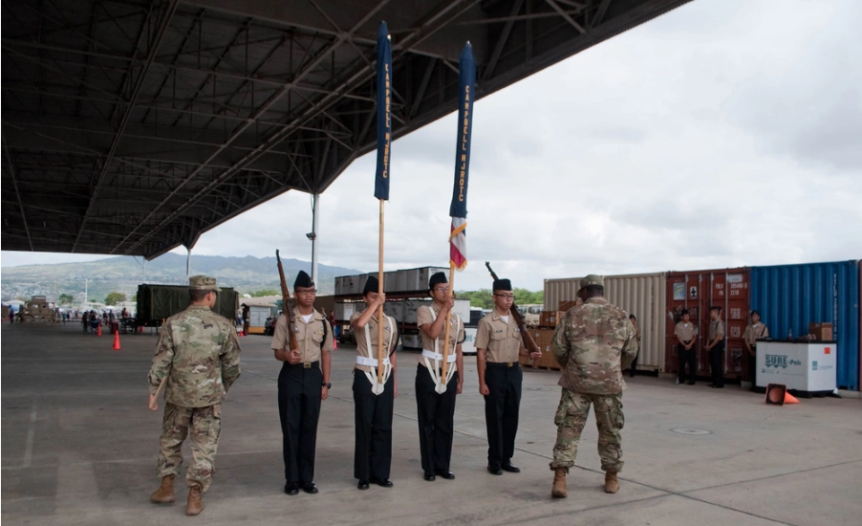
A second version occurs when an experienced Honor Guard member volunteers with JROTC, ROTC, or another cadet organization.
The Honor Guard member may teach a staff position, facing movement, color guard maneuver, weapon position, or command exactly as he has been trained.
To him, it may appear more precise, it may even look better, but that does not make it the correct standard for the cadets.
The governing question is not: Which technique looks best?
The governing question is: Which drill system applies to these personnel performing this function?
The instructor does not determine the drill system. The mission, organization, and governing publication do. That is authority before aesthetics.
Ceremony as Language
This is also an excellent example of Ceremony as Language. Regulation drill and ceremonial drill share ancestry, commands, movements, formations, and visual conventions. They are closely related, but they are not interchangeable.
Think of ceremonial drill as a specialized vocabulary used within a particular institutional setting. An Honor Guard member therefore has to learn something more sophisticated than ceremonial drill itself: he must learn when to stop speaking it.
- When serving with the Base Honor Guard, he uses ceremonial drill.
- When assisting ordinary Airmen with a unit ceremony, he must return to regulation drill.
- When volunteering with cadets, he must teach the drill system governing those cadets rather than importing Honor Guard techniques simply because those techniques are familiar.
In linguistic terms, this is a form of code-switching. Competence means not merely knowing multiple forms of the language, but knowing which form belongs in which context.
Why the Boundary Matters
Once ceremonial drill crosses that boundary, the error can propagate quickly.
An Honor Guard member teaches a cadet. The cadet later becomes a commander and teaches another cadet. An instructor remembers that “the Air Force Honor Guard taught us this.” A competition judge reinforces the technique. Eventually, a ceremonial adaptation can become accepted locally as regulation drill even though the governing publication never prescribed it.
The same process can happen within operational units. That is how institutional languages drift.
The distinction between regulation drill and ceremonial drill therefore cannot exist only inside manuals. Honor Guard personnel must understand the limits of their ceremonial vocabulary and be able to teach the correct system when working outside the Honor Guard mission.
Ceremonial drill is specialized for a reason. Preserving that boundary protects both systems.