
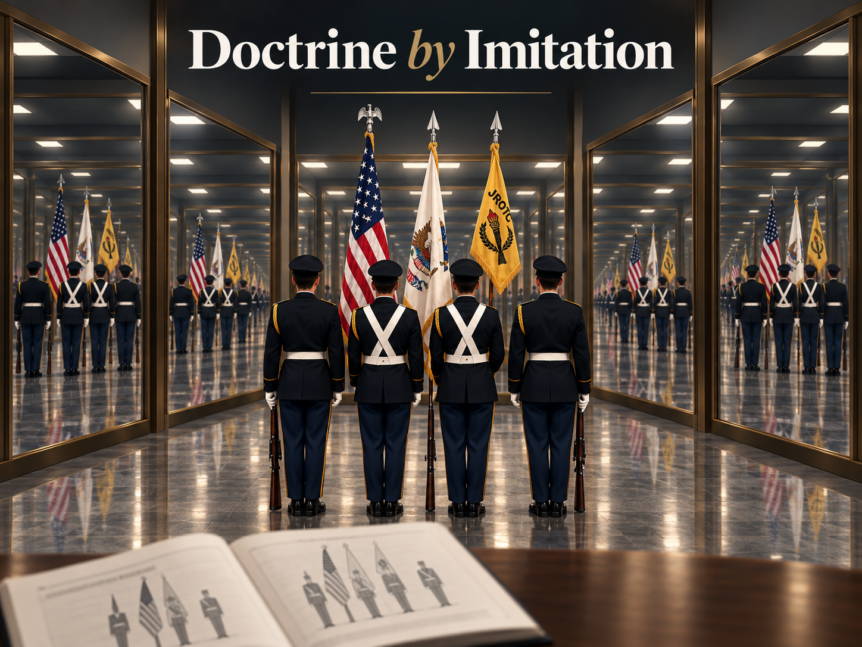
Visibility Creates Apparent Authority. Repetition Creates Perceived Legitimacy. Neither Creates Doctrine.
One of the most persistent problems in military drill and ceremonies is no longer confined to a unit, school, installation, or local community. The internet has changed the way incorrect ceremonial practices spread.
A mistake that once might have remained within one organization can now be photographed or recorded, posted online, viewed by thousands of people, copied by another unit, photographed again, and circulated even farther and on and on it goes.
At some point, this repetition begins to look like authority. Visibility creates apparent authority. Repetition creates perceived legitimacy. Neither creates doctrine. That distinction is becoming increasingly important for JROTC instructors and cadets.
The Internet Is a Training Environment
Whether we intend it or not, photographs and videos of military and military-style ceremonies teach. A cadet sees another color guard carrying a particular combination of flags and thinks, “We can do that.” An instructor sees several units performing the same movement and assumes, “That must be authorized.” A team watches another team place a guidon in a color guard and concludes that a guidon is simply another flag that can be added to the formation.
Nobody opens a regulation, nobody asks where the procedure originated, nobody determines whether the example is regulation drill, exhibition drill, a locally invented practice, or simply an error.
The image itself becomes the authority. That is how a local mistake begins to propagate. The process can be remarkably simple:
incorrect practice → public example → imitation → repeated examples →
perceived legitimacy → local tradition
Eventually, someone asks why the unit performs the procedure that way and receives one of the most dangerous answers in drill and ceremonies: “We’ve always done it this way.” Or: “Everybody does it.” These words do not establish authority, they are excuses.
Uniforms Make the Problem More Powerful
The military and cadet program image carries an additional problem: the appearance of official sanction.
When people see cadets in uniform performing at a football game, parade, ceremony, competition, or community event, they reasonably assume that what they are seeing has been taught and approved. The uniform gives the performance visual credibility. That does not mean the performance is actually correct.
A photograph of four cadets carrying colors can therefore communicate far more than the people posting it intended. If the national Color is improperly positioned, a guidon is being treated as another Color, inappropriate equipment is being used, or an unauthorized formation is being performed, those mistakes become visible examples available for imitation.
One unit sees it. Then another. Then another. A mistake does not become more correct because it has accumulated witnesses.
“Army JROTC Doesn’t Follow Army Drill”
I continue to receive messages from cadets claiming that Army JROTC does not follow Army drill standards. That statement deserves particular attention because U.S. Army Cadet Command has addressed the issue directly.
USACC Regulation 145-2 identifies drill and ceremonies as “one of the key ingredients of the Army JROTC Program” and states: “Drill will be conducted IAW current Army Training Circular 3-21.5, Drill and Ceremonies.”
The regulation then identifies TC 3-21.5 as “the Army standard for executing the Manual of Arms.” USACC Reg 145-2, para. 9-5. The regulation applies to U.S. Army Cadet Command and Army JROTC/NDCC units. Its stated purpose includes providing policy and guidance for the “standardization and execution” of the JROTC program.
TC 3-21.5 itself explains its purpose this way: “TC 3-21.5 provides guidance for Army-wide uniformity in the conduct of drill and ceremonies.” It further states that, to maintain consistency throughout the Army, its prescribed procedures should be followed as closely as possible.
That does not mean JROTC can never have JROTC-specific requirements. It does.
Competition rules provide an obvious example. USACC Regulation 145-2 expressly recognizes exhibition drill conducted under brigade-published standards. A competition SOP may also establish administrative requirements or event-specific procedures. But that is completely different from saying, “JROTC doesn’t follow Army standards.”
An exception requires authority. A competition rule has a source. A program-specific procedure has a source. “I saw another JROTC unit do it” is not a source.
Note: An event SOP may establish procedures for that event, but it does not create general doctrinal authority for those procedures outside the event. Any broader authority must come from the governing regulation, manual, order, or other competent source.
Event-specific permission does not become general authority merely because cadets and instructors repeat it elsewhere. But this happens all the time.
Cadets Are Learning From Other Cadets
This is where inadequate adult instruction becomes especially damaging. Cadets naturally learn from other cadets. They watch performances, exchange videos, attend competitions, follow drill accounts, and study successful teams. There is nothing inherently wrong with that. Observation is an important learning tool. The problem begins when observation replaces verification.
A first-year cadet watches a senior cadet perform a procedure. The senior cadet learned it from the previous commander. That commander learned it from someone who graduated three years earlier. Nobody remembers where it originated. Within a few years, a mistake can acquire a pedigree.
“The seniors taught us that.” This is an ongoing problem and happens for a decade or more and then someone opens up a manual and the discovery of just how “off” the training has become.
“Our instructor has always allowed it.” The authority of one person leads to devotion.
“Other schools do it.” Because something looks good, it is then repeated.
“We did it at competition.” An example is competition guidance that permits a state flag in place of the ROTC institutional color. That instruction governs the competition. It does not establish the state flag as the proper substitute for the institutional color in every other colors presentation.
None answers the fundamental question: What is the authority for the procedure?
That question must become the norm. It should be one of the first things to pop into everyone’s head.
The Instructor Does Not Have to Know Everything
There is another side to this problem that deserves acknowledgment. Retired military personnel do not automatically arrive at JROTC programs as experts in drill and ceremonies. An officer may have done very little marching since commissioning. An NCO may have spent years in highly technical or operational assignments in which drill was almost nonexistent.
Even someone who remembers basic drill well may never have received substantial instruction in color guard, guidon procedures, ceremonial formations, flag protocol, or the differences among service publications. Prior honor guard experience can provide an excellent foundation in discipline, precision, bearing, repetition, and attention to detail, but its direct technical transfer to JROTC drill is extremely limited to nonexistent. Military honor guards operate within specialized ceremonial systems, often using procedures, commands, equipment, and performance conventions that differ substantially from regulation drill and competitive JROTC drill. Experience is definitely a plus, but current education is key.
The problem begins when relevant experience is assumed to equal subject-matter expertise and nobody checks the governing source. Experience as a Drill Sergeant, Drill Instructor, Military Training Instructor, or similar accession-training instructor is valuable, but it should not be mistaken for automatic expertise in the JROTC environment. Those assignments develop command presence, instructional ability, discipline, and familiarity with basic service drill, but competitive JROTC drill is its own specialized arena, with regulation events, color guard, armed and unarmed competition, exhibition drill, event SOPs, and service-specific requirements that may never have been part of an instructor’s military duties.
JROTC also has a fundamentally different educational purpose. It is not basic military training, and its cadets are not recruits being indoctrinated into military service. The instructor’s task is to teach, develop, supervise, and help cadets understand the standards they are applying.
There is nothing shameful about saying: “I don’t know.” The professional obligation begins with what comes next. “I don’t know, so let’s look it up.”
An instructor can sit down with cadets, open TC 3-21.5, study the applicable paragraphs, practice the procedures, identify what they have been doing incorrectly, and learn alongside them. That does not diminish the instructor’s authority. It demonstrates leadership. The problem is not ignorance.
The failure occurs when ignorance is left uncorrected while cadets are given responsibility for the result. Sending cadets outside to “practice color guard” without competent instruction does not develop independence. If they have never been taught the governing standard, they can only reproduce what they already know, what another cadet tells them, or what they find online.
And online is exactly where the multiplication begins.
When the Error Becomes the Lesson
Consider a simple hypothetical example: One JROTC unit places its guidon in its color guard. Someone records the performance and posts it. One hundred people see the video.
Two cadets at another school think the larger formation looks impressive and suggest adding their guidon. Their unit performs it at a parade and pictures from that parade reach several thousand people. Three more schools copy it and those schools create additional photographs and videos. Eventually, a new cadet encounters dozens of examples of guidons being carried as though they were Colors. To that cadet, the question may no longer be, “Is this authorized?”, the evidence is overwhelming, “Everybody does it.” This is how visibility becomes apparent authority.
Then repetition creates perceived legitimacy. Eventually, correcting the practice becomes harder because the person presenting the actual governing publication now appears to be contradicting reality. “But I’ve seen hundreds of color guards do this.” While that may be true, it proves only that hundreds of people did it.
Evidence of Practice Is Not Evidence of Authority
This distinction is fundamental to serious research in drill and ceremonies: A photograph proves that something happened. It does not necessarily prove that it was authorized. The same applies to videos, historical photographs, official social-media accounts, ceremonies conducted by military units, and even practices performed by prestigious organizations. They are all evidence. Sometimes they are extremely useful evidence, but evidence of practice and evidence of authority are different things.
An official photograph can establish that a unit performed a procedure on a particular date. It cannot, by itself, establish the regulation authorizing that procedure. That requires another question: What publication governed the event? This is why serious ceremonial research cannot stop with “I found a picture.” The picture begins the investigation; it does not necessarily end it.
Public Errors Require Public Corrections
There is another consequence of the internet’s multiplying effect. If an incorrect practice is taught publicly, the correction sometimes needs to be public as well. Privately telling one unit that its procedure is incorrect may help that unit. It does nothing for the thousands of people who have already seen the video and may imitate it.
The proper subject of professional criticism is the observable procedure: formation, equipment, terminology, command sequence, flag placement, movement, or governing standard. Especially when minors are involved, appropriate criticism focuses on performance and training rather than personalities. But protecting cadets from personal ridicule cannot mean protecting incorrect practices from examination.
In fact, cadets have the greatest need for competent correction because they are students.
When poorly trained cadets publicly demonstrate incorrect procedures, the first question should not be, “Why would someone point this out?” It should be: How did we allow our cadets to reach a public performance without teaching them this correctly? That moves responsibility where it belongs.
There Is Also a Corrective Multiplication Effect
Fortunately, the internet works in both directions. I began publishing extensively about these subjects online more than a decade ago. At that time, blatant drill, color guard, flag, and ceremonial errors seemed almost constant. I received photographs, videos, and questions continually. Those errors have not disappeared, but I do not see the same volume of fundamental mistakes that I once did.
I cannot assign a percentage of that change to my own work. Better access to publications, other knowledgeable instructors, improved resources, and many other factors undoubtedly contribute. However, I do know that instructors and cadets have repeatedly told me that they changed procedures after reading my articles, watching my videos, or examining the publications I referenced. There is another multiplication process:
incorrect practice → public correction → source verification → improved instruction → correct performance → better public example
And eventually something even better can happen. The cadet does not need me to correct the next photograph. The cadet sees something unusual and asks: “Where is that authorized?” That question is far more valuable than memorizing any single correction.
Teach Cadets to Require Authority
This may be one of the most important skills we can give cadets who study drill and ceremonies. Do not teach them merely to imitate. Teach them to investigate, to think critically.
When they encounter a procedure, they should learn to ask:
- What publication governs this?
- Is this regulation drill, ceremonial drill, or exhibition drill?
- Is this a service standard or a competition-specific rule?
- Is this an authorized exception or merely a local practice?
- Am I looking at evidence that something was done, or evidence that it should be done?
- Can I identify the paragraph, figure, table, order, regulation, training circular, or other authority that establishes it?
That is how we stop institutional folklore from impersonating doctrine. There will always be mistakes. Drill and ceremonies involve thousands of details, and no instructor knows all of them from memory.
The goal is not perfection of memory. The goal is a culture of verification. When someone says, “Everybody does it,” the response should be: “That may tell us what people are doing. Now let’s find out what the standard says.” Because the internet can show us what is popular, what is repeated, and it can even make an incorrect practice look official. But there remains a distinction that every instructor and cadet should understand:
Visibility creates apparent authority.
Repetition creates perceived legitimacy.
Neither creates doctrine.
And the only reliable cure for imitation without authority is to return to the source. If you only remember one idea from this article, let it be this:
Do not eliminate the difficulty. Equip the cadet to meet it.
Comments 2
This article reminds me of a quote from the late Cal Ripken, Sr. (Cal’s dad) He was one of the stewards of “The Oriole Way.” aka baseball excellence from the early 1960’s to mid-1980’s.
“Practice doesn’t make perfect. Perfect practice makes perfect.”
Author
Thank you for your input. He was partly correct, practice, in no way, make perfect. But there is no such thing as “perfect practice”.
In reality, the phrase is more accurately state as Practice Makes Permanent.