
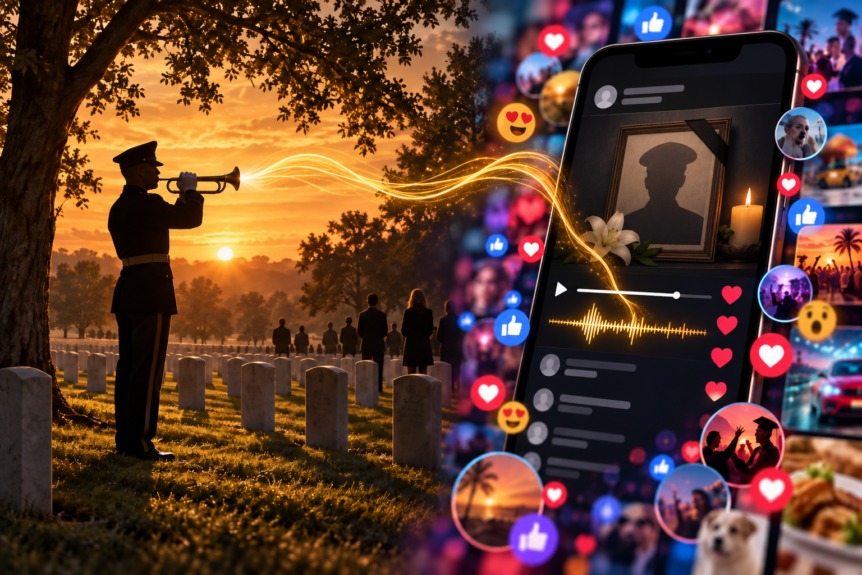
A video shows a wreath-laying ceremony or announces that a member of a service has died. Photographs and video snippets appear in sequence and Taps plays as the soundtrack. The intention is respectful. But the death of a service member or the laying of a wreath does not automatically make Taps the appropriate soundtrack for a video.
The language of putting Taps as background music cheapens the significance of the call.
The Call
Taps is a military bugle call with established ceremonial uses. Federal law requires it as part of military funeral honors for eligible veterans. Departments of the Army and Air Force guidance identifies the end of the military day, funerals, memorial services, and wreath laying ceremonies as occasions for its performance. These sources tell us when and why the call is sounded. They do not expressly address every use of its melody in a produced video.
The Army’s TC 3-21.5, paragraph 14-12, directs people in uniform attending a military funeral in their individual capacity to face the casket and salute while Taps is played. The Army’s Soldier’s Blue Book also identifies Taps as the last call of the day and describes its use at a military funeral. It says there is no need to stand at attention and salute when the nightly call is heard indoors.
The Marine Corps’ Drill and Ceremonies Manual, MCO 5060.20, places Taps at a defined point in unit memorial services. In its outdoor sequence, the commander orders “HONOR THE DEAD,” the formation presents arms, the firing detail fires three volleys, and the bugler sounds Taps. Its indoor sequence places Taps after the final roll call or sounds it without that roll call if the family wishes. These are prescribed actions within a ceremony.
U.S. Navy Regulations, chapter 12, article 1289.6, states that persons in the naval service salute “during the firing of volleys and the sounding of ‘Taps’” at a funeral. Article 1281 specifies a separate commemorative occasion: when a Navy ship passes Washington’s tomb, persons on deck salute as Taps is sounded. That example matters because the Navy does not confine ceremonial Taps to funerals.
The Air Force’s DAFI 90-1201, paragraph 8.2.7, says saluting is not required when Taps signals lights out or quiet hours, but prescribes honors when it is heard during a military ceremony, including a funeral, memorial ceremony, or wreath laying. Its band manual also lists the occasions for performing Taps.
Ceremonial Taps carries a purpose, a place in the sequence,
and associated honors.
The Occasion Determines the Response
At a military funeral or memorial ceremony, service members render honors according to their service’s policy. Under current Air Force guidance, uniformed personnel outdoors salute during Taps; indoors and uncovered, they stand at attention. Nightly Taps has a different purpose: it signals lights out or quiet hours, and Air Force guidance does not require a salute for that use. We should not turn these distinct practices into one universal rule.
A video that records Taps being sounded at a funeral or wreath laying documents what happened. The call remains connected to its occasion, participants, and purpose. Adding Taps later beneath a sequence of photographs is a separate decision. The editor has taken a ceremonial call and made it background music. The audience receives its emotional force without a distinct moment in which the honor is rendered.
This matters especially when an official honor guard or cemetery account publishes the video. Its productions teach the public what ceremonial honors mean. An official post can document a practice without establishing a rule, but repeated use of Taps as a general mourning soundtrack can teach viewers to hear it as a cue for sadness rather than a call sounded for a defined purpose.
The same question applies to The Star-Spangled Banner. Federal law identifies it as the national anthem and describes conduct during its rendition. Military instructions give it a place in ceremonies. A recording of an anthem performance preserves that act; using excerpts beneath a patriotic montage treats the anthem as atmosphere. The two pieces have different histories and rules, but both deserve more deliberate treatment than an ordinary music track.
This is an interpretation drawn from the standards, not a claim that federal law prohibits every video soundtrack. A produced memorial can honor someone without placing Taps under every image or spoken tribute. If Taps is included, give it a clear ceremonial purpose and its own moment. That moment would be the recording of the bugler sounding Taps during the ceremony, not the MP3 version available for making a social media post.
The call should communicate the honor, not simply supply the emotion. Taps is a deliberate call within a sequence of honors. In a video, footage of that sounding documents the honor; adding Taps later beneath narration or photographs/video makes it an editorial soundtrack.
For complete information about the bugle call Taps, Please click here to visit The Taps Bugler.