
A DrillMaster Research Memorandum
Date: April 21, 2026
I. Purpose
This memorandum evaluates the claim that the United States maintains two distinct national flags:
- A so-called “war flag” (the commonly recognized Stars and Stripes, the American flag), and
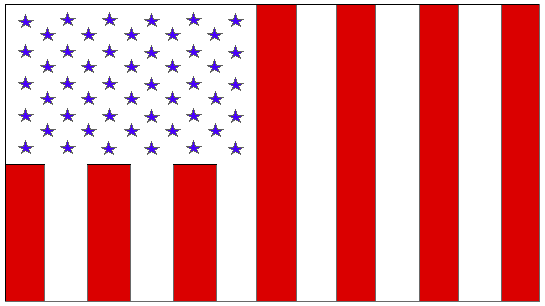
- A purported “peace flag” featuring a white canton with blue stars and either vertical or horizontal stripes.
The objective is to determine whether any such “peace flag” is supported by statutory law, executive authority, military regulation, or historical precedent, and to identify the origin of the claim.
If we have such a flag, we should be able to trace its beginning, origin, and even see its use, even if hidden, throughout our history.
II. Governing Law and Official Flag Definition
The design of the United States flag is explicitly defined in federal law.
- Title 4, United States Code, Section 1 establishes the national flag as consisting of:
- Thirteen horizontal alternating red and white stripes, and
- A blue union bearing white stars representing the states.¹
- Executive Order 10834 (1959) further codifies:
- The proportions of the flag,
- The arrangement of the stars, and
- Detailed construction specifications.²
- Title 4, Section 5 clarifies that for civilian use:
“The flag of the United States for the purpose of this chapter shall be the flag as defined in sections 1 and 2… and Executive Order 10834.”³
Finding:
There is no statutory or executive provision recognizing any alternate national flag for peacetime or civilian use. The law defines one national flag, not parallel “war” and “peace” variants.
We have one flag that represents every American- every single American. You can invent a flag for this or that belief, but that only divides when we should be unified.
III. Absence of a Codified “Peace Flag”
A comprehensive review of:
- Federal statutes (Title 4, U.S. Code),
- Executive orders,
- Military publications (e.g., Army Training Circular 3-21.5, Army Regulation 840-10, Marine Corps Order 5060.20, MCO 10520.3, Air Force Instruction 34-1201, Air Force Pamphlet 34-1203), and
- Historical flag specifications
reveals no reference to:
- A U.S. “peace flag,”
- A white canton with blue stars as a national symbol, or
- Any officially sanctioned vertical-stripe national flag.
Finding:
The “peace flag” described in modern claims has no basis in official doctrine, law, or regulation.
IV. Historical Source of Confusion: The Revenue/Customs Ensign
A historically documented flag exists that partially resembles elements of the claimed “peace flag.”
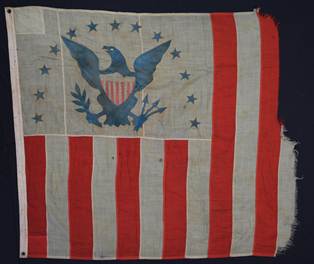
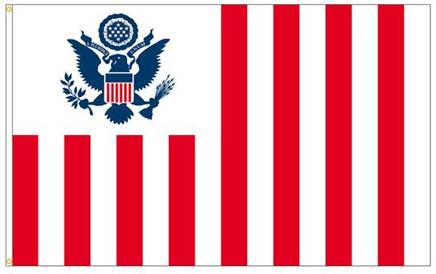
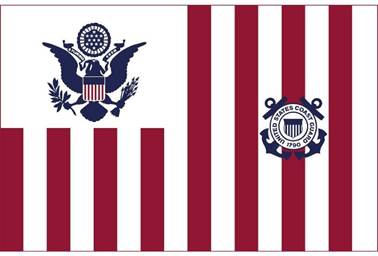
U.S. Revenue Cutter Service/Customs Ensign (1799–Present)

- Established in 1799 under the Treasury Department.⁴
- Features:
- Vertical red and white stripes,
- A white canton,
- A federal emblem (originally the U.S. coat of arms or eagle device).
- Used by:
- The Revenue Cutter Service (predecessor to the U.S. Coast Guard),
- U.S. Customs Houses, including land installations.⁵
Critical Distinction:
This ensign was a government service flag, not a national flag. It identified customs authority, not the United States as a whole. This flag was only flown aboard ship and at Customs Houses, it was and should not be carried.
Finding:
The closest historical analogue to the alleged “peace flag” is the customs ensign, but its purpose and symbolism are entirely different.
V. Literary Misinterpretation
It is my belief that this is where the “Civil Peace Flag” comes from. A commonly cited passage in The Scarlet Letter (1850), describes a customs house flag:
“From the loftiest point of its roof, during precisely three and a half hours of each forenoon, floats or droops, in breeze or calm, the banner of the republic; but with the thirteen stripes turned vertically, instead of horizontally, and thus indicating that a civil, and not a military, post of Uncle Sam’s government is here established.”⁶ (emphasis mine)
This passage has been interpreted by some as evidence of a “civil” or “peace” flag. But, that’s not the case:
- Hawthorne was describing a specific custom house flag, not establishing doctrine. To understand this, you must take the context of his writing and not just assume what does not exist.
- His statement aligns with the known use of the customs ensign (see the images above), not an alternate national flag system.
- The text is literary, not legal or regulatory.
Finding:
This passage is descriptive and contextual, not authoritative. Its use as proof of a national “peace flag” is erroneous.
VI. Modern Variants and Inconsistencies
Modern “civil peace flag” designs exhibit significant variation:

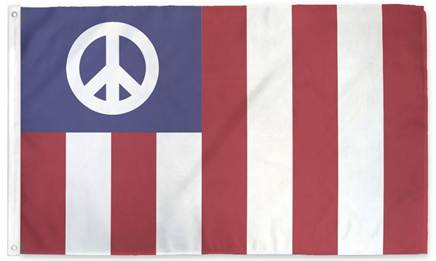
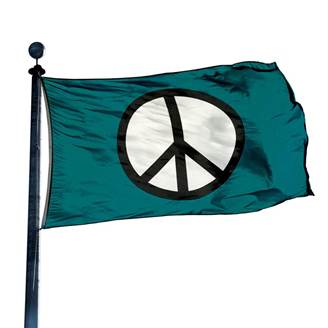
Observed inconsistencies include:
- Vertical vs. horizontal stripes,
- Presence or absence of stars,
- Omission of the federal eagle or coat of arms,
- Non-standard proportions.
Implication:
Authentic flags—especially national flags—are defined with precision and consistency. The variability here indicates non-standardized, modern invention.
Finding:
These designs lack the uniformity expected of any officially sanctioned flag system. But, let me say this: if you want to emphasize peace and flay any one of these flag, I fully support you in doing so. I just do not support the idea that Americans are flying the “wrong flag” when hoisting the Stars and Stripes.
VII. Association with Pseudolegal Narratives
The “peace flag” theory frequently appears in connection with “Title 4 flag” claims, sovereign citizen ideology, and assertions that the United States operates under “martial law” signified by the current flag. See my article on Flag, Fringe, and Finial Theory.
Legal and academic sources have identified such terminology as part of pseudolegal frameworks, not recognized legal doctrine.⁷
Finding:
The theory’s modern propagation is linked to non-credible interpretive systems, rather than established legal or historical scholarship.
VIII. Modern Source Claim: “Civil Flag” in You Know Something is Wrong When…
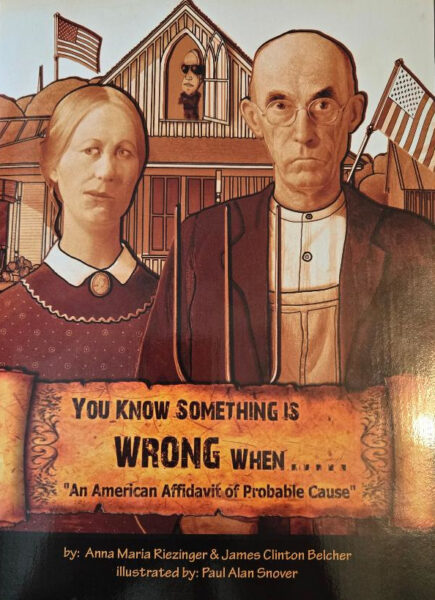
The publication You Know Something is Wrong When… An American Affidavit of Probable Cause asserts the existence of a “Civil Flag of the United States of America Major,” described as a flag with a white canton and vertical red-and-white stripes.
The text specifically instructs that:
- “American State Citizens” are to fly this “Civil Flag,”⁸
- The commonly recognized Stars and Stripes is not the “real flag,”⁹
- The vertical-stripe, white-canton flag represents the legitimate national identity.
However, critical analysis of the publication reveals:
1. Absence of Citations or Primary Authority
The book provides no references to federal statutes, executive orders, military manuals, archival government records, or ANY other documentation to substantiate its claims regarding an official “civil flag.”
2. Terminological Invention
Phrases such as “American State Citizens” and “Civil Flag of the United States Major,” do not appear in recognized legal, constitutional, or regulatory frameworks governing United States citizenship or national symbols.
3. Contradiction of Established Law
The assertions directly conflict with 4 U.S.C. §§ 1–2 (flag definition), and Executive Order 10834 which together define a single, official national flag with horizontal stripes and a blue canton.
4. Alignment with Pseudolegal Interpretations
The structure and claims within the publication are consistent with broader pseudolegal narratives, particularly those associated with sovereign citizen ideology, alternative citizenship theories, and claims of hidden or suppressed governmental structures. These frameworks are widely recognized in legal scholarship as non-credible and unsupported by law.
IX. Analytical Significance
The inclusion of this source is important not because it validates the “civil flag” theory, but because it demonstrates a modern origin point for the claim in published form, a pattern of assertion without documentation, and a divergence from verifiable legal and historical sources.
In research method terms, this publication functions as a secondary artifact of belief, not a primary or authoritative source.
X. Conclusion
The evidence leads to a clear and definitive conclusion:
- There is one legally defined United States flag, established in federal law and executive order.
- No official “peace flag” exists in statute, regulation, or historical national usage.
- The closest historical reference—the customs/revenue ensign—is a service flag, not a national alternative.
- The modern “civil peace flag” concept is a misinterpretation, reinforced by literary misreading and pseudolegal narratives.
The reference to a “Civil Flag” in You Know Something is Wrong When… does not provide evidentiary support for the existence of such a flag. Instead, it reinforces the conclusion that:
- The “civil peace flag” concept is constructed through unsupported assertions,
- It lacks grounding in law, regulation, or historical practice, and
- Its dissemination is tied to modern ideological frameworks rather than documented American vexillology.
Final Determination:
The claim that Americans are flying a “war flag” instead of a “peace flag” is unsupported by law, history, and official practice.
XI. Footnotes
- 4 U.S.C. § 1, Flag; stripes and stars on.
- Executive Order 10834, August 21, 1959.
- 4 U.S.C. § 5, Display and use of flag by civilians; codification of rules and customs.
- U.S. Coast Guard, “Revenue Cutter Service History and Ensign Development.”
- U.S. Customs and Border Protection historical flag usage documentation.
- Nathaniel Hawthorne, The Scarlet Letter, “The Custom-House” introduction (1850).
- University of North Carolina School of Government, Sovereign Citizen Movement Quick Reference Guide.
- Reizinger and Belcher, You Know Something is Wrong When… An American Affidavit of Probable Cause (The American Affidavit Pure Trust, 2014), 41.
- Ibid., 17, 41, 201.
Downloads
ICS DCS 12-300 The “Civil Peace Flag” Claim Authority Interpretation and Practice Analysis
ICS DCS 12-301 Silence Omission Illustration Not Equal Authority
Comments 4
This is a myth. The flag code states that if it looks like the flag of the united states it is the flag of the united states (4USC Ch 1 sec 3 ) The flags at Disneyland and magic kingdom are all 45 star flags- Walt Disney wanted Mainstreet USA to resemble classic American mainstreets at the turn of the 20th century.
THWD! I had never heard of the Civil Peace Flag before and your article was an interesting read! I do have a question about flags/banners. On a recent trip to Disney World, I was informed by my 21 year old grandson that nearly all flags flying above buildings merely look like the US flag but are considered banners. Reasoning behind so that they don’t have to lower them during inclement weather. I thought I recalled a past article that if it appears to be a US flag it must conform to regulations! Just wondering about your opinion. Thank you for all the hard work you do. USAFHG 1970-72.
Author
Hello sir!
THWD, at the BHG level (on my part)! A banner and a flag are essentially the same thing. There is no reasonable expectation to bring down all of those flags on top of the buildings every time there is inclement weather. The same thing goes for the small flags on the 18″, or so, long sticks placed at gravesites (e.g., Flag In). What the Flag Code describes is specific instances where the Flag is displayed on an in-ground pole, a pole on the side of a building, or carried. It does not mention the flags you see at Disney that are at the peak of buildings or other out-of-the-way places.
The dimensions of the flag are public law. You probably read it here!
Thank you for writing, I appreciate it!
This is a myth. The flag code states that if it looks like the flag of the united states it is the flag of the united states (4USC Ch 1 sec 3 ) The flags at Disneyland and magic kingdom are all 45 star flags- Walt Disney wanted Mainstreet USA to resemble classic American mainstreets at the turn of the 20th century.