
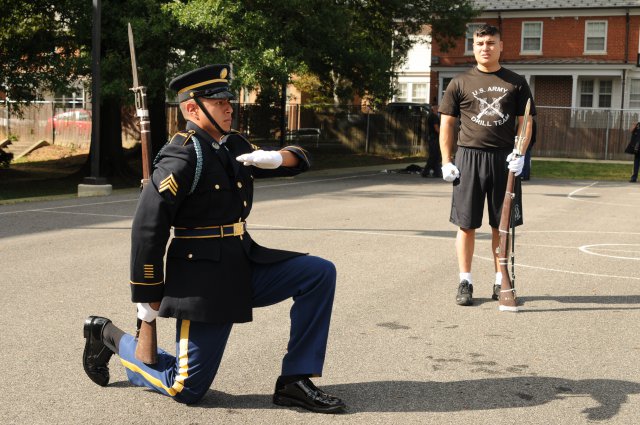
This is a common issue I have seen across cadet programs:
The training looks fine… until the uniform goes on. Then everything falls apart or maybe it just seems “off”.
Pivots get sloppy. Step length changes. Spacing sags and weaves. Timing drifts. Confidence drops.
And the assumption is usually: “We just need more practice.”
No—you need a better training environment.
INSTRUCTOR ACTION
Before your next practice, define:
- What surface are we training on?
- What footwear are we allowing?
- What equipment is integrated today?
- What uniform elements are introduced?
If you can’t answer all four, your training environment is incomplete.
The Problem Isn’t Repetition. It’s Mismatch.
I’ve watched cadets train in: Sandals, slides, Crocks, soft running shoes, and even only on gym floors.
Then they step onto concrete, in full uniform, wearing low quarters—and suddenly nothing works the same way. That’s not a discipline issue. That’s not a motivation issue. That’s a training design failure.
If you don’t train in the conditions you perform in, you are not training—you are approximating.
Four Things Are Always in Play (Whether You Realize It or Not)
Every movement your team executes is shaped by four variables:
1. Condition (Fidelity)
How close is training to performance reality? If your cadets only experience “easy mode” in practice, performance will expose the gap immediately.
2. Surface
Grass, gym floor, asphalt—it matters.
- Gym floors = controlled, forgiving
- Concrete = higher friction, more resistance
- Grass = unstable, inconsistent
Change the surface, you change the movement. Be prepared.
3. Load (Equipment)
Rifles, flags, sabers, even caskets—these are not accessories. They change:
- Balance
- Timing
- Coordination
If you add equipment late, you’re not refining—you’re restarting the learning process.
4. Constraint (Uniform)
The uniform isn’t just for appearance. It restricts:
- Movement
- Ventilation
- Feedback (especially with gloves and headgear)
If your team only wears the uniform right before performance, expect stiffness and inconsistency.
Why a Performance “Randomly” Falls Apart
It’s not random. What you’re seeing is this:
- Training = one environment
- Performance = completely different environment
So the body has to relearn under pressure. Sometimes this isn’t necessarily an issue. For instance, up north, training and practice takes place inside infield houses and gyms because the snow is three feet deep outside and that means your performances will be on the same surface.
That’s why:
- Pivots suddenly stick or over-rotate
- Cadence changes
- Alignment breaks down
The team didn’t regress—they were never trained under the different conditions to begin with.
REALITY CHECK
If your team only performs well:
- In athletic shoes
- On a gym floor
- Without equipment
- Out of uniform
Then your team is not performance-ready.
They are environment-dependent.
What Good Training Actually Looks Like
You don’t jump straight to full uniform—but you also don’t stay in “comfort mode.”
You progress:
Early Training
- Athletic wear
- Stable footwear
- Controlled surface
Focus: learning mechanics
Development
Introduce:
- Equipment
- Partial uniform items
- Especially the cover that has a brim (restricts vision)
- Wear the uniform blouse or an equivalent jacket to simulate restriction*
*This is why the Marines at Marine Barracks Washington wear the old BDU M95 Field Jacket.
Vary surfaces:
- If you know that your team will perform on grass, concrete, and maybe asphalt, make sure you give the team access to each well before the performance
Focus: adapting to real constraints
Rehearsal
- Full uniform
- Performance surface
- Full equipment
Focus: validating execution under real conditions
This Is Doctrine Now
I’ve formalized this into a set of foundational documents through the Institute for Ceremonial Standards.
If you are instructing, coaching, or leading a team, you need these:
- ICS DCS 10-400 – Training Condition Fidelity
- ICS DCS 10-401 – Surface Interaction and Friction
- ICS DCS 10-402 – Load Bearing and Equipment Effects
- ICS DCS 10-403 – Uniform Constraint Effects
- ICS DCS 10-404 – Integrated Training Environment Design
These aren’t suggestions—they explain why teams succeed or fail in performance.
Bottom Line
If your team looks great in practice but inconsistent in performance, don’t just add more reps.
Fix the environment.
Because at the end of the day:
You don’t rise to the level of your practice.
You perform at the level of the conditions you trained in.