
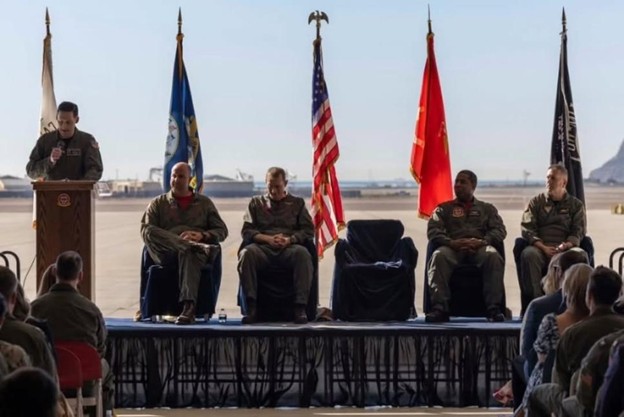
Yesterday’s article had two photos of incorrect Navy Flag displays. This article goes in-depth to explain what the issues are for both.
Image Analysis: The NAS North Island display

- Unauthorized civilian finials
- The CA, USN, and POW flags are topped with conical spear-style finials. These finials are civilian decorative standards and are not authorized for military use.
- In a Navy-only display, all flagstaffs would be required to be topped with the battle-ax finial in accordance with NTP 13(B). The presence of mixed conical finials indicates reliance on a civilian commercial flag set rather than Navy doctrine.
- Improper use of the spread eagle on the U.S. flag
- The U.S. (national) flag is topped with a spread eagle, which in this context is also a civilian convention used to visually elevate the U.S. flag when all other staffs use decorative spear finials.
- While the Navy does authorize the eagle in specific circumstances, that authorization is conditional and situational, not discretionary. The use of the eagle is governed by detailed criteria outlined in NTP 13(B) and is not simply applied at will to emphasize honor.
- USMC finial requirement overrides all others
- The presence of the Marine Corps color imposes an immediate and non-negotiable requirement: all flagstaffs must be topped with the flat, silver spade finial.
- This requirement is mandated by MCO 5060.20.
- Once the USMC color is included, no other finial system is authorized, regardless of service, preference, or aesthetics.
- Equal staff height dictates U.S. flag placement
- All flagstaffs in the display are of equal height. Under Navy doctrine, this requires the US flag to be placed in the position of honor—the far right of the display (viewer’s left)—followed by the remaining flags in proper order of precedence.
- With equal staff heights, placing the U.S. flag in the center is not authorized.
- Even if centering were permitted, the order shown would still be incorrect
- Even if placing the U.S. flag in the center were authorized (it is not under Navy doctrine), the surrounding order in the image would still be wrong.According to NTP 13(B), paragraph 204:
- The first position is immediately to the US flag’s right
- The second position is immediately to the US flag’s left
- Based on the flags present, the correct arrangement around a centered U.S. flag would be:
- To the US flag’s right: CA
- To the US flag’s left: USMC
- To the right of the CA: USN
- To the left of the USMC: POW
- Additionally, the image in NTP 13(B) shows five flags mounted in a single stand with radiating angles, meaning the flagstaffs are not on the same flat vertical plane, further invalidating any argument based on center positioning or equal precedence.
- Even if placing the U.S. flag in the center were authorized (it is not under Navy doctrine), the surrounding order in the image would still be wrong.According to NTP 13(B), paragraph 204:
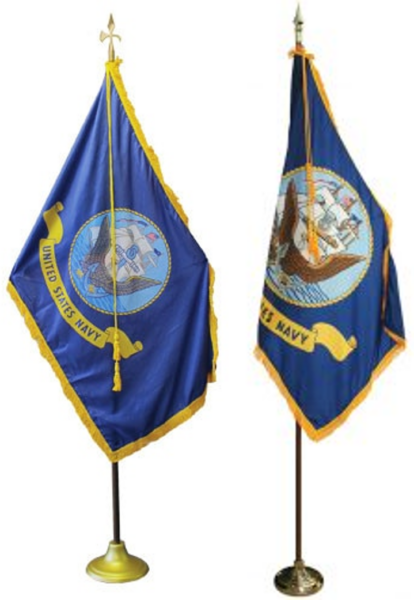
Features
- Single US Navy flag (two separate displays)
- Gold fringe
- Gold cord and tassels
- Battle-ax finial
- Conical spear finial
- Brown, office-style staff
- Weighted decorative base
- Flag spreaders
- No accompanying flags
- No ceremonial context (guard, posting, honors, or event)
Decision Tree Outcome
I will post the Decision Tree at the end of the article.
- Military Display? No
- Ceremonial-Civilian Display? Yes
- Decorative (Purely Décor)? Borderline, but elevated above décor
This display is best classified as a: Ceremonial-Civilian Display using Military Symbolism. It is not doctrinally military, but it is also not casual décor.
Why This Is Not a Military Display
Step 1: Staff System (Fails Military Test)
The brown office-style staff is the decisive factor.
- Originates in civilian/government interior décor
- Not part of Navy ceremonial staff systems
- Designed for permanent static display, not ceremonial use
Once the staff is civilian, the system cannot be military, regardless of finial.
Step 2a: Finial Context (Misapplied Authority)
The battle-ax is a Navy finial—but:
- It is authorized only within a complete Navy ceremonial system
- It is not a decorative accent
- It assumes doctrinal context that is not present here
Placed on a civilian staff, the battle-ax becomes symbolic, not authoritative.
Step 2b. The conical spearhead is a civilian decorative finial
The conical spearhead (often described as Greco-Roman or classical in appearance) is not a Navy-authorized finial. Its use originates in civilian flag display traditions, where it functions as a neutral, decorative terminal rather than a symbol of authority or command.
In Navy practice:
- Finials are service-specific
- Finials are context-dependent
- Finials are regulated, not decorative
The conical spearhead exists almost exclusively in the civilian market and is frequently sold as part of mass-produced “office flag sets.” Its widespread presence in military-adjacent spaces reflects commercial availability, not authorization.
Step 3: Cord and Tassels (Civilian Signal)
Gold cord and tassels are:
- Common in civilian/government indoor displays
- Often sold as part of office flag kits
- Not default or universal in military practice
Their presence here reinforces ceremonial styling, not regulation.
Step 4: Single-Flag Context
A single service flag, indoors, on a permanent stand:
- Is not a posting of the colors
- Is not tied to honors, command presence, or ceremony
This places it squarely in display, not ceremony.
Step 5. Flag spreader use indicates civilian display logic
The flag in this display is supported by a flag spreader, a device designed to force the flag outward into a triangular or fan-shaped presentation. Flag spreaders are civilian display devices, commonly used in offices, courtrooms, and memorial interiors to improve visibility and aesthetic balance.
In Navy ceremonial doctrine, flags are:
- Carried or displayed naturally from the staff
- Allowed to fall according to gravity and construction
- Not mechanically shaped for appearance
The presence of a flag spreader confirms that this display prioritizes visual presentation over doctrinal accuracy, reinforcing its classification as ceremonial-civilian rather than military.
The use of a flag spreader or a conical spearhead is a reliable indicator of a civilian display system, regardless of the flag or finial attached.
Final Classification Statement
Although the battle-ax finial is a Navy ceremonial device, the use of a civilian office-style staff, decorative base, and cord-and-tassel configuration places this display within a ceremonial-civilian framework. Military flag displays are defined by complete, service-specific systems, not individual components. As configured, this display borrows military symbolism without meeting Navy doctrinal standards.
The Decision Tree
Is This Military, Ceremonial-Civilian, or Decorative?
Step 1: What is the staff?
- Ceremonial military staff system → go to Step 2
- Office-style / furniture-grade staff → Not military
- Yes, and matches doctrine → go to Step 3
- Decorative, civilian, or mismatched → Ceremonial-Civilian
Step 3: Is the display part of a military function?
- Color guard, posting, honors, command ceremony → Military
- Static display, office, lobby, courtroom → go to Step 4
Step 4: Are military elements being used symbolically?
- Yes (fringe, cord, finial for appearance) → Ceremonial-Civilian
- No (pure décor, no military logic) → Decorative
A military finial does not make a display military.
The system, context, and authorization do.
Bottom Line: What This Actually Means
Let’s step back and tell the truth plainly—not emotionally, but institutionally. The current state of Navy indoor flag displays is not the result of disregard or disrespect. It is the result of a systemic breakdown.
Over time, fewer people researched:
- Authorized staffs
- Authorized finials
- Situational requirements for display hardware
At the same time, the governing documents that do exist became:
- Increasingly difficult to locate
- Poorly titled for instructional use
- Untaught outside a shrinking ceremonial community
As institutional knowledge faded, so did demand.
How the Supply System Collapsed
Military supply systems respond to requests, not doctrine.
When:
- Units stopped requesting authorized ceremonial hardware
- Commands accepted civilian substitutes without challenge
- Instructors stopped teaching the distinctions
…the supply chain followed suit.
Manufacturers discontinued:
- Modular ceremonial staff systems
- Service-specific finials
- Interchangeable components
and concentrated instead on:
- Civilian office displays
- Decorative flag sets
- One-size-fits-all products that sell reliably
This was not malicious. It was market logic.
The Resulting Problem (And Why It’s So Hard to Fix)
The Navy now faces a difficult and expensive reality:
- Correct equipment is no longer readily available
- Recreating it would require:
- Research
- Contracting
- New tooling
- Justification for extremely low demand
For most commands, the cost—financial and administrative—far outweighs the perceived benefit.
And the uncomfortable truth is this:
Only a very small number of people know this is wrong.
Fewer still care enough to fix it.
That makes systemic correction unlikely.
What I am Is Not Saying
This is not an argument that:
- Displays are disrespectful
- People are negligent
- Units are failing morally
It is an acknowledgment that:
- Doctrine without demand withers
- Standards not taught disappear
- Availability replaces authorization over time
The Navy did not abandon its ceremonial standards; they were quietly priced out of existence by a loss of knowledge, demand, and supply.
Why This Still Matters
This issue matters not because most displays will ever be corrected—but because standards only survive when they are understood.
This section exists to:
- Preserve knowledge that is no longer institutional
- Explain why the standard disappeared
- Give instructors language to describe the problem accurately
- Prevent further erosion through misunderstanding
Military ceremonial doctrine does not disappear all at once. It erodes quietly:
- When equipment is no longer taught
- When availability replaces authorization
- When civilian substitutes go unchallenged
Understanding what is correct allows instructors and commanders to:
- Accurately classify displays as military, ceremonial-civilian, or decorative
- Avoid unintentionally misrepresenting military authority
- Make informed decisions when correct equipment is unavailable
- Teach cadets and junior personnel the difference between tradition and approximation
Even when correction is impractical, clarity is still possible.
This sidebar exists to ensure that:
- Doctrine is not rewritten by vendors
- Aesthetic preference does not replace authorization
- Knowledge is preserved even when practice cannot be
You may not be able to fix the system, but you can prevent misunderstanding by naming what something is—and what it is not.