
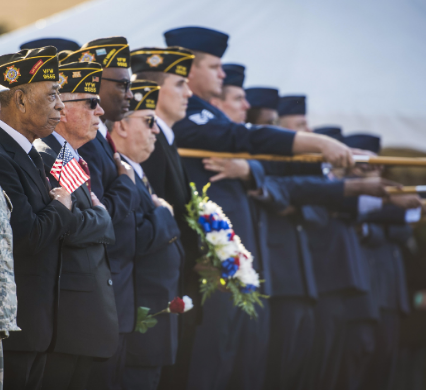
I recently received a message and then several more asking for guidance as a veteran on when to salute. So, here is the information.
1. Military/Veteran Saluting in Civilian Clothes
The Law
U.S. law permits veterans and service members not in uniform to render the hand salute during the national anthem and when the U.S. flag is raised, lowered, or passes in review.
2. Saluting the National Anthem, Taps, the Pledge, and Service Songs
National Anthem
- Outdoors for Anthem: Salute or hand over heart.
- Indoors for Anthem: Stand at Attention (hand over heart).
Taps
Taps is not a saluting moment unless it is:
- Funeral outdoors, salute.
- Funeral indoors, the correct action is attention, no salute.
The Pledge of Allegiance
For Soldiers, there is AR 600-25.
- 2 – 6. Pledge of Allegiance
Soldiers may recite the Pledge of Allegiance as noted below in accordance with Section 4, Title 4, United States Code (4 USC 4)—
a. During military ceremonies, Soldiers will not recite the Pledge of Allegiance.
b. At official functions, social events, and sporting events, Soldiers should—
(1) When in uniform, outdoors, stand at attention, remain silent, face the flag, and render the hand salute.
(2) When in uniform, indoors, stand at attention, remain silent, and face the flag.
(3) When in civilian attire, stand at attention, face the flag with the right hand over the heart and recite the Pledge of Allegiance. Headgear should be removed with the right hand and held over the left shoulder, the hand being over the heart.
NTP 13(B), applies to Naval personnel (Marines, Sailors, and Coast Guardsmen).
- 218. Naval personnel in uniform but uncovered or in civilian clothes shall render the pledge of allegiance to the flag by facing the flag and standing at attention with the right hand over the heart. Personnel in uniform and covered shall render the military salute. The pledge of allegiance is as follows: “I pledge allegiance to the flag of the United States of America and to the Republic for which it stands, one nation under God, indivisible, with liberty and justice for all.”
The following bullet points are an edited quote from Department of the Air Force Instruction (DAFI) 90-1201 (8 October 2024) and applies to Airmen and Guardians. The AFI expands on the information to include veterans.
- 8.2.1.1. Outdoors, when a U.S. flag is displayed, individuals in military uniform, will stand and present the military salute on the first note of the National Anthem (or by command when part of a formation) and maintain that position until the last note of music or command. (T-0) Per the National Defense Authorization Act of 2009, military personnel and veterans, wearing civilian attire, also have the option to render the hand salute from the first to last note of music. Personnel in civilian attire should stand, remove any non-religious headdress, and place their right hand over their heart. When the U.S. flag is not displayed or observed, face toward the music and act in the same manner as if the U.S. flag were visible.
- 8.2.1.2. Indoors, when a U.S. flag is displayed, individuals in military uniform, will stand at attention and maintain that position until the last note of the National Anthem. (T-0) The NDAA of 2009 applies. Personnel in civilian attire should stand, remove any non-religious headdress, and place their right hand over their heart. Sometimes ceremonies are conducted inside areas such as hangars or maintenance bays, that are designated as “outdoor” ceremonies. In this case, announcements or signs should indicate that the ceremony is being conducted as an outdoor ceremony, and the customs of paragraph 8.2.1.1 in this publication apply to official party and guests.
If your meetings have started with the Pledge and it feels like the right thing to do, please continue. If you are in public with a majority of civilians, state it. Just like the Apostle Paul telling Corinthians about eating meat, your group’s tradition of reciting the Pledge embodies the principle of Christian liberty used for community good.
Your group is saying, in effect: “We know we don’t have to do this, but we choose to.” The decision to recite the Pledge isn’t about necessity; it’s about edification (building up the group). It is an act that reinforces shared identity, patriotism, and tradition, helping to foster the unity and sense of purpose that defines the group.
The focus shifts from “What do I need to do?” to “What will help build up this community?” In this case, embracing the tradition strengthens the bond and honors the history of the group, which is a noble and Biblically sound reason for the practice.
Service Songs
Standing for one’s service song is a tradition, not a regulation. Note- service songs should not be played for Memorial Day, Forcing vets and retirees to stand on this day is inappropriate. Correct action:
- Stand at Attention
- There is no saluting tradition associated with service songs.
3. Regarding Parades and Poor Standards
Your frustration is understandable and very common. Two points to keep in mind:
a. Color Guards in Parades
- Stand and salute six paces before and after the color guard passes.
- Most local groups simply do not have formal training.
- Local first responders and JROTC units tend to follow proper manuals.
- Veteran and civic groups often invent procedures or pass down local tradition.
You are correct to step back if something is incorrect, but please don’t let imperfect groups keep you away from your community.
b. Spectator Behavior
Spectators today are not taught flag etiquette. This is cultural ignorance, not disrespect. This is exactly why DrillMaster educational work as well as the work of some others is necessary, not a reason to withdraw. Please don’t withdraw, you are needed.
4. Providing Counsel When You Don’t Feel 100% Confident
You are more informed than you think. The standards are:
- Law: Title 4, U.S. Code, Chapter 1
- Military drill + ceremonies: Army TC 3-21.5, MCO 5060.20, AFPAM 34-1203
Your understanding is already aligned with the official doctrine.
If you help your veteran post—even gently—you’ll likely raise the standard simply by clarifying a few basics:
- No saluting outdoors (unless under arms, guards for a color guard).
- Army, Air Force, and Space Force traditionally salute uncovered and indoors (depending on event factors)
- The Marine Corps, Navy, and Coast Guard salute only when covered (and outdoors).
- Hand over heart indoors.
- No salutes for service songs.
- Proper parade (six paces before and after the colors pass) and funeral procedures.
You don’t need to know everything to guide them in the core fundamentals.
5. Summary
Indoors:
- Stand at Attention, facing forward.
- Hand over heart is appropriate if there are more civilians than veterans (civilians will not understand, it’s best to not offend).
- No salute.
Outdoors:
- Veterans may salute for the Anthem and when the US flag passes.
- Salute for Taps at funerals outdoors.
- Do not salute for service songs or the Pledge.
Parades and Veteran Group Events:
- Follow the standards even if others don’t.
- Your conduct is correct based on US Code and military custom.
Comments 1
The army is different than other services. Whereas the Air Force says airmen SHOULD stand, and the DoNavy does not regulate it other than discussion at balls, such as in 5060-20. Army requires both standing for their and every services song. No regulation towards vets however.
It is humorously also directive telling individuals ( Soldiers?) to sing, which was new in the late 90s, didn’t require prior to that. So it is interesting that the regulation doesn’t just tell Soldiers what to do, it directs individuals, so maybe it does apply to vets, and everyone! The air force, welcomes Airmen to sing, but does not require it.
Army Regulation 600 – 25
Page 7
4 – 4. The Army song
“The Army Goes Rolling Along” is the official song of the U.S. Army. The Army song concludes all reviews, parades,
and honor guard ceremonies. Individuals will stand at attention and sing the lyrics of the Army song when the Army song
is played. Individuals will stand at attention during the playing of official songs of other Services.