

Revision note: This article was substantially revised in August 2026. The original version attempted to provide a comprehensive parade sequence where no single national standard exists. The revised version distinguishes prescribed precedence, derived guidance, and recommended organizing conventions.
Street parades or even a military parade (a pass-in-review, not “pass and review”) is a celebration of a special event like the anniversary of the signing of the Constitution on September 17, 1787, Independence Day, Memorial Day, or Armed Forces Day. There are any number of reasons for a parade and this article will be helpful for parade organizers.
No single federal law, military regulation, or national protocol publication establishes a comprehensive order for every military, foreign, tribal, federal civilian, state, territorial, local, cadet, veteran, public-safety, and private color guard participating in a civilian street parade.
This article therefore distinguishes among:
- Prescribed precedence established by law or official regulation.
- Derived precedence produced by applying an official rule to a comparable circumstance.
- Recommended sequence established by The DrillMaster and the Institute for Ceremonial Standards when controlling authority is silent.
A parade organizer may establish the sequence of entries, but may not direct a participating military or governmental organization to violate its own governing directives.
Separate color guards must remain visibly and operationally distinct. Each must have its own commander, entry number, formation, and normal parade interval. They should not be aligned so closely that spectators reasonably perceive them as one combined formation. The formation occupying the right is in the position of honor; that position does not, by itself, place its commander in command of the other formation.
Read here about the difference between a color guard and a flag display team.

Ability Does Not Create Authority
Military organizations, federal civilian agencies, tribal governments, state agencies, county agencies, and municipal departments operate under different sources and levels of authority. Each answers to its own laws, regulations, directives, policies, and chain of command. A color guard visually represents that governing authority. Similar uniforms, equipment, training, or missions do not make personnel from different authorities interchangeable.
Personnel from different authority levels should not be combined into one color guard merely because they possess the ability to perform together. Ability is not authorization, and participation in the same event does not create a common chain of command. Unless competent authority has expressly authorized a combined formation and established the standard under which it will operate, each organization should remain a separate formation.
Separate color guards can participate in the same parade and demonstrate unity of purpose without creating the false appearance of institutional integration. Cooperation does not require organizational blending.
Joint?
The order of multiple color guards is a broad subject. We will go over information that you may not have considered. Before we continue, I need to ensure everyone is aware that agencies should not mix. That means filling positions in the same formation (i.e., CBP right rifle, US Army US color bearer, local PD bearer, etc.).
- Federal agencies do not mix together (e.g., military and Border Patrol).
- Federal agencies do not mix with state and local agencies.
- State and local agencies can mix, except for military, they remain separate.
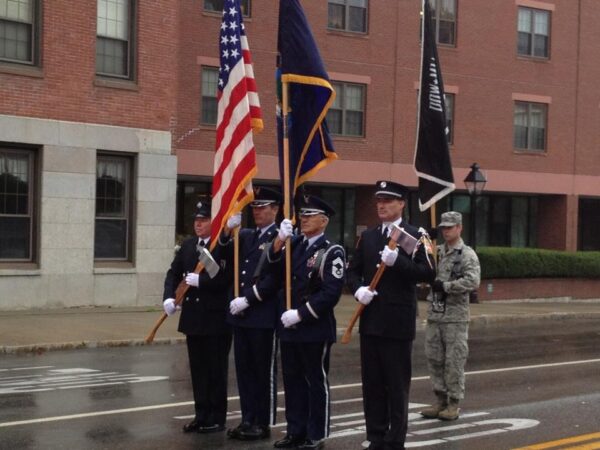
While on the surface this color guard above of Maine Air National Guard Airmen and Bangor Firefighters looks to be the kind of togetherness we all desire, DoD, Army, Marine Corps, and Air Force regulations state military color guards are made up of the members of each branch of military service and that’s it. The military does not mix with any other agency at the federal, state, or local level. Plus, we don’t carry the POW/MIA flag unless its for the funeral of a former POW. Never any other time.
Military and civilian first responders should not be mixed within the same color guard formation.
A color guard is a visual representation of a single chain of command and a single governing authority. Military members represent the Armed Forces under military law and regulations; first responders represent civil authorities under local and state law. Combining them in one formation implies a unified command and status that does not exist. The correct solution is to field separate military and public safety color guards within the same ceremony, each representing its own institution while standing united in purpose.
Joint at the Federal and State Levels
We need to follow that standard at the federal and state levels. Just because someone might wear a uniform in another organization doesn’t mean mixing is authorized.
Read here for the difference between Joint Armed Forces, Joint Service.
Joint at the Local Level
The Joint Agency color guard is very common. This color guard is made up of law enforcement officers, firefighters, and EMS personnel.
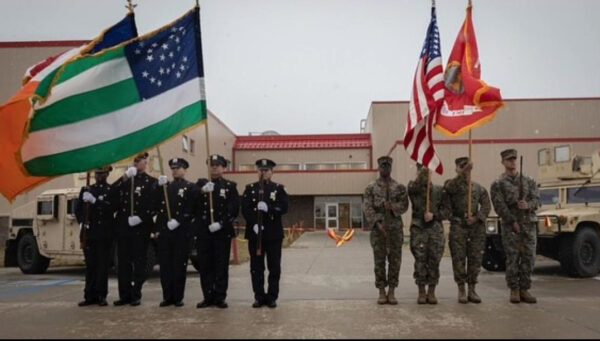
The above photo shows how first responders and military work together – they do it separately. Color guards don’t integrate, that sends a bad message. Precedence: the team on the right can be the one in charge of the ceremony. When both teams are invited the precedence for what team is on the right goes in order: federal, state, county, city.
ICS/DrillMaster recommended sequence when no controlling local policy exists
Tribal Color Guards
On tribal lands: The host tribal government’s protocol and direction control. Unless the tribal authority directs otherwise, the host tribal color guard should occupy the first ceremonial position.
Off tribal lands: No single nationwide rule establishes the precedence of tribal-government color guards relative to state, territorial, or local-government teams. The organizer should consult the participating tribes and avoid classifying tribal nations as state or local agencies. If no agreement exists, the host or honored nation should go first, followed by a neutral method such as alphabetical order by official tribal name.
Federal Agencies First
These are the federal services/agencies that would field a color guard in a parade. Since all are at the federal level, they could be organized in this order.
- Department of Defense/War (War Department, 1789) (AR 600-25)
- US Military Academy cadets
- Naval Academy midshipmen
- Air Force Academy cadets
- Coast Guard Academy cadets
- Merchant Marine Academy midshipmen
- Army (Jun 14, 1775)
- Marine Corps (Nov 10, 1775)
- Navy (Mar 27, 1794)
- Air Force (Sept 18,1947)
- Space Force (Dec 20, 2019)
- Army National Guard*
- Coast Guard
- Army Reserve (April 23, 1908)
- Marine Corps Reserve (August 29, 1916)
- Naval Reserve (March 3, 1915)
- Air National Guard*
- Air Force Reserve (April 14, 1948)
- Coast Guard Reserve
- Other recognized military training organizations, in service order
*Organizers must determine whether the team is participating in federal or state status. State law or state military regulation may control when the team represents the state rather than ARNGUS or ANGUS in federal status.
- Department of the Interior ( March 3, 1849)
- National Parks Service (Aug 25, 1916)
- Fish and Wildlife Service (Jun 30, 1940)
- Department of Justice 1870
- US Marshal Service (Sept 24, 1789)
- Maritime Service (1950)
- US Merchant Marine Service (March 15, 1938)
- Cadets of the Merchant Marine Academy would be the ones who march (see DoD, above).
- US Merchant Marine Service (March 15, 1938)
- Department of Homeland Security (2002)
- Customs and Border Patrol (Jul 31, 1789)
- Coast Guard (before time began, but the actual date is Aug 4, 1790)
- Coast Guard Reserve (February 19, 1941)
- US Secret Service (April 14, 1865)
Military service manuals prescribe military color-guard formations composed and equipped according to military standards. DoDI 5410.19, Volume 4, separately prescribes the Joint Armed Forces Color Guard. No general authority permits a civilian parade organizer to replace or mix-in positions within a military color guard with members of civilian agencies.
Accordingly, military and civilian public-safety personnel participate as separate formations unless a competent authority has expressly established and authorized another arrangement. Participation in the same event does not itself authorize integration into the same formation.
For more on US military joint armed forces order, read here.

Foreign National Teams
AR 600-25, paragraph 4-5, says invited foreign Soldiers receive a position of honor ahead of U.S. Soldiers. If multiple foreign nations participate:
- The nation being honored goes first.
- Otherwise, commanders’ grades may establish the order.
- Alphabetical order in English is a permitted fallback.
That is prescribed for Army-governed parades. For a civilian parade, this is the closest official protocol model, not a universal civil rule.
State Agencies
When multiple states are represented, go in the order of Admission to the Union.
- Army National Guard (Dec 13, 1636)
- Air National Guard (Sept 18, 1947)
- State agencies like Fish and Game/Wildlife
- State Guard Militia
- State Police/Troopers/Highway Patrol, etc.
Tribal Teams Here When Off Tribal Lands
If there is more than one tribe represented, contact the tribes and see what agreement they have between them for precedence. Some go by alphabetical, some by language, and others might use something different. There is no set standard across the country. If no agreement, alphabetical might be a good way to organize the teams.
Territory Teams Here
If more than one US territory would be represented, their order is when the territory was acquired.
Local Agencies Third
County/parish and city first responders. For more on first responder joint service order and how I came to find these dates, please read here.
- Sheriff (1626)
- Police (1751)
- Firefighters (1678)
- EMS (1865)
Cadet Organizations
Order is the same as the parent service.
- ROTC (Harvard 1915)
- ROTC/JROTC (officially created with NDAA 1916)
- Army ROTC
- Navy ROTC
- Air Force ROTC
- Coast Guard ROTC
- Army JROTC
- Marine Corps JROTC
- Navy JROTC
- Air Force JROTC
- Space Force JROTC
- Coast Guard JROTC
- (Claude Pepper Leadership Program 1989, redesignated JROTC 2023)
- Civil Air Patrol (December 1, 1941)
- Military Explorers (1949)
- US Naval Sea Cadet Corps (1958)
- Sea Scouts (1912, under the Coast Guard Auxiliary since 2019)
- Independent Army-based programs
- Independent Marine Corps-based programs
Veteran Organizations
These are the organizations most likely to forma color guard and march.
- Veterans of Foreign Wars (Sept 82, 1899)
- American Legion (March 1919)
- Marine Corps League (Aug 4, 1937)
- Vietnam Veterans of America (1978)
Scout Programs
While names of the organizations may change, the establishment dates are set.
- Boy Scouts (Feb 8, 1910)
- Girl Scouts (1912)
Faith-Based Youth Programs
There are several programs, all might not march. The ones I know of follow:
- Salvation Army Junior Soldiers USA 1880
- United Boys and Girls Brigades of America 1887
- Christian Service Brigade 1937
- Approved Workmen Are Not Ashamed (AWANA, 1950)
- Seventh Day Adventist Pathfinders Club (1950)
- Calvinist Cadet Corps 1952
- Royal Rangers 1961
When Does all of this Actually Matter?
Only when color guards will be one right after the other. If the teams will be spaced out by several other parade entries, then the order doesn’t necessarily apply, unless you, the parade organizer, wants it to apply.
Last doctrinal review: August 18, 2026
Primary authorities: AR 600-25; DoDI 5410.19, Volume 4; applicable service drill-and-ceremonies manuals
Recommended civil-parade conventions developed by: John K. Marshall and DeVaughn Simper, Vexillologist
Comments 4
I have a question as to where a tribal Honor Guard would fit into the order listed above. When the parade occurs on tribal reservation lands, and they are representing their tribal nation, what level of precedence would the tribal Honor Guard receive?
Author
What a great question and DeVaughn and I couldn’t believe that we missed this! I have added information to the article for on and off tribal lands protocol. I hope this answers your question, please let me know if you need more guidance.
Regarding faith based groups, the following can march but are missing from your list:
Salvation Army Junior Soldiers USA 1880
United Boys and Girls Brigades of America 1887
Christian Service Brigade 1937
Calvinist Cadet Corps 1952
Royal Rangers 1961
Author
Mr. Ramos,
Thank you so much for your input! I truly appreciate it. I just couldn’t think of any more organizations, but I knew they are out there.
Adding this right now!