

When Elite Identity Becomes Ego Inflation
A service Honor Guard represents that service at the highest levels of military and governmental ceremony. Its members perform demanding duties in highly visible settings where mistakes can carry consequences far beyond the individual ceremony. The mission requires discipline, precision, endurance, maturity, and a serious understanding of ceremonial responsibility.
That distinguished mission naturally creates institutional pride. It should.
However, pride in an institution can become unhealthy when the institution’s reputation is transferred automatically to each new member as a declaration of personal superiority. This is especially possible when young trainees are recruited during Basic Military Training or Boot Camp, placed on a special assignment track, and sent directly to the service’s Honor Guard in Washington DC before they have accumulated much experience elsewhere in their service.
If they are repeatedly told that they are “the best of the best,” what exactly are they being taught? Are they being challenged to meet an exceptional standard, or are they being assured that selection has already made them exceptional?
That distinction matters.
Links
Listen to this article as a discussion in a DrillMaster Deep Dive podcast (yesterday at 5am ET) and watch an explanation on a DrillMaster DeepDive Explainer Video (Thursdays at 5am).
Study the Institute For Ceremonial Standards Publication, ICS Pub 03-101 Ceremonial Identity Formation Stewardship-Centered Training. and download the Training Tool: ICS Form 03-101-01, Ceremonial Identity Training Audit.
Selection Is Not Mastery
Recruiters must fill authorized positions. They identify trainees who appear to possess the physical characteristics, bearing, attitude, aptitude, and trainability necessary for the mission. The selection process may be demanding, and not everyone will qualify. Nevertheless, selection establishes potential. It does not establish mastery.
A new selectee has not yet demonstrated years of ceremonial expertise, leadership, judgment, humility, or sustained professional excellence. The he has been given an opportunity to begin developing those qualities.
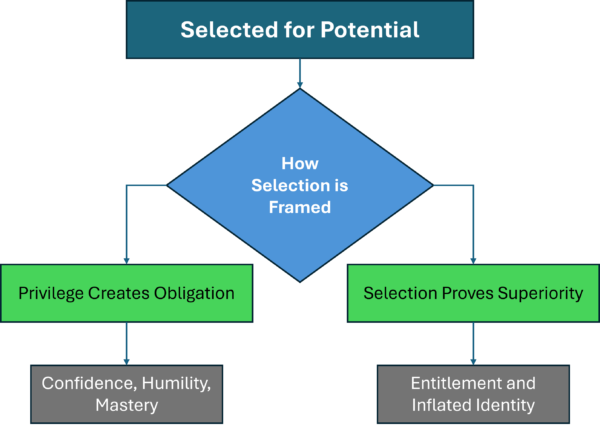
The healthiest message is therefore not: You were selected because you are already the best.
It is: You were selected because you appear capable of meeting an unusually demanding standard.
The first statement confers status. The second assigns responsibility. The difference may appear small, but it can influence how the trainee understands the assignment, other trainees, outside instruction, correction, and personal accountability.
Premature Elite Identity
The process can be described as premature elite identity formation.
The individual receives the identity of an elite professional before earning the knowledge, judgment, and sustained record that should support it. The trainee learns to say, “I am one of the best,” before developing a mature understanding of what excellence requires.
Repeated often enough, institutional praise may become personal self-assessment.
- The one selected may begin with: I have been selected for a prestigious organization.
- That can gradually become: I belong to the premier organization, so I must be a premier ceremonial professional.
- It may eventually become: Because I am a member of this organization, my judgment is better than the judgment of those outside it.
At that point, institutional pride has become borrowed status. The individual is treating the organization’s accumulated reputation as if it were a personal accomplishment.
The Honor Guard’s reputation was built over decades by generations of ceremonial guardsmen. A new member inherits responsibility for protecting that reputation. The new member does not immediately inherit personal ownership of every achievement that created it.
The process may be understood as Elite-Identity Foreclosure: the premature adoption of an elite professional identity before the individual has acquired the experience, demonstrated mastery, or critical perspective necessary to evaluate and earn that identity. This is based on James Marcia’s identity-status model, foreclosure occurs when a person adopts and commits to an identity without adequately exploring alternatives or critically examining it. The identity is often supplied by parents, authority figures, culture, or an institution.
The problem is not merely that the identity arrives early. It is that it arrives prepackaged and institutionally validated. The individual may not yet have served in another operational setting, compared different ceremonial systems, encountered substantial external expertise, or developed enough professional independence to distinguish among:
- the organization’s prestige;
- the member’s potential;
- the member’s actual competence; and
- the member’s personal worth.
Foreclosure also helps explain why later correction may provoke defensiveness (this is classic). If “Service Honor Guard—best of the best” has become central to the individual’s identity, a challenge to a practice can feel like a challenge to the person:
If our method may be wrong, perhaps my organization is not infallible. If my organization is not infallible, what does that mean about the elite identity it gave me?
That is where ordinary doctrinal disagreement can become identity-protective behavior.
When “Elite” Contradicts Service Before Self
I will get service specific for a moment with my service as an example. The ego-centered direction of premature elite identity directly contradicts one of the Air Force’s core values: Service Before Self.
“Service Before Self” requires the Airman to subordinate personal recognition, comfort, status, and ambition to the needs of the mission. The Honor Guard assignment should be one of the clearest expressions of that value. The ceremonial guardsman stands in public view, but the ceremony is not about the guardsman. The member’s visibility exists to direct honor toward the Nation, the Air Force, the colors, the office, the event, or the deceased—not toward the individual performing the ceremony.
Ego inflation reverses that direction. Instead of asking: How can I serve this mission faithfully? the member begins to ask, even if only implicitly: What does this prestigious assignment say about me?
The institution’s reputation then becomes a source of personal status. The uniform becomes evidence of superiority. Public visibility becomes personal recognition. Correction becomes an insult. Other Airmen and ceremonial units become people against whom the member measures importance.
That is not Service Before Self. It is service used to elevate self.
The contradiction can be expressed simply:
- Service Before Self: I subordinate myself to the mission.
- Inflated elite identity: I use the mission to elevate myself.
- Service Before Self: The organization’s reputation increases my obligation.
- Inflated elite identity: The organization’s reputation increases my status.
- Service Before Self: Correction helps me protect the standard.
- Inflated elite identity: Correction threatens my superior identity.
- Service Before Self: My performance directs attention toward whom or what is being honored.
- Inflated elite identity: My performance directs attention toward me.
The Honor Guard’s prestige should therefore increase humility, not reduce it. The greater the visibility of the assignment, the more carefully the member must resist making the mission a platform for personal importance.
This does not mean ceremonial guardsmen should lack confidence or pride. They should take pride in serving the mission and develop the confidence necessary to perform under extraordinary scrutiny. But pride and confidence must remain subordinate to service.
A ceremonial guardsman may be the most visible person in the setting while being the least important subject of the ceremony.
That is one of the central disciplines of ceremonial service: to perform with exceptional presence without making oneself the center of attention.
The uniform is not a crown. The assignment is not a declaration of personal greatness. Institutional prestige is not a personal possession. Each is held temporarily in trust and must be used in service to something greater than the individual.
The proper result of being told that the Honor Guard represents the highest standards should therefore be:
Because this mission is greater than I am, more is required of me.
It should never become:
Because I serve in this mission, I am greater than others.
The first is Service Before Self. The second is self-elevated through service.
Ego Inflation Contradicts the USAF Honor Guard Charge
The ego pathway also contradicts the Honor Guard Charge—not merely one sentence within it, but the Charge as a whole.
That contradiction is especially significant because the Charge is not an outside criticism imposed upon the Honor Guard. It is the organization’s own statement of what a ceremonial guardsman is supposed to be. It is recited daily, committed to memory, and used to shape the member’s professional identity.
The Charge begins:
“Handpicked to serve as a member of the United States/(X*)Base Air Force Honor Guard…”
*X = identification of that base.
“Handpicked” is powerful language. If isolated from the rest of the Charge, it can feed a sense of personal exceptionalism:
I was selected because I am better than others. But “handpicked” does not stand alone. The member is handpicked to serve. Selection is immediately connected to service and obligation—not superiority. Every succeeding part of the Charge redirects attention away from the self.
“My standards of conduct and level of professionalism must be above reproach…”
The Charge does not say that the newly selected Airman’s conduct and professionalism are already above reproach. It says that they must be above reproach.
That is a requirement, not a compliment. The distinction is essential: You are not above others because you were selected. More is required of you because you were selected. The ego pathway converts a demanded standard into an accomplished status. It changes “I must become worthy of this responsibility” into “My selection proves that I am already exceptional.”
“…for I represent all others in my service.”
The ceremonial guardsman does not stand before the public primarily as an individual. The member represents other Airmen.
That representational responsibility should suppress ego, not inflate it. The guardsman’s visibility belongs to the Air Force. The ceremonial uniform does not create a platform for personal distinction; it makes the individual responsible for communicating the professionalism and dignity of the entire service.
The ego pathway reverses that relationship. Instead of using the self to represent the Air Force, the individual begins using the Air Force Honor Guard’s reputation to enhance the self.
“Others earned the right for me to wear the ceremonial uniform…”
This may be the Charge’s clearest rejection of personal entitlement. The present member did not create the uniform’s meaning, establish the organization’s history, or personally earn all the respect attached to it. Others built that inheritance. The uniform therefore represents a trust received from predecessors. It is not evidence that the newest wearer has already equaled their accomplishments.
Prestige transfer says: I wear this uniform; therefore, its reputation belongs to me.
The Charge says: Others earned the right for me to wear it. That should produce gratitude, humility, and stewardship. It should never produce a sense of ownership over institutional prestige.
“I will honor their memory by wearing it properly and proudly.”
Even the member’s pride is directed outward. The uniform is worn proudly to honor those who came before—not to announce the wearer’s personal greatness. This is healthy institutional pride. It recognizes that the individual has entered something larger and older than the self.
Ego inflation changes the purpose of the uniform. Instead of asking how its proper wear honors predecessors and represents the service, the member begins treating it as visible proof of elite personal status.
“Never will I allow my performance to be dictated by the type of ceremony, severity of the temperature, or size of the crowd.”
This sentence rejects performance for applause, visibility, or personal reward.
The standard does not change when the audience is small, when the ceremony appears unimportant, or when no senior leader is present. The guardsman performs faithfully because the duty itself warrants faithful performance. That is Service Before Self in ceremonial form.
An ego-centered performer is energized by attention, prestige, important audiences, and visible assignments. The Charge requires consistent service when those rewards are absent.
The ceremony involving an unknown veteran and a small family deserves the same commitment as the ceremony involving national leaders and television cameras. The guardsman’s motivation must come from duty—not from the amount of recognition available.
“I will remain superbly conditioned to perfect all movements throughout every drill and ceremony.”
The Charge requires continuing preparation. It does not declare that membership has already produced perfection.
“Remain superbly conditioned” requires repeated effort. “To perfect all movements” describes an ongoing professional pursuit. Neither permits the ceremonial guardsman to substitute affiliation for competence.
The ego pathway says: Because I belong to the premier organization, my performance must be premier.
The Charge says: Because of the mission entrusted to me, I must continually condition and prepare myself to perform properly.
One assumes excellence through identity. The other demands excellence through disciplined work.
“Obligated by my oath…”
The ceremonial guardsman is not self-authorizing and does not serve merely by personal preference. The member is obligated by an oath.
An oath places the individual under authority. It is fundamentally incompatible with the idea that personal prestige, institutional reputation, or internal custom places the member above correction or controlling standards.
The oath does not obligate the Air Force to affirm the member’s elite identity. It obligates the member to serve faithfully.
“…constantly driven to excel by a deep devotion to duty and a strong sense of dedication.”
The Charge identifies the proper motivation for excellence: devotion to duty and dedication.
It does not identify superiority, praise, organizational status, public admiration, or comparison with other Airmen as proper sources of motivation. The member should strive for excellence because the duty deserves excellence.
Ego inflation alters that motivation. Excellence becomes a way to maintain an elite self-image, protect status, defeat comparison, or secure recognition. The outward performance may initially look similar, but its moral direction is different.
Dedication asks: What does the duty require?
Ego asks: What does my performance prove about me?
“Representing every member, past and present, of the United States Air Force…”
The final portion of the Charge again places the ceremonial guardsman in a representative role.
The member does not stand only for the Honor Guard, much less for the self. The member stands for every Airman, past and present—including those who never wore the ceremonial uniform, never served in a highly visible assignment, and never received the distinction associated with being “handpicked.”
It would be a profound contradiction to claim superiority over the very Airmen one has vowed to represent. The ceremonial guardsman cannot faithfully represent all Airmen while treating ordinary Airmen as a lesser class against whom Honor Guard status is measured.
“…I vow to stand sharp, crisp, and motionless, for I am a ceremonial guardsman.”
The identity of “ceremonial guardsman” is presented as a vow expressed through conduct. The Charge does not end: I am a ceremonial guardsman; therefore, I am superior.
It ends by connecting identity with disciplined action. The title carries a behavioral obligation. The member must repeatedly make the identity true through performance, conduct, devotion, and representation both on and off duty, in-person and online. The title is not the achievement. It is the promise.
The Charge Must Be Taught as a Whole
The entire Charge moves in one consistent direction:
- selection toward service;
- prestige toward responsibility;
- visibility toward representation;
- inheritance toward stewardship;
- pride toward remembrance;
- performance toward consistency;
- identity toward obligation; and
- excellence toward duty.
Ego inflation moves in the opposite direction:
- selection becomes superiority;
- prestige becomes personal status;
- visibility becomes attention;
- inheritance becomes entitlement;
- pride becomes self-importance;
- performance becomes display;
- identity becomes rank over others; and
- excellence becomes proof of personal greatness.
The danger may begin when “handpicked” is emphasized more strongly than “to serve.”
If trainees repeatedly hear that they are the “best of the best” while reciting the Honor Guard Charge, they may be receiving two competing identity messages. One tells them that selection elevates them above other Airmen. The other tells them that selection obligates them to represent those Airmen with humility, consistency, and devotion.
The Charge itself resolves the conflict. A ceremonial guardsman is not handpicked to be placed above others. A ceremonial guardsman is handpicked to serve and represent others. The Charge is not a celebration of the self. It is a daily renunciation of self-centered service.
Ego Inflation Is Not the Same as Confidence
Confidence is necessary in ceremonial work. A ceremonial guardsman must execute movement decisively, remain composed under scrutiny, recover professionally when something goes wrong, and perform without constant reassurance.
Confidence says: I have trained for this duty, and I am prepared to perform it correctly.
Ego inflation says: My position proves that I am exceptional, and my affiliation makes my judgment authoritative.
Confidence is grounded in preparation. Ego inflation is grounded in identity. Confidence remains open to correction because it understands that competence can always be improved. Ego resists correction because criticism threatens the identity on which the individual’s status depends.
A confident guardsman can say, “I was wrong. Show me the controlling standard.”
An ego-inflated guardsman may say, “This is how my service’s Honor Guard does it,” as though affiliation by itself settles every doctrinal question.
That is especially dangerous in drill and ceremonies. The prestige of an organization does not transform an unsupported practice into doctrine. Authority still comes from controlling law, policy, regulation, manuals, orders, and properly established organizational standards.
Authority must remain before aesthetics, reputation, and institutional preference.
Different People Will Receive the Message Differently
Not every trainee who hears “best of the best” will develop an inflated ego. Individuals interpret institutional language through their existing maturity, character, experience, and need for approval.
A grounded individual may hear the phrase as an aspiration: Much is expected of me. I must work to become worthy of this assignment. Another may hear it as confirmation of superiority: I was chosen because I am already better than others. The first interpretation encourages discipline and humility. The second can produce entitlement.
This is not necessarily a matter of someone having a “weak constitution.” That expression does not quite identify the issue. The vulnerability may involve immaturity, insecurity, undeveloped critical thinking, an excessive dependence on group approval, or simply a lack of experience against which to test the claim.
That should not be surprising. Many recruits are young, newly separated from their previous lives, and only beginning to construct their military identities. Basic Military Training is intentionally transformative. If a prestigious organization enters during that period and gives an person an unusually elevated identity, that identity can become powerful very quickly.
Institutional leaders must therefore take responsibility for how the message is framed. They cannot assume that every young trainee will automatically translate superlative praise into humble obligation.
The Selection Effect
Being selected from a larger group naturally feels meaningful. One may reasonably conclude, “They saw something in me.”
That may be true. Recruiters may recognize potential, presence, discipline, physical suitability, or the ability to learn. However, the service is also filling positions required to accomplish a mission. Selection is both personal and administrative. The opportunity must be valued without turning it into a mythology of personal greatness.
In plain terms, authorized positions exist, and qualified people must fill them. Every organization needs capable human beings assigned to its positions. The prestige of the mission does not change that administrative reality.
This is the useful truth behind the phrase “bodies in positions,” although that phrase should be handled carefully. Ceremonial guardsmen are not merely interchangeable objects. Each one is a Soldier, Marine, Sailor, Airman, Guardian, or Coastguardsman with individual dignity, potential, and responsibility. At the same time, no member should mistake being placed into a required position for proof of extraordinary personal superiority. A billet can be prestigious. Occupying it does not automatically make its occupant exceptional.
Prestige Transfer
Prestige transfer occurs when the reputation of the organization becomes attached to the individual without sufficient distinction between institutional achievement and personal achievement.
The 3rd Infantry Regiment, Marine Barracks Washington, Navy Ceremonial Guard, Air Force Honor Guard, Space Force Honor Guard, and the Coast Guard Ceremonial Honor Guard are each service’s premier ceremonial organization. A new ceremonial guardsman may therefore begin to reason:
The Honor Guard is the premier organization.
I am in the Honor Guard.
Therefore, I am a premier ceremonial authority.
The conclusion does not necessarily follow, a non sequitur. The individual may be serving within the premier organization while still being inexperienced, incomplete in training, mistaken about a procedure, or unfamiliar with the larger body of governing doctrine.
Organizational membership can provide access to outstanding instruction and experience. It can place a person in an environment where mastery is possible. It does not eliminate the need to earn that mastery.
The uniform identifies the member’s assignment. It does not certify the infallibility of the person wearing it.
The Closed-Group Problem
Elite organizations often develop strong internal cultures. Shared hardship, exacting standards, distinctive duties, and organizational traditions strengthen cohesion. This can be beneficial when it produces trust, consistency, and mutual accountability. It becomes hazardous when the group’s internal reputation is used to dismiss outside knowledge.
If members hear only that their organization is the best, they may stop asking whether their practice is authorized, current, safe, or doctrinally sound. Internal repetition can make a claim feel true even when the claim has not been tested against controlling authority.
A closed prestige system can teach members to evaluate information according to its source rather than its substance: If it came from us, it must be correct. If it came from outside, it cannot be as good.
That attitude prevents professional growth. No organization possesses all ceremonial knowledge. Service honor guards, installation honor guards, joint-service units, ceremonial organizations, instructors, historians, medical professionals, and specialists in flags, protocol, training science, and human performance may each hold relevant knowledge. A premier organization should be confident enough to examine outside information on its merits.
The Cost of Inflated Identity
An inflated elite identity can affect far more than personality. It can influence training, safety, doctrine, and institutional credibility.
The affected member may:
- resist correction from someone perceived as lower in status;
- treat organizational custom as controlling authority;
- dismiss external expertise without evaluating its evidence;
- confuse visual sharpness with ceremonial correctness;
- protect institutional reputation rather than acknowledge an error;
- imitate inherited practices without understanding their origin;
- use affiliation as a substitute for explanation;
- regard other Airmen or honor guards as inherently inferior; and
- pass the same inflated identity to the next generation of trainees.
Eventually, the organization may become skilled at reproducing its own confidence without being equally skilled at examining its assumptions.
That is not excellence. It is institutional self-confirmation.
“Best of the Best” Creates the Wrong Comparison
The phrase “best of the best” defines excellence by comparison with other people. It implies that the selected individual occupies a higher human or professional category than other Airmen.
But an Honor Guard member does not need to believe that other Airmen are lesser in order to understand that ceremonial duty demands more from the member in certain areas.
A maintainer, defender, medic, pilot, cyber specialist, personnelist, or services individual may possess expertise that the ceremonial guardsman does not. The Honor Guard assignment creates specialized responsibility, not universal superiority.
The more appropriate comparison is not between the ceremonial guardsman and other Airmen. It is between the guardsman’s present performance and the standard required by the mission.
The essential question is not: Am I better than they are?
It is: Am I meeting the standard entrusted to me?
That question encourages continuous development because the standard remains above the individual. “Best of the best” can suggest that the individual has already arrived.
Pride Should Point Outward; Humility Should Point Inward
Healthy institutional pride directs attention toward the mission: This organization represents the Air Force, and I must protect its credibility. Unhealthy pride directs attention toward the individual: This organization is prestigious, so others should recognize me as prestigious. The first produces stewardship. The second demands recognition.
Ceremonial service should be especially resistant to personal glorification because the guardsman is rarely the subject of the ceremony. The guardsman exists to communicate honor on behalf of the institution.
At a funeral, the family should remember the honor rendered to the deceased, not the self-importance of the ceremonial team. During a colors presentation, attention should be directed toward the colors and what they represent, not toward performers seeking admiration for their bearing or technique.
The ceremonial guardsman must be highly visible while remaining personally secondary. That combination requires humility.
An Elite Standard Without Elitism
The answer is not to eliminate pride, prestige, or demanding language. The mission deserves all three. The answer is to connect them consistently to obligation.
Training language could emphasize:
- You have been selected for potential, not declared superior.
- The reputation of this organization is held in trust. It is not your personal property.
- Your assignment gives you responsibility, not immunity from correction.
- Precision is expected, but precision does not replace doctrinal authority.
- You are here to represent the Air Force, not to elevate yourself above it.
Membership begins your obligation to learn. It does not complete your professional development. The standard is elite. That does not require the member to become an elitist. Such language can build confidence without manufacturing superiority.
Selection Grants an Opportunity and an Obligation
Each service Honor Guard should recruit capable members, develop a strong identity, maintain exacting standards, and remind its members that they serve in an exceptional assignment, but the message must remain properly ordered.
- Selection identifies potential.
- Training develops ability.
- Experience deepens judgment.
- Correction protects the standard.
- Humility preserves the mission.
- Consistent conduct earns professional respect.
The institution may be premier from the day a new member arrives, but that individual is still a trainee. No ceremonial guardsman becomes “the best” merely by receiving an assignment, wearing a distinctive uniform, or repeating the organization’s reputation. Excellence must be demonstrated through faithful service, sound judgment, doctrinal accuracy, disciplined performance, teachability, and humility.
The most useful message for a newly selected member may therefore be this:
You were not selected because you have already become the best. You were selected because someone recognized the potential for you to meet an unusually demanding standard. The assignment is not a crown. It is a responsibility.
The reputation you are entering was built by others, and your task is to preserve and strengthen it through disciplined, humble, and faithful service. That understanding does not weaken an elite organization. It is what keeps an elite organization worthy of the name.