
Honor the Fire Service Without Rewriting the Color Guard Standard
Every year as September 11 approaches, military installations and civilian public-safety agencies begin planning Patriot Day and 9/11 remembrance ceremonies. Firefighters understandably want the fire axe represented. It is immediately recognizable, historically meaningful, and visually communicates the fire service in a way few other objects can.
That creates a recurring question for military color guards: Can the rifle guards simply carry fire axes instead?
For an Air Force color guard, I cannot find published authority that says they can. That does not mean the axe cannot or should not be used in the ceremony. It means we need to put it in the correct ceremonial role.
Authority Note: This article was written to fully answer an Air Force SSgt’s question. The same principle applies for all branches.
What the Air Force Publication Actually Says
AFPAM 34-1203, Drill and Ceremonies, paragraph 7.32.1.2, states that the flagbearers are unarmed and that the guards are armed with “rifles or revolvers.” The paragraph does not identify the fire axe as an alternative color guard weapon.
The same goes for TC 3-21.5 and MCO 5060.20.
The Air Force Honor Guard Career Field Education and Training Plan reinforces the distinction. Its Colors training includes Air Force drill with the rifle—Port Arms, Present Arms, and related movements. The heraldry section of the same publication even identifies the crossed rifles on the Honor Guard badge as representing the Honor Guard’s primary weapon.
There is an important qualification. AFPAM 34-1203 says that it cannot cover every unusual ceremonial situation and that good judgment, applied while considering the purpose of the movement or procedure, can often provide a solution. It also assigns installation commanders responsibility for developing operational guidance to implement drill and ceremony policy.
That gives us room to solve unusual ceremonial problems but it does not automatically give us authority to replace a prescribed piece of color guard equipment with something else. The images in manuals also matter- rifles are shown in each color guard photo. There is a difference between adapting a ceremony and rewriting the color guard.
Has the Air Force Has Used Fire Axes Ceremonially?
Absolutely. There are several official Air Force examples.
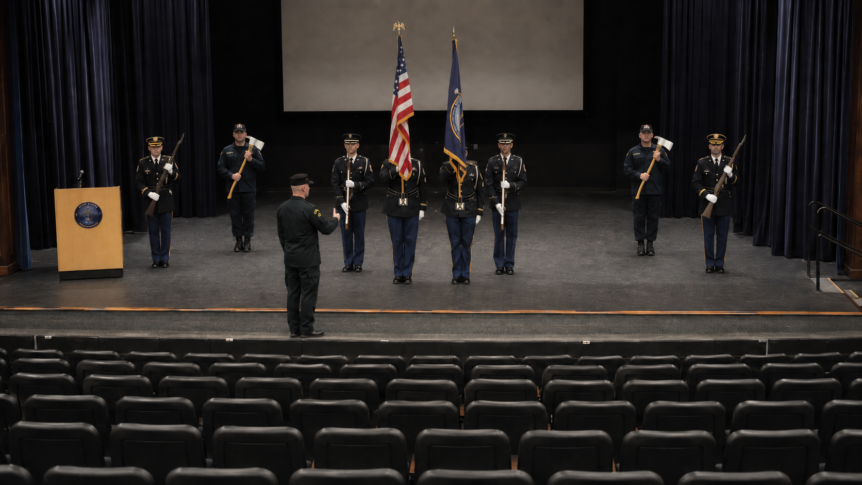
- At Al Udeid Air Base in 2018, a 9/11 remembrance ceremony included two Security Forces defenders carrying rifles and two firefighters carrying fire axes. Air Forces Central described the formation as an honor guard representing both law-enforcement and firefighting communities.
- At Moody AFB in 2021, an Airman assigned to the base honor guard was photographed holding a ceremonial axe before the installation’s 9/11 memorial ceremony.
- At McConnell AFB in 2017, an Air Force firefighter carried an axe during a Patriot Day Retreat ceremony.
- At Little Rock AFB in 2023, an Airman from the Civil Engineer Squadron Fire Department carried an axe during the base’s 9/11 remembrance ceremony.
There is therefore plenty of precedent for ceremonial use of the fire axe. But precedent and authority are not the same thing. An official photograph proves that something happened. A Public Affairs caption can tell us what an organization called it. Neither automatically establishes that the practice is prescribed or authorized by the governing drill-and-ceremonies publication. That distinction is especially important when developing standards.
Notice that none of those situations had the axe bearers replace the rifle guards.
Don’t Eliminate the Axe — Separate the Elements
There is a much cleaner solution. Keep the military color guard configured according to the applicable military standard and add two firefighters carrying ceremonial axes. or one firefighter and one SF Defender as a separate ceremonial element.

For a typical indoor presentation, I recommend the following arrangement.
The two members of the ceremonial element enter at Port before the color guard enters. They take positions on either side of the location where the color guard will halt, approximately two steps behind the color guard and roughly four steps outside each flank. Exact distances can be adjusted for the location. They face the audience.
The color guard then enters normally. When the color guard executes Present Arms, the axe bearers execute the prescribed Present position with the axe.
When the color guard returns to Right Shoulder Arms (Carry) or Port Arms, the axe bearers execute the corresponding movement with the axe.
When the color guard departs, the firefighters remain momentarily in position. After several seconds, they depart as their own element. That small pause is important.
Visually, it tells the audience that these are two related but separate ceremonial elements and that is very important.
- The members of the ceremonial element (police and fire/fire alone) are not extra guards who happen to be carrying axes.
- The axe bearers are not members added to the color guard formation.
- The Colors retain their military identity and precedence while the (police and) fire service receives meaningful representation.
The Axe Needs Its Own Manual of Arms
Years ago, I developed a manual of arms specifically for the ceremonial fire axe*. Mirrored Port explanation here.
*The manual I developed matches the USAF Honor Guard manual of the rifle. You do not have to learn the entire manual. Enter at Port, go to Present, return to Port, and depart.
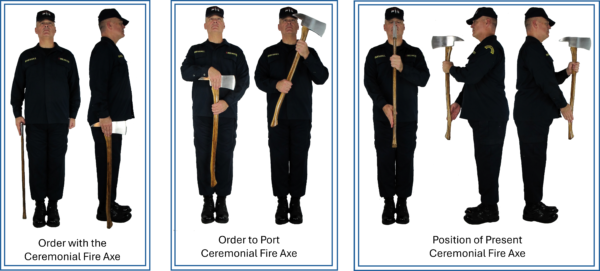
Simply replacing a rifle with an axe and improvising movements creates another problem. A fire axe has different dimensions, balance, hand positions, safety considerations, and symbolic purpose from a rifle.
The proper approach is not: “Do rifle drill while holding an axe.”
It is: “Develop axe drill appropriate to the axe.”
Attention, Port, Present, and other positions need to be intentionally established for the tool. The axe bearers and rifle guards can therefore respond to the same ceremonial cues while executing different techniques. That gives us an excellent example of ceremonial language.
When the command is: Present, ARMS, the rifle guard translates that command through the military rifle manual of arms. The firefighter translates that same command through the ceremonial axe manual of arms. The timing and meaning can be coordinated, and the physical vocabulary does not have to be identical. That is not inconsistency. It is proper ceremonial differentiation.
This is Ceremony as Language
(I am working on a new book on this subject.) A rifle beside the Colors communicates something specific. A firefighter carrying an axe communicates something different. We create confusion when we assume that because two objects can be carried in approximately the same place, they have the same ceremonial function. They do not.
The rifle guard is part of the structure of the military color guard. The firefighter axe bearer represents the fire service and, in this case, its fallen. Both have meaning. Neither needs to replace the other. In fact, maintaining the distinction makes the ceremony more powerful because the audience can visually understand both identities. This is the same principle I continually stress in drill and ceremonies:
Authority before aesthetics.
Do not begin with, “This would look good.” Begin with, “What does each element mean, and what authority or standard governs it?” Then design the ceremony around those answers.
Civilian Fire Departments Are Different
A civilian fire department is not automatically bound to a military color guard system. A department may establish a ceremonial standard that uses firefighters armed with axes as its color guards. If that is the department’s adopted system, the axe can become part of that organization’s ceremonial vocabulary.
The situation changes when military personnel perform a military color guard. Military status brings military standards with it. A military fire department does not become a civilian ceremonial organization merely because its members are performing a firefighter-themed ceremony. The better answer is not to discard military standards for the occasion but keep the military standard and add the firefighter tradition.
For This Year’s 9/11 Ceremonies
If your installation fire department wants axes represented during its September 11 ceremony, I strongly encourage it. Train the axe bearers. Give them defined positions and movements. Rehearse their timing with the color guard. Place them where their relationship to the Colors is visually obvious without making them appear to be substitute color guards. Let the Colors remain military Colors. Let the firefighters remain firefighters. When we preserve both identities, we do more than make the ceremony look professional. We allow the ceremony to say exactly what we intend it to say.
Suggested photo caption:
The DrillMaster demonstrates positions from a ceremonial manual of arms developed specifically for the fire axe. A defined axe manual allows firefighters to participate as a distinct ceremonial element without substituting the axe for the prescribed weapons of a military color guard.
Comments 2
Thank you for addressing this. As a Career and Volunteer FF in NY this event has significant meaning to us. Learning how to do it right is as important as the meaning of the day.
Author
My pleasure, sit. I am glad to help.