
Authority, Emulation, and Ego in Drill & Ceremonies
The category error: elite ceremonial technique being imitated in environments where it is not authorized.
This is subtle — and therefore more dangerous — because it looks disciplined.
What People Are Copying
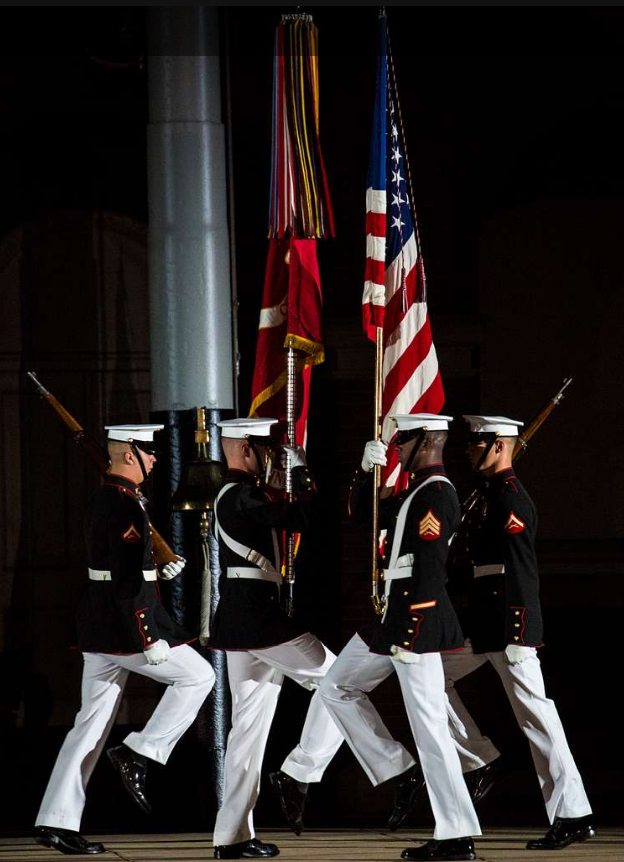
The maneuver being imitated is the four-man color guard countermarch executed with simultaneous pivots, as performed by:
- Marine Barracks Washington (Specifically the Commandant’s Four)
This technique is a ceremonial innovation, not a regulation drill baseline.
It is engineered for:
- Exhibition-level precision (not “exhibition drill”)
- Institutional ceremonial authority
It is not described in:
- MCO 5060.20
- TC 3-21.5
- DAFPAM 34-1203
Those publications authorize Wheel, Turn, and About movements.
They do not authorize a synchronized four-man pivot countermarch for standard color guard application.
Why It Exists at 8th & I
Marine Barracks Washington is not a typical unit. It is a ceremonial command with delegated authority to standardize and execute techniques beyond the baseline manual.
That authority is institutional. It is not transferable.
Just because a unit can execute a maneuver does not mean that maneuver becomes doctrinal.
The Core Issue: Authority vs. Imitation
The logic error sounds like this:
“The Marines do it. Therefore, we can, because we are Marines.”
That reasoning ignores:
- Command authority
- Mission scope
- Ceremonial designation
- Publication governance
The Commandant’s Four operates under ceremonial directive.
A Marine or Navy Fleet color guard, college, high school, or cadet corps team does not.
When others perform the simultaneous-pivot countermarch, they are not executing doctrine.
They are performing imitation ceremony.
Why Simultaneous Pivot Is Not Regulation-Authorized
From a regulation drill standpoint:
- The prescribed 180-degree turn for a joint or Marine-directed color guard is the Left About, MARCH.
- A Marine-only 180-degree turn is Countermarch with pivots that take place at different times.
The synchronized four-man pivot alters:
- Pivot sequencing
- Center reference
- Alignment mechanics
- Command timing structure
It becomes a different maneuver because the only way simultaneous pivots can take place is pivots on the inside flank. Look at the photo at the top of the page of the C4 at marine Barracks Washington. They have just executed the first pivot for their Countermarch. Here is what we see:
- The USMC bearer and left rifle guard executing a Right Flank with the pivot on the left foot platform (ball of the foot and everything forward to the toes).
- The National bearer and right rifle guard executing an Inside Left Flank with a pivot on the left foot platform.
This is how the simultaneous pivots happen. For you to do this, you have to purposefully adapt the Countermarch in the MCO to this, which is not authorized.
“But It Looks Better.”
It does. It truly does. That is the recurring theme in D&C.
Looking better does not equal being correct.
There is a persistent belief that ceremonial innovation equals elevation.
In reality, it often equals deviation.
The discipline in drill is restraint — not flair.
The Ego Factor
There is ego in drill & ceremonies because:
- Precision is visible.
- Authority is performative.
- Applause is intoxicating.
- Social media rewards spectacle.
When teams insert non-authorized maneuvers, they are often chasing:
- Cool factor
- Crowd reaction
- Perceived elite status
But discipline in regulation drill means suppressing ego in favor of standard.
Competition Context — Judge’s Position
In a regulation drill event:
If a team executes a simultaneous-pivot countermarch not described in the governing manual:
- It is an unauthorized movement.
- It is a structural deviation.
- It replaces an authorized move sequence with an invented technique.
This should be evaluated as:
- A major procedural violation.
- Not creativity.
- Not interpretation.
Judges should respond clinically:
“The team executed a simultaneous-pivot Countermarch not prescribed in the governing manual. Regulation drill requires compliance with authorized movements.”
No sarcasm.
No theatrics.
Just standards.
Judge’s Note — Simultaneous-Pivot Countermarch (Regulation Drill)
When adjudicating a regulation drill event governed by:
- Marine Corps Order 5060.20
the method for turning a four-man color guard is plainly prescribed. The movement structure, pivot sequence, and command execution are defined. There is no authorization for a synchronized, simultaneous-pivot countermarch.
If a team executes the “Commandant’s Four–style” simultaneous pivot in place of the prescribed movement:
- They have substituted a non-authorized technique.
- They have replaced a written standard with an imitation ceremonial maneuver.
- They have materially altered the required execution.
This is not interpretation.
This is not stylistic variance.
This is direct non-compliance with a plainly written procedure.
Disqualification Threshold
If the competition rules state that all movements must conform to the governing service manual, then:
Executing a simultaneous-pivot countermarch in place of the prescribed method constitutes:
- A fundamental procedural violation.
- An intentional deviation from written doctrine.
- A substitution of unauthorized movement.
That meets the threshold for disqualification.
This is analogous to:
- Changing the method of rendering honors.
- Altering the order of colors.
- Reversing prescribed command structure.
The maneuver is written plainly in the manual.
Deviation is not arguable.
Judge Conduct
Even when disqualification is warranted, demeanor must remain professional.
Recommended phrasing:
“The team executed a simultaneous-pivot countermarch not authorized in Marine Corps Order 5060.20. The governing manual prescribes a specific method for the turn. Substitution of a non-prescribed maneuver constitutes a disqualifying deviation.”
No emotion.
No ridicule.
No commentary on motivation.
Judges enforce standards — they do not police ego.
Final Adjudicative Principle
Ceremonial units with delegated authority may innovate within their mission.
Regulation drill competitors may not.
When the manual is explicit, there is no gray area.
Compliance is not optional.
The Clean Line
Only ceremonial units with delegated authority may innovate technique.
That includes:
- Marine Barracks Washington
- United States Navy Ceremonial Guard
- United States Coast Guard Ceremonial Honor Guard
If they choose to standardize a technique internally, that authority rests within their mission scope.
It does not extend outward.
Final Principle
In Regulation Drill:
- If it is not written, it is not authorized.
- If it is not authorized, it is not correct.
- If it is not correct, it should not be rewarded.
Precision in drill is not about being impressive.
It is about being obedient to standard.
And that is where the ego must end.