
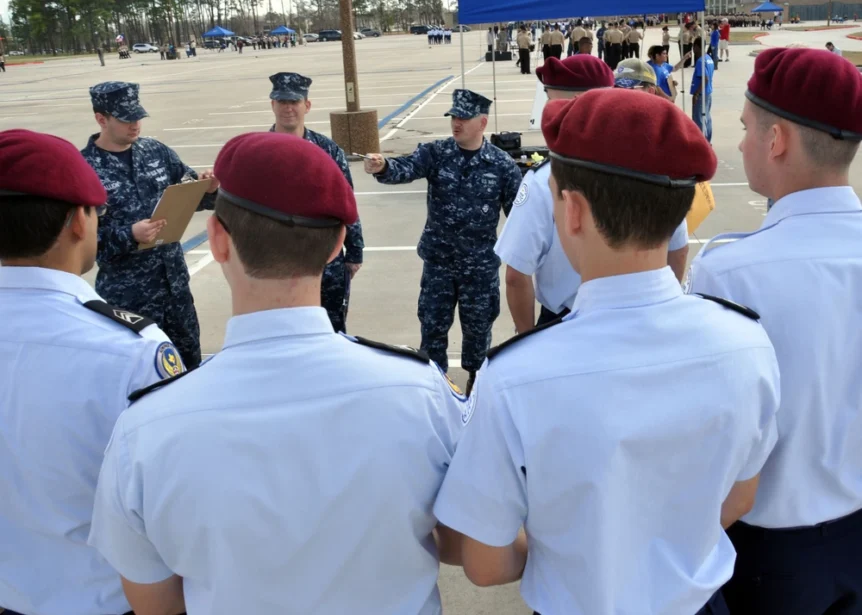
This guidance provides judges with a consistent framework for evaluating flight (platoon) commander positioning during regulation drill, ensuring assessments are based on published drill standards rather than regional practice, instructor habit, or competitive normalization.
Judges are reminded that frequency of exposure does not establish authorization.
For context, please read this article: Can a Flight Commander Switch Sides During Regulation Drill?
Doctrinal Reference Standard
In Air Force–based regulation drill, the flight commander’s position relative to the formation is prescribed:
- Centered in front of the formation when halted (Line Formation)
- On the left side of the formation when marching (Column Formation)
This positional relationship is part of the command-and-control structure of regulation drill and is not discretionary.
Judges must evaluate commander positioning based on adherence to prescribed relationships, not perceived effectiveness or local custom.
Authorized (Acceptable)
A commander’s relative position may appear to change only as the result of a prescribed movement, including but not limited to:
- Column movements that reorient the formation
- Countermarches or directional changes executed in accordance with regulation
- Halting movements that return the commander to a centered front position
In these cases, the commander is maintaining doctrinal alignment while the formation changes orientation.
No downgrade is warranted when positional changes are caused by prescribed commands executed correctly.
A downgrade may be warranted when a commander:
- Deliberately crosses from the left side to the right side of the formation
- Alternates sides during a marching sequence
- Repositions himself to improve visibility, alignment monitoring, or perceived control
- Treats commander location as a tactical or stylistic choice
These actions represent discretionary movement and are not supported by regulation drill doctrine.
Common Misconceptions Judges Must Avoid
Judges should consciously avoid the following assessment errors:
- “This is common in my region, so it must be acceptable.”
- “The commander maintained good control, so the movement is justified.”
- “It looked clean, so it should not be penalized.”
Regulation drill prioritizes standardization over optimization. Visual effectiveness does not supersede doctrinal correctness.
Evaluation Guidance by Caption
Depending on the score sheet and adjudication system in use, unauthorized commander side-switching may impact:
- Command Presence / Military Bearing – deviation from prescribed command discipline
- Adherence to Standards – failure to maintain doctrinal positioning
- Overall Effect (Regulation Context) – disruption of standardized visual command structure
Judges should apply measured downgrades, not punitive ones, proportional to:
- Frequency of the deviation
- Whether the movement was intentional
- Whether it disrupted formation control or uniformity
Judge Language for Commentary
Judges are encouraged to use neutral, instructional language in commentary, such as:
- “Commander positioning deviated from prescribed regulation drill standards.”
- “Commander repositioned laterally without a prescribed movement.”
- “Command presence affected by non-standard commander movement.”
Avoid speculative or instructional commentary such as:
- “Commander needed better visibility.”
- “This is usually accepted.”
- “I understand why they did it.”
Key Principle for Judges
Judges evaluate regulation drill based on doctrine, not tradition.
Consistency across regions, events, and judging panels depends on evaluating what is authorized, not what is common.
Summary for Judge Training
- Commander positioning in regulation drill is prescribed
- Discretionary side-switching is not authorized
- Regional normalization does not override doctrine
- Judges must assess based on standards, not exposure
- Commentary should remain neutral, factual, and defensible
This approach protects:
- Cadet instruction
- Program credibility
- Judge integrity
- Inter-regional consistency
Judge Clinic Handout:
Excellent question—and the short answer is:
Evaluating Flight Commander Positioning in Regulation Drill
Caption-Aligned, Standards-Based Guidance
PURPOSE
This handout establishes a uniform judging standard for evaluating flight (platoon) commander positioning during regulation drill and aligns observed deviations with specific adjudication captions to ensure consistent scoring across regions and panels.
DOCTRINAL BASELINE
(Standards Reference)
In Air Force–based regulation drill:
- Halted: Commander is centered in front of the formation
- Marching: Commander is positioned on the left side of the formation
Commander positioning is prescribed and forms part of the unit’s command-and-control structure.
AUTHORIZED POSITION CHANGES
(No Caption Impact)
A commander’s relative position may change only as the result of prescribed movements, such as:
- Column movements
- Countermarches
- Authorized directional changes
- Halting movements returning the commander to front-and-center
In these cases, the formation reorients around the commander.
No downgrade is applied in any caption when this occurs correctly.
UNAUTHORIZED POSITION CHANGES
(Caption-Dependent Evaluation)
A commander independently repositioning—including crossing from left to right, alternating sides, or relocating for visibility or control—represents a deviation from regulation standards.
Judges should evaluate impact using the following caption guidance.
CAPTION ALIGNMENT GUIDANCE
Command Presence / Military Bearing
Evaluate here when:
- Commander movement reflects a breakdown in command discipline
- Positioning appears discretionary or improvised
- Commander authority is expressed through movement rather than command
Typical Commentary
“Command presence affected by non-standard commander movement.”
Adherence to Standards / Compliance
Evaluate here when:
- Commander positioning deviates from prescribed regulation drill
- Movement is not the result of a command or prescribed maneuver
- Standardized commander-formation relationships are not maintained
Typical Commentary
“Commander positioning deviated from prescribed regulation standards.”
Overall Effect (Regulation Context)
Evaluate here when:
- Non-standard commander movement disrupts the visual command system
- The deviation affects formation cohesion or uniformity
- Repeated deviations accumulate across the sequence
Typical Commentary
“Overall effect reduced by inconsistent commander positioning.”
COMMON JUDGING ERRORS TO AVOID
(All Captions)
Do not justify unauthorized movement because:
- It is common in the region
- It appears effective or clean
- The commander maintains control
- The rationale seems reasonable
Regulation drill prioritizes standardization over optimization.
SCORING APPLICATION
Downgrades should be:
- Measured, not punitive
- Proportional to frequency and impact
- Caption-appropriate, not duplicated unnecessarily
Judges should avoid double-penalizing the same deviation across multiple captions unless the impact is clearly distinct.
KEY PRINCIPLE FOR JUDGES
Regulation drill evaluates discipline within constraints, not tactical adaptation.
Judges assess what is authorized, not what is customary.
For use in judge clinics, adjudication manuals, and standardization briefings.