
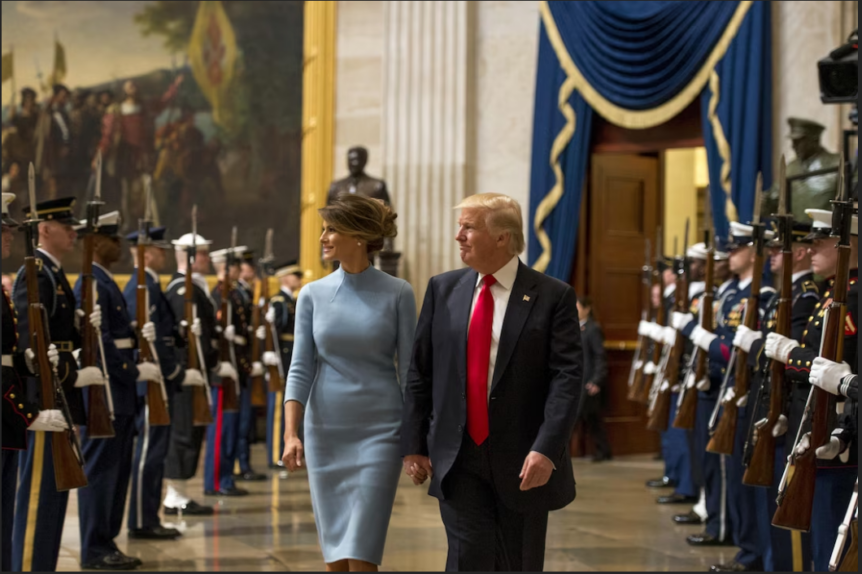
Three facing-rank formations may look alike, but their authority, arms, manning, and ceremonial purpose are not interchangeable.
| Honor cordons, sword or saber cordons, and side boys all create a passage between two facing ranks. That resemblance causes persistent mistakes. ICS DCS 101 explains the authority, weapons, personnel, numbers, and proper use of each formation—and why a color guard must never be split to imitate one. |

The Similar Appearance Is the Source of the Confusion
An honor cordon, a sword or saber cordon, and side boys share an obvious visual arrangement: personnel stand in two facing ranks while an honored person passes between them. From a distance, that may be all an event planner sees. The temptation is then to treat the formations as interchangeable—to arm an honor cordon with swords, call side boys an unarmed cordon, or divide a color guard to create the same general appearance.
That approach mistakes geometry for authority. A formation is not defined merely by the aisle it creates. It is defined by why it exists, who is entitled to receive it, how many personnel are assigned, what those personnel carry, what action they perform, and which publication or command decision authorizes the ceremony.
ICS DCS 101, The Honor Cordon, Sword/Saber Cordon, and Side Boys, brings those distinctions into one practical reference. The essential points are summarized below; the downloadable DCS provides the detailed authority, historical research, source links, and planning cautions.
A Color Guard Is Never a Cordon
This is the most important categorical point in the document. A color guard is not authorized to divide into two groups, take positions on opposite sides of an entrance or aisle, and face inward to imitate a cordon. The colors remain together in their prescribed formation and order of precedence.
The national, departmental, organizational, and other colors are institutional symbols. They are not decorative markers to be distributed along a pathway. A cordon is made up of personnel assigned to the cordon. Side boys are also a personnel detail. When an event requires both a color guard and a cordon, the two remain separate ceremonial elements.

The rule is simple: colors stay together; personnel form the cordon.
The Official Honor Cordon
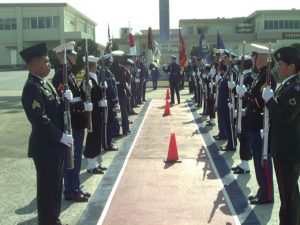
The official honor cordon recognizes an entitled official or military officer during an official arrival or departure. For the Army arrival-and-departure formation described in TC 3-21.5, the cordon is armed with rifles. Swords and sabers are not substitutes.
The formation consists of two equal squads facing one another, plus a commander. Because the cordon members are evenly divided and the commander is additional, total strength is an odd number from 11 through 21. The specific number is determined by the office or military grade of the person being honored.
- 21 for the President or a former President
- 19 for the Vice President, senior defense officials, Service secretaries and chiefs, and comparable offices
- 17 for a general or admiral
- 15 for a lieutenant general or vice admiral
- 13 for a major general or rear admiral
- 11 for a brigadier general or rear admiral (lower half)
The formation comes to Attention and renders Present Arms as the entitled person passes. DoD funeral guidance has separate provisions for joint funeral cordons, including an unarmed cordon used to line a State funeral procession route. That exception should not be used to redefine the Army arrival-and-departure cordon as optionally armed.
The Sword/Saber Cordon

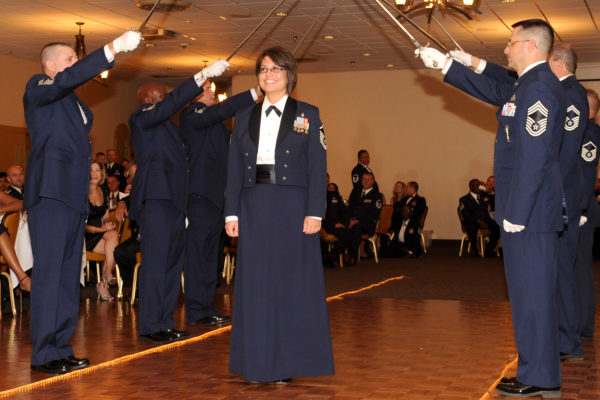
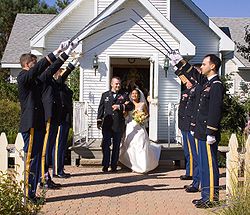
The sword or saber cordon has a different purpose. It creates a symbolic ceremonial passage, most commonly for a newly married couple at a military wedding. The detail normally consists of six or eight bearers divided equally into two facing ranks. Applicable Service and command guidance determines who may participate and which weapon is authorized.
The members raise their swords or sabers to create an arch. They are not rendering Present Arms to a visitor based on rank. The arch is the defining action of the ceremony. The detail should use one authorized weapon type consistently; swords and sabers should not be mixed simply because both are available.
Calling the formation an “Arch of Swords” or “Arch of Steel” does not transform it into an official honor cordon. Likewise, increasing the number of sword bearers does not make the ceremony equivalent to the rifle-armed, 11- to 21-member Army honor cordon.

Side Boys


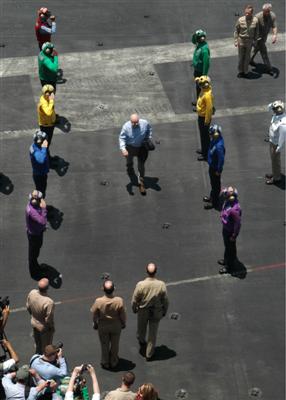

Side boys belong to the naval tradition of tending the side. They form part of the honors rendered to an entitled officer or official boarding or departing a vessel during an official visit. The Officer of the Deck controls quarterdeck honors, and the Boatswain’s Mate pipes the side.
Side boys are always unarmed. They do not carry rifles, swords, sabers, or ceremonial substitutes. The Boatswain’s Mate carries and uses the boatswain’s pipe; the side boys do not. Click here to read about saluting and the left-hand salute.
The traditional explanation is that the personnel tending the side once needed both hands to handle lines, accommodation equipment, baggage, and, when required, the block and tackle used to hoist a chair or platform from a boat. That account should be identified as traditional rather than presented as conclusively proved history. The present ceremonial rule, however, is unambiguous: arming side boys creates an unauthorized hybrid.
Side boys are assigned in even numbers according to office or grade:
- Eight for general, admiral, lieutenant general, vice admiral, and above
- Six for major general, brigadier general, and rear admiral
- Four for lieutenant colonel, colonel, commander, and captain
- Two for major, lieutenant commander, and below
Receiving More Than One Entitled Official
When several members of an official party individually rate side honors, they are received separately in ascending order of precedence. The junior entitled person is piped aboard first with the appropriate number of side boys. Additional side boys are then added as required before the next senior member is received. The process continues until the senior member is received with the full number that person rates.
Side honors are principally shipboard. Navy Regulations limits their use at a naval station and permits the senior officer present to direct them when they serve a definite purpose. That limited authority does not make side boys a general-purpose unarmed cordon for balls, banquets, or civilian venues.
The Military-Ball Entrance Formation
Many service members remember a formal entrance detail at a military ball: the formation remains at Parade Rest for enlisted attendees, comes to Attention for the top three enlisted grades, and renders Present Arms for commissioned officers. The sequence is ceremonially coherent and can add dignity to an event.
The difficulty is not necessarily the local practice. The difficulty is calling it a doctrinal honor cordon. No controlling Service publication has been located for that exact military-ball sequence. When a commander authorizes the practice locally, the honest and useful label is ceremonial reception detail.
That distinction allows a unit to preserve an appropriate local tradition without claiming official authority that has not been published. An actual honor cordon may still be provided for the ball’s guest of honor or another entitled visitor. It forms for that person, performs the prescribed arrival sequence, and departs; it is not a standing formation through which every attendee passes according to grade.

Building and Vehicle Door Openers
Door openers can be integrated visually without being counted as cordon members. At double doors, the cordon can align with the outer edges of the doorway while one opener stands at each door. The pair then appears to continue the facing ranks, but both remain support personnel outside the prescribed cordon strength.
The opener whose right hand remains free renders the hand salute with the cordon. The opener who must use the right hand to control the door does not salute; a left-hand salute is not substituted. The same principle applies to a vehicle-door opener. Position the opener outside the rifle movement path, keep the official party’s route clear, and rehearse the movement before the ceremony.
Why Download DCS 101?
The distinctions above solve the immediate practical problem, but the complete DCS provides more than a summary. It places the three formations in matching categories, gives the detailed manning rules, separates current doctrine from local adaptation, and supplies direct links to Army, Marine Corps, Navy, Air Force, and DoD references.
It also presents the historical evidence with appropriate levels of certainty. The word cordon, the French haie d’honneur, ceremonial street lining, early twentieth-century “cordons of honor,” the possible relationship of European sword arches, and the traditional explanation for side boys are not all supported to the same degree. DCS 101 identifies what is documented, what is a useful analogy, and what remains a reasonable historical inference.
The practical principle is unchanged: use the correct personnel, arms, numbers, commands, and authority—and call the formation what it is.
| Download ICS DCS 101 The Honor Cordon, Sword Cordon, and Side Boys |
Firefighters

The Honor Guard Manual. This is an excellent opportunity to use the 5-foot ceremonial pike pole!
The Sequence of Events
The cordon forms up (tallest toward the VIP’s entrance) well before ceremony and performs at least one dry run, is then dismissed to change into the ceremonial uniform. At least ten minutes before the ceremony:
- Cordon forms up and marches at Port to its marks.
- Once at the site, the cordon members pick up an automatic Mark Time.
- The commander gives Cordon, HALT; Center FACE; Dress Center, DRESS; Ready, TWO; Ready, FRONT:* and Stand at, EASE (or Parade, REST).
- The commander should remain at Attention and, when the VIP arrives, give, Cordon, ATTENTION; Present, ARMS.
- After the VIP passes through completely, the commander gives, Order, ARMS; Ready, FACE (face toward departure direction), Port, ARMS; Forward, MARCH. The team then marches off to their transportation.

*Guidance for the dressing sequence (accomplished visually):
- Dress Center, DRESS– All heads drop so that all members reposition to their marks. If no literal marks, squad members will align their feet directly across from each other using the squad on the marching right (before the Center, FACE) as the guide.
- Ready, TWO– All member’s heads snap to the direction from which the VIPs enter the cordon or, if there is a structure that can be sued for alignment (e.g. a door frame) you can also dress to that. Here, all members ensure that their shoulders are aligned be only moving front/backward.
- Ready, FRONT– All heads snap back to Attention.
The “Welcome” comes when the couple has passed through the cordon as described above. The bride and groom stop just past the last two cordon members and the member closest to the bride taps her on her backside and says, “Welcome to the [insert service]!”, and assumes Attention.
Comments 3
Hello,
I am seeking information about the term, “blades to the wind”. I wondered if it might be associated with the ceremonial arch when, having drawn a sword or sabre, to avoid injury the command, “Blades to the wind”, might be used. Or am I being fanciful.
If you have any further information and can spare the time I would be interested to know. Having read the commands used in the section, “ The Honour and Sword /Sabre Cordons”, I was a little saddened not to come across this term. I understand that most commands in the military need to be short or sound a little staccato but for a wedding arch maybe a touch of mystery or romance might also be appropriate.
Thank you for reading this.
Sue Finnett.
Author
Ms. Finnett,
I’ve never heard of the term, “Blades to the winds”. Your suggestion does seem quite possible since the only manual in the US that has any direction for the sword arch is MCO 5060.20. The tradition of the Arch of Steel is lengthy, but the Army and Air Force never had published guidance. It is very possible that the Draw, Sword! command was then followed by the Blades to the Winds! command to twist the sharp edge up.
Staccato commands are definitely necessary when marching, but when static, there are certain instances where a well-trained team can execute the command no matter how long winded it is.
DM
Author
Ms. Finnett,
Great news! I put out a request on my social media accounts for information on “blades to the wind” and received great feedback.
In this book, found here, https://books.google.com/books?id=lTD3DwAAQBAJ&newbks=1&newbks_redir=0&printsec=frontcover&pg=PA224&dq=blades+to+the+wind+ceremony&hl=en&source=gb_mobile_entity#v=onepage&q=blades%20to%20the%20wind%20ceremony&f=false there is a mention of the technique and you got it right! Look at the third paragraph.
It’s possible that this comes from the US Naval Academy, but I’m not certain. It seems it is a sea service thing as a Sailor and Marine both learned about it over 20 years ago, but no one else had any information.
DM