
Color guards do not always move through ideal spaces. Doorways, low ceilings, stage entrances, overhangs, ramps, and other confined areas can force a team to adjust the position of the colors temporarily while still maintaining dignity, control, and respect for the flags. This article explains the practical methods for navigating both low-clearance and very low-clearance areas, including the available options, the commands that may be used, and the body and staff positions required for each method. The photos that follow illustrate each position so leaders and trainers can make informed decisions before the team encounters the obstacle during a ceremony.
Let me state this: You can use methods listed in the MCO or TC as long as those methods do not replace your service’s methods.

Port
When a rifle is in front of your body at an angle with the muzzle dissecting the left shoulder and butt stock over the right hip, that is the Port Position. If both of your hands are in the proper place, that is called Port Arms. There are different versions of Port Arms, depending on your equipment.
Port Arms is used when marching at double time with a guidon. Please keep in mind though, that a guidon is not a color.

The Port Position, as described above, is not authorized for a flagstaff/color, it is not a very dignified position for carrying our nation’s flag, or other flags in a ceremonial situation. Marines running PT with the national flag at Port is another matter.
Trail
The Navy, Marines and Coast Guard do have a position for the color that is very similar to the ceremonial position of Port Arms, it’s called Trail Arms.
Here is Trail Arms for a color. It is used when traveling in Line or Column Formation for short distances. There is nothing wrong with the Army, Air Force, or Space Force using this position. Just because it is only listed in MCO 5060.20, doesn’t mean it is forbidden for the other service to use it. It is a very good option for everyone to use when in a low clearance situation and cannot go to Carry.

The Command. No command is required for Trail, just give “Forward, MARCH” and on the first step, lift the equipment approximately three inches off the marching surface.
Port For Colors
The Air Force and Space Force Honor Guard Port Arms position has both rifle guards at Port and the color bearers in the Port for Colors position (my term)- bottom ferrule of the staff off the marching surface 4″ to 6″ and the left forearm horizontal across the body (4″ from the torso) with fingers extended and joined.

While Port for Colors is a ceremonial technique (feet together), there is nothing wrong with adopting it for regulation drill (feet at 45) applications. If you need to use it, please do. The position was developed for a reason.
A variation to this is to have the left forearm across the body, but have the left hand grasp the staff. I appreciate this technique more since it provides greater stability for the staff and virtually eliminates “Fishpoling”, (think of Huckleberry Finn), the bottom ferrule of the staff pointing forward and the staff angled over the shoulder, like you are going fishing. Anyone can use this adaptation of Trail Colors for low clearance areas.

The Command. “Port, ARMS” is the command. On the command of execution, reach across with the left hand and lift the staff four inches to six inches so that your forearm is horizontal when finished. Rifle guards go to Port.
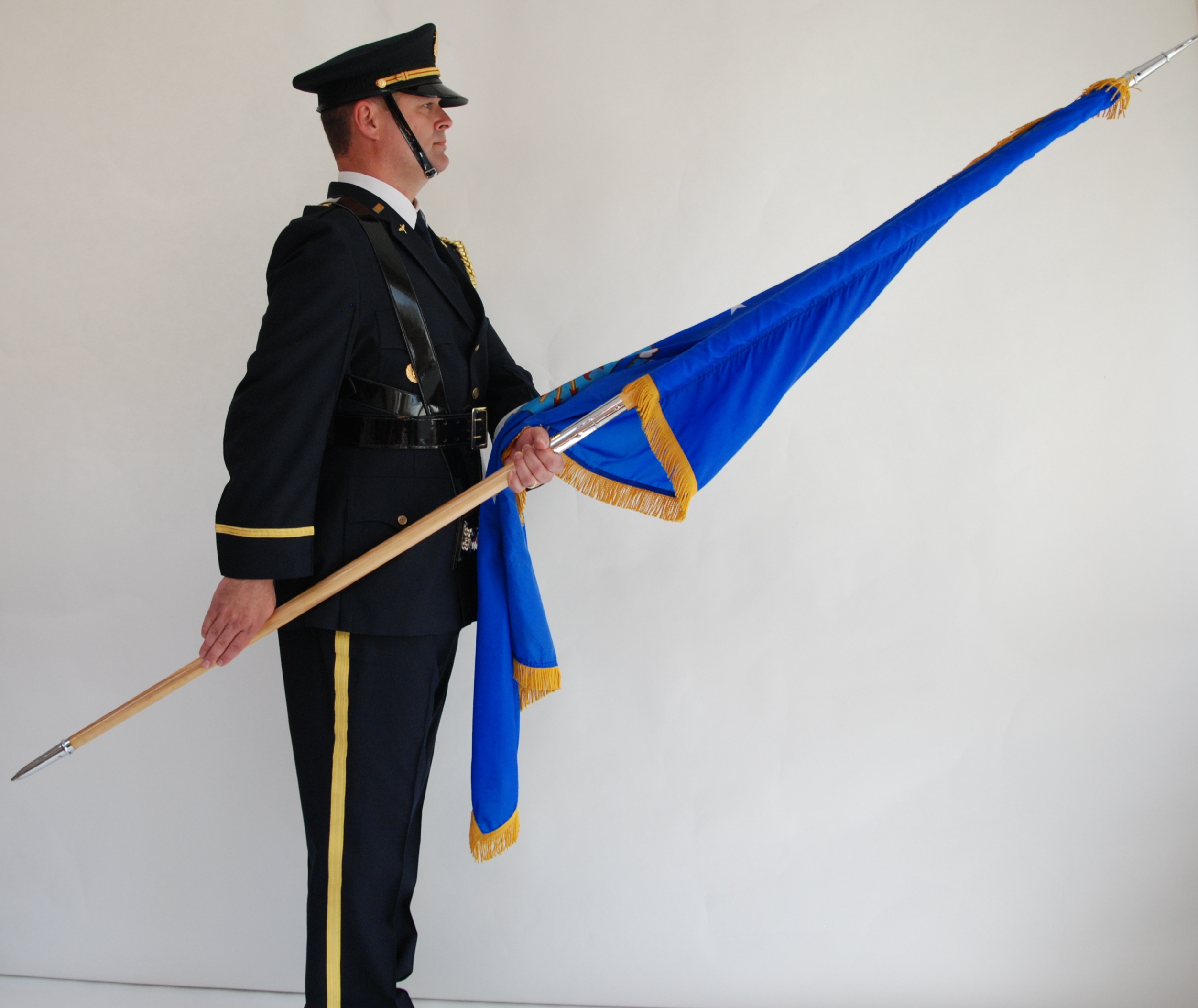
Angle Port
A very low clearance situation requires you to angle the staff forward. It is called, “Angle Port.” Please, do not angle the staff backward as you will not be able to see the finial (ornament on top of the staff) and be able to avoid overhead obstacles.
You have probably not heard of Angle Port because it is a ceremonial position created by the military honor guards (although, the MCO does describe the position without naming it). Why this is not in service drill and ceremonies manuals, I don’t know- it would be very helpful for those in the field. Here is the Angle Port position:

The Command. The command to get here is “Bearer’s, Ready Two”. “Bearers” is to identify the color bearers. The command is called after Port Arms is called. Dip the flagstaffs together in three counts, make sure the finial for the US is conspicuously higher that the others.
A full explanation is in my book, The Honor Guard Manual.
Controlling the Flag
If the silk (flag material) falls forward and is at risk of touching something beneath it, grasp the staff with your right hand behind the left while keep the staff at the same angle and pull the staff back toward your torso so that you can gather the silk over the left forearm (as shown above). Regrasp the staff with the left above the right and place the right at a flare at the rear of the staff. Guidelines:
- When marching, gather the flag regardless.
- When halted and at Present (with a low ceiling, Angle Port is also Present), if the flag is not at risk of touching anything else, leave it hang forward. You will recover it when you come back to Port or right after the anthem.
Comments 4
We have a competition approaching that requires us to follow the Army Drill & Ceremonies Manual. I can’t find what guidelines it has for dealing with low ceilings. We have to carry the colors at “low carry” for this competition. What would you advise?
Author
Hello and thank you for the question.
There is no such thing as “Low Carry” as an official position. It’s either Trail or Port as I described above. I rewrote the article just now for you to give a better explanation.
You have everything you need here and in the MCO. There is nothing wrong with using methods from TC 3-21.5 or MCO 5060.20, as long as they do not replace your service methods.
Hello,
For angle port you noted bearers as the preparatory command, does this mean that the guards remain at shoulder for the whole movement, or would they go down to port?
Author
The command given, “Bearers, Ready Two”, is called from Port, a ceremonial drill position. It’s not called from Carry/Right Shoulder. The guards are always at a complimentary position with the bearers.
If you are in JROTC, you can use this position. The guards must be at Port.