
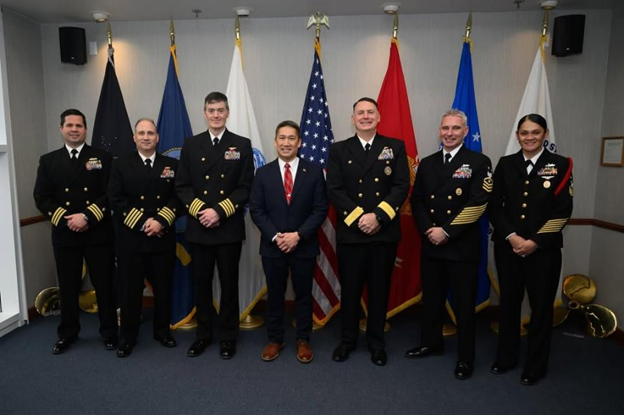
Joint military displays are governed by service ownership of the colors, joint-service hierarchy, and cross-service compatibility. They are not governed merely by the installation, the uniform of the color guard, or the service affiliation of the ownership of the static display.
That distinction matters.
A Navy installation does not make every color “Navy.”
A Sailor-only color guard does not make the Army, Marine Corps, Air Force, Space Force, or Coast Guard colors Navy-owned.
A Marine Corps-led partial joint team does not erase the ownership of the Air Force color.
The members of the color guard are the custodians of the colors for the ceremony. They are not the doctrinal authority for every color present.
The controlling principle is this:
In a joint display, no single service’s unique equipment, ornamentation, or ceremonial insignia may be applied selectively or universally unless it is authorized for the colors to which it is applied and compatible with the joint formation.
That principle is not always written as one neat sentence in one manual. It is derived from service color regulations, Navy and Marine Corps ceremonial guidance, Army flag doctrine, joint ceremonial practice, and long-standing DoD protocol norms.
The key is this: Joint displays are governed by compatibility, not custody.
Two Common Scenarios — Both Incorrect
I have seen these scenarios countless times, so they need to be addressed directly.
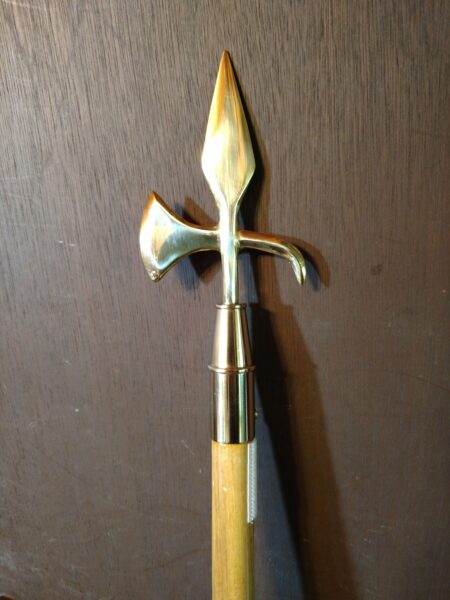
Scenario 1: Battle-Ax Finials on All Service Colors
Example:
- Navy/Coast Guard installation
- Sailor-only color guard
- Army, Marine Corps, Navy, Air Force, Space Force, and Coast Guard colors
- Battle-ax finial placed on every staff
This is incorrect. Why?
Because a Navy/Coast Guard-only finial is being placed on non-Navy and non-Coast Guard colors. That violates service ownership of the colors and falsely implies that Navy ceremonial equipment may be applied to the colors of every other service.
It may look uniform, but it is not doctrinally compatible. As an example: Navy-owned does not mean Navy-only standards.
Example:
- Navy and Coast Guard colors use the battle-ax
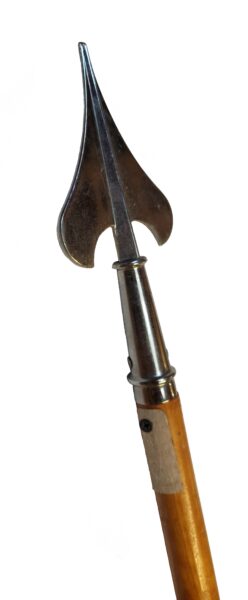
- Army, Marine Corps, Air Force, and Space Force colors use the flat silver Army Spearhead/spade
This is also incorrect in a joint display.
At first glance, it may seem better because each color is using a service-authorized finial. But inside a joint formation, it creates a visual hierarchy. The Navy and Coast Guard colors now carry a visibly distinct service-unique ornament while the other service colors use the common spearhead.
That visually privileges the sea-service colors inside a formation that is supposed to communicate joint parity.
In joint formations, no service gets visually privileged equipment unless that distinction is explicitly authorized. National color precedence is authorized. Service order of precedence is authorized. Selective finial distinction is not.
The Correct Doctrine-Based Answer
All service colors in a joint display should use a common finial authorized across the formation.
That finial is: The flat silver Army Spearhead/spade.
This ensures:
- uniformity
- cross-service compatibility
- no implied service dominance
- correct joint protocol
- no unauthorized application of a service-unique device
The flat silver spearhead is the safest joint standard because it does not impose one service’s unique ceremonial device on another service’s color.
Cords and Tassels
The same logic applies to cords and tassels.
Cords and tassels are not decorative accessories to be added because a color “looks plain.” They are authorized historical ceremonial ornaments. They must be governed by the standard that controls the formation and by the authorization for the specific color involved.
This becomes especially important in joint formations because the Marine Corps color is the only service departmental color that normally has a cord and tassels when streamers are not mounted. The organizational color for the Corps of Cadets at West Point is another special case, but that does not apply to routine joint service color displays.
The Army, Navy, and Air Force designate cords and tassels for certain positional colors, not for routine departmental colors in a joint service color guard. The sea services also prescribe the red, white, and blue cord and tassels for the National Ensign/National Color when carried under their standard. That is why the governing formation matters.
Joint Armed Forces Color Guard
IAW DoDI 5410.19 Vol 4, a full joint color guard is called a “Joint Armed Forces Color Guard”, the Army standard governs.
A full joint team is not a Marine Corps color guard, a Navy color guard, or an Air Force color guard merely because one service supplied some or all of the personnel. It is a joint formation, and the equipment should be compatible across the formation.
In the Joint Armed Forces Color Guard setting: cords and tassels are not mounted on the service colors.
Battle streamers should be mounted. However, if battle streamers are unavailable, their absence does not authorize adding the Marine Corps scarlet-and-gold cord and tassels as a substitute. That is the key point.
Missing streamers are an equipment deficiency. That deficiency is not permission to decorate one service color differently from the others in a joint setting: color guard or static display.
So, for a full joint team, battle streamers should be mounted, if available (all colors or none); if not, carried plain:
- National Color — no RWB cord and tassels under the Army/joint model
- Army Color
- Marine Corps Color — no cord and tassels
- Navy Color
- Air Force Color
- Space Force Color
- Coast Guard Color
The Marine Corps color should not receive the scarlet-and-gold cord merely because the streamers are absent. Doing so would make the Marine Corps color appear more ornamented than the other service departmental colors and, depending on the formation, even more visually decorated than the National Color. That is not the message a joint formation should communicate.
The correct answer is simple: Full joint team/display: common finials, no cords and tassels, battle streamers if available. If streamers are unavailable, the service colors have nothing attached.
Partial Joint Color Guards
A partial joint color guard is different.
A partial joint team involves two or more services, but not the full Joint Armed Forces Color Guard structure. For example:
- Marine Corps and Air Force
- Navy and Air Force
- Marine Corps, Navy, and Air Force
- Army and Marine Corps
- Space Force and Coast Guard
In a partial joint team, the senior or controlling service standard normally governs the detail, unless a higher headquarters or event authority directs otherwise.
That means the answer can change depending on which service controls the formation.
A Marine Corps-Led Partial Joint Team
If the Marine Corps is the senior/controlling service, and the team is functioning as a Marine Corps-led partial joint color guard, then Marine Corps color-guard standards apply.
In that case:
- National Color — red, white, and blue cord and tassels
- Marine Corps Color — scarlet-and-gold cord and tassels when streamers are not mounted
- Other service departmental colors — no cord and tassels unless
For example, if the Marine Corps and Air Force are working together in a Marine Corps-led partial joint color guard with no battle streamers available, the correct arrangement would be:
- U.S. Color — red, white, and blue cord and tassels
- Marine Corps Color — scarlet-and-gold cord and tassels
- Air Force Color — no cord and tassels
That is not because the Marine Corps color is being elevated above the Air Force color. It is because the Marine Corps standard governs the partial joint team, and the Marine Corps color has its own authorized ornamentation when streamers are not mounted.
The Air Force departmental color does not receive a cord and tassels simply to make the formation visually match. Unauthorized ornamentation is not a solution to visual imbalance.
If the Navy or Coast Guard is the senior or controlling service, the sea-service standard governs the National Ensign/National Color.
In that case:
- National Color/Ensign — red, white, and blue cord and tassels
- Navy Color — no cord and tassels
- Air Force, and Space Force Colors — no cord and tassels
- Coast Guard Color — no cord and tassels unless separately authorized
When No Cords and Tassels Are Correct
No cords and tassels are correct when the team is functioning under the Army/joint model.
This includes the full Joint Armed Forces Color Guard and any partial joint formation where the controlling authority deliberately adopts the Army/joint standard for uniformity.
In that case: Common finials. No cords and tassels. Battle streamers if available. Plain service colors if streamers are unavailable.
This is often the cleanest and least confusing approach for public joint displays.
The Important Distinction
The same item can be correct in one formation and incorrect in another.
The Marine Corps scarlet-and-gold cord and tassels are correct on the Marine Corps color in a Marine Corps-led partial joint color guard when streamers are not mounted.
The same cord and tassels are not appropriate on the Marine Corps color in a full Joint Armed Forces Color Guard governed by the Army/joint standard.
Likewise, the red, white, and blue cord and tassels are correct on the National Color/National Ensign under sea-service standards, but they are not used on the National Color in a full joint team governed by the Army/joint model.
The question is not, “Is this ornament authorized somewhere?”
The question is: Is this ornament authorized for this color, in this formation, under this governing standard?
That is the doctrinal test.
Key Takeaway
Joint color guards and static displays are governed by compatibility, not custody.
The host installation does not override service ownership of the colors. The uniform of the color guard does not override the authorization rules for each color. A Sailor-only color guard carrying joint service colors does not make the formation doctrinally Navy. A Marine Corps-led partial joint color guard does not make the Air Force color a Marine Corps color.
The colors remain what they are:
- Army colors remain Army-owned
- Marine Corps colors remain Marine Corps-owned
- Navy colors remain Navy-owned
- Air Force colors remain Air Force-owned
- Space Force colors remain Space Force-owned
- Coast Guard colors remain Coast Guard-owned
The color guard carries the colors. It does not rewrite the doctrine attached to them. The same goes for a static display.
One Final Reinforcement
This same logic applies to other joint display requirements:
- Fringe usage in joint contexts
- Fringe is required for all colors at all times
- The exception here is when the Marine Corps is the commanding service- this requires the national to not have fringe.
- When the Navy is the commanding service, fringe on the national is not a requirement but is authorized.
- Color size must be 4’4”x5’6”
- Staff length must be 9’6”
- Finials
- Cords and tassels
- Battle streamers
- Command authority versus ceremonial authority
In joint service displays, compatibility is the standard.
You do not solve a joint-equipment problem by applying one service’s unique equipment to everyone else. You also do not solve it by allowing one or two service colors to appear visually privileged inside a joint formation.
The correct approach is disciplined, uniform, and doctrine-based:
Use common equipment where joint compatibility is required. Use service-specific ornamentation only when the governing formation and the specific color authorize it.
That is the difference between merely carrying multiple military colors and presenting them correctly.
The color guard is the custodian, not the doctrinal authority.