
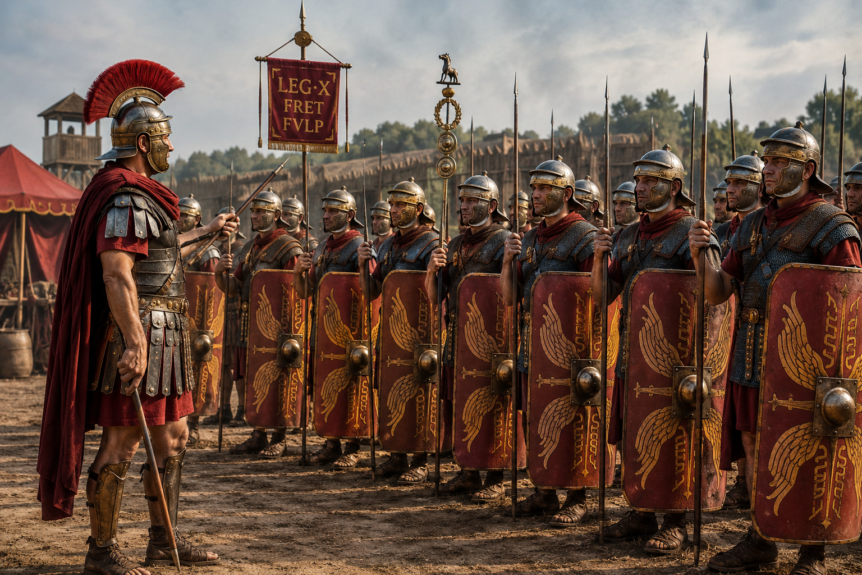
Oddly enough, no one seems to have written down the Latin commands used by the Roman army until roughly AD 580, when the East Roman Emperor Maurice included military commands in the Strategikon. That is long after the high point of the Roman legionary army and about 450 years after the period many Roman reenactment groups portray, roughly AD 130–140. Still, as far as direct command references go, that late source is one of the few things we have.
That means we need to be honest. What we call “Roman drill” today is not a perfectly preserved first- or second-century Roman drill manual. We do not have the Roman equivalent of TC 3-21.5, MCO 5060.20, or AFPAM 34-1203. What we have are fragments: later commands, ancient descriptions of training, military logic, reenactor experimentation, and practical field use. Put together carefully, they allow us to recreate a reasonable Roman infantry drill system.
This work has already been pioneered by groups such as the Ermine Street Guard, which developed a working system of Roman drill for living history display and education. Matt Amt of Legio XX Valeria Victrix also expanded and organized Roman drill material for reenactors. The result is not perfect certainty, but it is useful, disciplined, and historically informed. (LARP)
Ad Signa
Ad signa means “to the standards” or “to the signs.” In practical reenactor use, this is the command for Fall In.
When the centurio, commander for the day, or designated leader gives this command, stop what you are doing, take up your shield and pilum, and move quickly to the vexillum or designated formation point. Form a single shoulder-to-shoulder rank facing the commander.
This is not a casual gathering. It is the beginning of military order.
Silentium
Silentium means Silence.
In modern terms: no talking in the ranks. No side conversation. No adjusting equipment unless required. No joking, wandering eyes, or unnecessary movement.
A formation cannot be disciplined if the soldiers in it are still acting as individuals. Silence is one of the first indicators that a group has shifted from casual activity to military control. Legio XX’s drill guidance similarly describes Silentium as silence and attentiveness until released. (LARP)
Mandata Captate
Mandata captate literally means something like “observe the orders” or “pay attention to the commands.” This is commonly used by reenactment groups as the Roman equivalent of Attention. (LARP)
At this command, stand straight, eyes front, shield held by the grip in the left hand, and pilum held vertically in the right hand just below the square block. The body is still. The mind is on the commander.
This has a useful modern parallel. Many Spanish-speaking militaries use Atención before certain commands. Mexico, for instance, still uses that attention concept in command language. The idea is the same: prepare the formation mentally and physically to receive the next order.
Ordinem Servate
Ordinem servate means Keep your position, maintain order, or stay in formation.
This command would be used when the line needs to remain steady and each man must preserve his place. It is not a dramatic command, but it is important. A Roman formation depended on order: shield position, spacing, alignment, and the ability to move as a body.
In modern drill terms, this is not far from reminding personnel to maintain interval, alignment, and position.
A Note on Certainty
We need to be careful with claims. Some commands used by reenactment groups are based on later sources. Some are reconstructed. Some are practical Latin phrases developed because a working drill system needs commands for movements that ancient sources do not describe in complete detail.
That does not make the work invalid. It simply means we should present it honestly.
Roman drill reconstruction is a blend of:
- surviving late Roman command references
- ancient descriptions of discipline and training
- battlefield logic
- Latin grammar
- reenactor field testing
- practical movement requirements
That is very similar to what we do in modern ceremonial analysis when a manual gives the general requirement but not every small mechanical detail. We use the source, apply logic, and build a system that can be taught and repeated.
Why This Matters
Drill is not just movement. Drill is communication.
Commands create order. Standards provide orientation. Silence establishes discipline. Attention prepares the body and mind. Maintaining position preserves the formation.
Whether we are discussing a Roman century, a modern color guard, a cadet flight, or an honor guard detail, the principles remain familiar: the leader gives a clear command, the formation understands it, and the unit responds as one body.
That is the real connection between ancient and modern drill. The words have changed. The equipment has changed. The structure has changed. But the purpose remains the same: discipline, control, communication, and unified movement.
Suggested Sources and Further Reading
- Strategikon of Maurice
One of the few surviving military texts to preserve late Roman/East Roman command terminology and battlefield organization concepts. - Maurice
Traditionally credited as the author of the Strategikon. - Legio XX Valeria Victrix Roman Drill Page
Matt Amt’s long-running Roman reenactment resource containing reconstructed Roman drill commands, explanations, and formation practices. - Ermine Street Guard Official Website
One of the pioneering Roman reenactment organizations whose research and practical drill systems influenced many modern Roman living-history groups. - Matt Amt
Researcher and reenactor known for developing practical Roman drill interpretations and educational materials. - Thoughts on War
Referenced for broader military philosophy regarding discipline, command, and martial tradition. - Perseus Digital Library
Major online resource for classical texts, translations, and ancient military references. - Internet Medieval Sourcebook: Strategikon
Online excerpts and reference material from the Strategikon. - Roman Military History
Useful area of study for understanding the development of Roman drill, discipline, and battlefield communication systems. - Experimental Archaeology
Many modern Roman drill systems rely partly on experimental archaeology and reenactor field testing to bridge gaps in surviving documentation.