
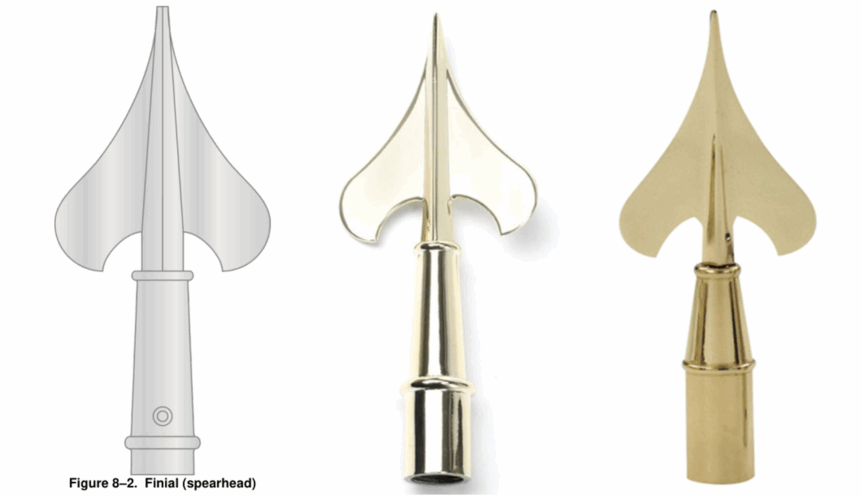
Every so often, another piece of ceremonial folklore appears that sounds authoritative because it has been repeated for years.
Maybe I need to create a Myth category…
A recent example sent to me was this:
The spade, or spearhead, on a military flagstaff is supposedly positioned with the flat side facing forward during peacetime and turned so the blade faces forward during wartime. I was told that when I was first assigned in 1990 to the 836 Air Division Honor Guard at Davis-Monthan AFB, in Tucson, AZ.
No, there is no such thing as a peacetime-versus-wartime meaning in US military drill doctrine. The orientation of the spearhead is a matter of drill and equipment alignment. It does not announce the nation’s state of war.
See The Flagstaff Spade Marker. That marker is how you ensure your finial is aligned properly.
Flat to the Front
The normal orientation of the Army Spearhead (“Spade”), is with the flat side facing forward.
An interesting problem arises when we look for that instruction because the principal drill manuals do not all state it in words.
Army TC 3-21.5, Drill and Ceremonies, does not appear to contain a textual instruction directing the color bearer to orient the flat side of the spearhead forward. Its illustrations, however, depict the staffs in the conventional flat-forward orientation. TC 3-21.5 establishes Army-wide drill procedures, but it is not the Army’s only source governing flags and flagstaff equipment.
The same situation exists in the Department of the Air Force drill publication. DAFPAM 34-1203, Drill and Ceremonies, does not appear to specifically state which side of the spade faces forward during Order, Carry, or Present.
That silence does not create an alternate orientation.
Other protocol guidance supplies the missing information.
The Army Standard
Army flag doctrine is distributed among several publications rather than contained entirely in TC 3-21.5.
AR 840-10 governs Army flags, guidons, streamers, flagstaffs, and related equipment. Army protocol publications have also addressed how that equipment is actually arranged for ceremonial use.
The 2001 edition of DA Pam 600-60, A Guide to Protocol and Etiquette for Official Entertainment, stated: “Ensure all finials are positioned in the same direction.” (That’s a bit helpful, but could be much better, Army.)
It then explains that for most Army flags this means the flat portion of the finial faces forward. (“most Army flags”? How does that work?)
The Army’s ceremonial practice continues to reflect that standard. The current Old Guard Blue Book, in its flag-mission setup guidance, states: “Flat side of finial must face toward intended audience or observer.” The Old Guard also directs that the top seam of the flag be aligned with the finial as viewed by the observer (that means the pole hem seam faces front). That is significant. The flat-forward orientation is not something assumed merely by looking at photographs. Army ceremonial guidance has explicitly stated it.
TC 3-21.5 may not repeat the instruction every time it describes Order Colors, Carry Colors, or Present Colors, but the absence of redundant wording does not authorize turning the spearhead 90 degrees and assigning a completely different meaning to it.
The Marine Corps Makes the Distinction Explicit
The Marine Corps gives us the clearest example because MCO 5060.20 specifically addresses spearhead orientation as part of drill movements. The normal orientation is flat forward. When returning the guidon from Present Guidon, for example, the manual states: “The flat side of the spearhead is back facing to the front.”
It gives essentially the same instruction when returning to Carry Guidon. The Marine Corps therefore does not leave us guessing about the normal orientation. But the Marine Corps also has a legitimate 90-degree rotation of the staff. That is where things become interesting.
The Marine Corps Exception: “Cutting the Cake”
When a Marine Corps organizational color renders its salute at Present, the staff rotates as the color is lowered. This rotation is a gradual 90-degree turn so that the spade ends up edge-forward when the arm is fully extended. When the color returns upright, the staff rotates back and the flat side of the spearhead again faces forward.
It has absolutely nothing to do with whether the United States is at war. This Marine Corps movement may be one possible source of the myth. Someone unfamiliar with the doctrine could see a Marine Corps organizational color rotate its staff at Present, recognize that the spearhead has moved from flat-forward to blade-forward, and later attach an invented explanation to that movement.
I thought this might have something to do with the origin of the myth, but the rotation of the staff is very modern. The important point is that Marine Corps doctrine tells us why that staff rotates.
When Did the Marine Corps Begin Rotating the Organizational Staff?
The history of the Marine Corps drill manual makes the staff rotation especially interesting. The requirement to keep the spearhead flat to the front is old. The requirement to rotate the organizational-color staff during the salute appears to be much newer.
The following chronology is based on the manuals and contemporary Marine Corps publications presently identified. It should not be read as proof that no unpublished local practice existed earlier. It establishes what the published doctrine actually said.
1954. The Marine Corps adopted the eight-man squad drill during a period of considerable experimentation with close-order drill. A 1960 Marine Corps newspaper account later described the eight-man system as having been adopted in 1954 and subsequently replaced by the 13-man drill. This changing drill environment is useful context because the comprehensive manual that followed was intended to consolidate material that previously had not existed in one publication.
1956. The Marine Corps Drill Manual was approved on 26 January 1956. Marine Corps historical sources confirm that date and note that the newly formalized Marine Corps Birthday ceremony was incorporated into it.
On 20 July 1956, the Camp Lejeune Globe announced that the new manual would reach bookstands in August. The article described it as a Marine Corps Association publication covering drill and ceremonies from individual drill through military funerals. Most significantly, it stated that, “For the first time, all drill and ceremonial procedures have been combined” in one manual. The paper reported that the manual was expected off the press about 1 August.
The 1956 manual itself gives us direct evidence concerning the spearhead. At Order Color, page 206 states: “Hold the staff so that the flat side of the spearhead faces front.”
At Carry Color, the manual again establishes the flat-forward orientation. Page 208 continues the movement into Carry, and page 209 describes the finished position with “the flat side of the spearhead facing front.” Then comes Present Color.
The national color bearer completes the movement with the spearhead still flat forward. The organizational color bearer then: “lowers the staff smartly to the front by straightening his right arm.” Nothing in that instruction says to turn, twist, or rotate the staff. Nothing directs the sharp edge of the spearhead downward.
That omission is important because the manual expressly discusses spearhead orientation elsewhere. It tells the bearer when the flat side faces front. If a 90-degree staff rotation had been part of Present Color, the manual was entirely capable of saying so.
1957. By 8 March 1957, there had already been at least two editions of the 1956 manual. The Marine Corps Association announced errata sheets correcting both the first and second editions. The corrections had been reviewed and approved by the Training and Test Regiment and G-3, Headquarters Marine Corps. The notice even distinguished corrections applying only to the first edition from corrections required in both editions.
That is useful publication-history evidence. The 1956 manual was not simply a privately produced handbook that happened to describe Marine drill. It was being maintained with Headquarters Marine Corps participation.
Nothing we have yet identified in those early editions establishes the later organizational-color staff rotation.
1959–1960. Marine Corps drill doctrine remained unsettled. In 1959, Marine Corps newspapers reported that a new pocket-size eight-man-drill pamphlet would serve until a forthcoming “all-inclusive Marine Corps Drill Manual” could be distributed, then expected in early 1960.
By November 1960, however, Commandant Gen. David M. Shoup had ordered the Marine Corps to abandon the eight-man squad drill and return to the Landing Party Manual for close-order drill. Contemporary reporting described the Landing Party Manual as the “old drill.” The associated revision canceled MCO 1500.13 and portions of chapter three of the Marine Corps Drill Manual.
This period is important to the publication history, but it does not presently provide evidence that the organizational-color salute acquired a spearhead rotation. Additional manuals or changes from this period would need to be examined before making that claim.
1980. On 28 August 1980, NAVMC 2691, Marine Corps Drill and Ceremonies Manual, provided another comprehensive Marine Corps treatment of drill and ceremonies. Its foreword identifies no superseded publication.
For the organizational color, NAVMC 2691 preserves essentially the same movement found in 1956. At Present, the bearer seats the staff in the sling and then: “Lower[s] the staff smartly to the front by straightening the right arm.” Again, no rotation is described. But the same 1980 manual provides a critical comparison. Present Guidon specifically requires the bearer, while lowering the guidon, to: “turn it to the right” so that the sharp edge of the spearhead faces down.
That makes the organizational-color omission considerably more significant. By 1980, Marine Corps doctrine explicitly understood a lowered staff movement in which the spearhead rotated from flat-forward to edge-down. The manual prescribed that rotation for the guidon. It did not prescribe it for the organizational color.
Thus, as late as 1980, the two movements were doctrinally different.
2003. MCO P5060.20, dated 5 May 2003, canceled NAVMC 2691. The new order stated that existing procedures had been revised and reorganized and that “a large amount of new information” had been added. This is the first manual in the documentary trail presently examined in which the organizational-color salute explicitly acquires the rotation.
Paragraph 7104 directs the organizational color bearer to lower the staff naturally to the front and then states: “The staff will rotate naturally as it goes forward” causing the sharp edge of the spearhead to face down. That is the movement Marines sometimes describe informally as “cutting the cake.” The manual also directs that when the organizational color returns upright, the flat side of the spearhead again faces front.
2019. MCO 5060.20, dated 15 May 2019, canceled MCO P5060.20 CH-1 and became the current Marine Corps Drill and Ceremonies Manual. It retained the 2003 organizational-color movement. The current manual directs the bearer to lower the organizational color and states that the staff rotates naturally so that the sharp edge of the spearhead faces down. The current manual also retains the separate, older Present Guidon rotation. When the guidon is lowered, the bearer is expressly told to rotate the staff so that the sharp edge faces down. That produces a particularly interesting historical sequence.
The 1956 organizational color lowered without any rotation. The 1980 organizational color still lowered without a rotation, while the guidon explicitly rotated. By 2003, the organizational-color salute had acquired essentially the same spearhead-orientation characteristic already found in Present Guidon. The current 2019 manual retains both. Interestingly, the rotations for each staff are in the opposite direction: the guidon rotates counter-clockwise and the flagstaff rotates clockwise.
We cannot yet say that the organizational-color movement comes from Present Guidon, but that does make sense. The seam of the pole hem is required to be at the edge of the spade for the color and guidon flag, facing opposite directions to make each rotation look correct so that each flag hangs naturally.
More importantly for the present subject, none of these publications connects spearhead orientation with peace or war. The historical record instead shows a normal flat-forward orientation, an older prescribed rotation for Present Guidon, and a later prescribed rotation for the Marine Corps organizational-color salute. That is drill doctrine developing over time. It is not a wartime signal.
The Air Force Standard
The Department of the Air Force provides an even clearer example of why we must look at more than one publication.
DAFI 90-1201, Protocol, identifies the authorized Department of the Air Force finial: “The authorized finial for DAF use is the silver spade.” It establishes the required equipment but does not, in that paragraph, specify which surface of the spade faces forward.
DAFPAM 34-1203, the drill manual, likewise does not appear to contain an explicit spade-orientation instruction.
But AFPAM 34-1202, Guide to Protocol, does. Paragraph 2.5.5 states: “Finials (metal nickel-plated spades) are parallel to the audience with flat side out.” That is explicit.
So, for the Air Force and Space Force, the photographs and illustrations showing the flat side forward are not merely artistic choices, they conform to published Department of the Air Force protocol guidance. Again, nothing in that guidance says anything about turning the spade according to whether the country is at peace or war.
This would be a good time to read: How to Properly Mount a Flag on a Flagstaff.
The Navy provides another useful example of why finial orientation is governed by function and regulation rather than invented symbolism. NTP 13(B), Flags, Pennants and Customs, specifically directs that:
“the cutting edges of the halberd and the battle-ax shall face forward.”
The current NJROTC Cadet Field Manual is even more specific for drill, directing that “the cutting edge of the battle-ax shall face forward for all drill movement.”
A Navy battle-ax carried with its broad face forward and its blade pointing sideways is not an alternate orientation. That is incorrect. Like the Army, Marine Corps, and Air/Space Force spade, the Navy finial has a prescribed relationship to the front.
This is not merely an old convention buried in an obsolete document. NTP 13(B), (15 September 1986) used by the Navy and Coast Guard, is still cited by Navy instructions. OPNAVINST 10520.1B of 28 December 2021 cites NTP 13(B) as one of its governing references for Navy flags and battle streamers.
A Joint Armed Forces Color Guard Is Different
The Marine Corps organizational-color salute should not be carried into a Joint Armed Forces Color Guard.
MCO 5060.20 distinguishes the standard Marine Corps color guard from a Joint Armed Forces Color Guard. The Marine Corps color guard carries the national color and organizational color. In the joint formation, the respective service colors are carried in service precedence next to/behind the national color.
DoDI 5410.19, Volume 4 likewise specifies that a Joint Armed Forces Color Guard carries the National and Army Colors followed by the individual Military Service Colors of the Marine Corps, Navy, Air Force, Space Force, and Coast Guard.
The Marine Corps service color in a Joint Armed Forces Color Guard is not functioning as the organizational color of a standard Marine Corps color guard. The Marine Corps organizational-color salute, including the characteristic rotation of the staff, is therefore not imported into the joint formation.
Furling and Unfurling
The same principle should govern furling and unfurling.
Here we need to distinguish an explicit written instruction from the necessary application of an established standard. I am not aware of a service manual that says, in so many words, “while furling or unfurling a color, keep the flat side of the spade facing forward.”
But we know the finished orientation because the staff will be brought to Order or Carry. The color should be unfurled and furled so that the spade ends flat facing the marching surface.
There Is No Secret Message in the Spade
There is nothing in the ball finial at the top of the flagpole and the spade is not a wartime indicator. Blade-forward does not mean war. Flat to the front does not mean peace.
The normal orientation is flat forward, and we can document that orientation in Army and Department of the Air Force protocol guidance as well as Marine Corps drill doctrine.
The notable exception is the Marine Corps organizational-color salute. At Present, the staff rotates as part of that required movement and returns flat forward when the color returns upright.
That movement has a doctrinal purpose and there is nothing symbolic about it.
This is an important Ceremony as Language principle as well. Ceremonial movements can communicate meaning, but that meaning must come from authority, established custom, or clearly identifiable ceremonial function. We cannot simply assign a dramatic story to a piece of equipment and then teach the story as military tradition.
Before accepting an explanation about colors, staffs, finials, cords, fringe, streamers, or any other ceremonial equipment, ask for the source.
And when someone claims that the position of a two-inch piece of metal communicates something as consequential as whether the United States is at war, the source should not be difficult to find. There isn’t one.