
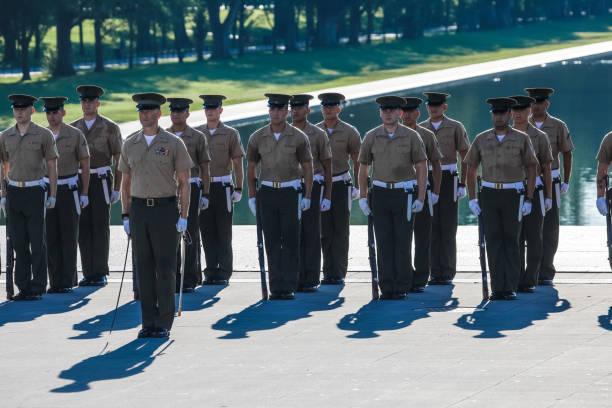
Your mother is right: stop slouching, sit up! Your posture matters.
That seems like such a simple statement, but in drill and ceremonies it reaches much deeper than “stand up straight.” Just like in dance and other physical performances, posture is the first thing the audience sees. It is the first visible evidence of discipline. Before the first command is given, before the first step is taken, before the colors move, before the rifles are shouldered, before the casket is carried, the body has already begun communicating.
And that communication is either helping the ceremony or hurting it.
In drill and ceremonies, posture is not decoration. It is not a cosmetic detail. It is not something to fix at the last second before stepping off. Posture is the physical foundation for military bearing, command presence, precision, formation awareness, and ceremonial dignity.
A performer who stands well communicates readiness, discipline, restraint, and respect. A performer who slouches, shifts weight, collapses through the torso (curved spine), looks around, or lets the equipment pull the body out of alignment communicates something very different, even if that was never the intent. The body speaks.
Posture Is Communication
Ceremonial drill is visual communication. The audience may not know the manual, the regulation, or the exact standard being applied, but they know what discipline looks like. They know what confidence looks like. They know what a trained formation feels like when they see it.
A color guard, firing party, pallbearer team, cordon, escort, or drill team represents more than the individuals in the formation. They represent a unit, department, school, service, agency, or institution. Their posture communicates whether that representation is controlled and professional or casual and unprepared.
This is why posture is part of the standard. When posture fails, bearing fails. When bearing fails, the formation loses credibility.
The Body Is the Platform
In drill and ceremonies, the body is the platform for every movement.
If the platform is unstable, the movement built on it will be unstable. Poor posture affects facings, marching, step length, equipment carriage, command voice, timing, balance, and endurance.
A color bearer with poor posture often compensates through the shoulders, wrists, lower back, or grip. A rifle bearer who collapses through the torso will usually struggle to maintain clean, repeatable positions. A pallbearer with poor body organization may transfer unnecessary stress into the neck, shoulders, back, hands, and arms.
That is not just a visual issue. It is a performance issue and, over time, it can become a health issue.
Posture also matters outside of ceremony. Daily posture affects how the body stands, sits, walks, carries, lifts, works, and recovers. The same body used in ceremony is the body used in life. Poor alignment under load, fatigue, or repetition can create unnecessary strain. Good posture supports better movement, better balance, better breathing, and better long-term function.
Kinesthetic Awareness: Feeling the Formation
There is another layer that often goes unnamed: kinesthetic awareness.
That is the better term for what many performers describe as “feeling” the formation. It is not a mystical energy field. It is not magic. It is trained body awareness.
Kinesthetic awareness is the ability to sense the position and movement of the body. In formation, that awareness expands into the performer’s relationship with others: interval, distance, alignment, cadence, equipment position, timing, and movement direction.
A well-trained formation does not depend on everyone constantly turning the head to look around. Excessive visual checking breaks bearing and creates unnecessary movement. Instead, trained performers learn to use posture, peripheral vision, sound, cadence, foot strike, equipment relationship, and repeated rehearsal to understand where they are in the formation.
They feel the cadence through the body.
They sense interval and distance.
They perceive movement without staring.
They maintain alignment without hunting for it.
That is formation awareness.
A Formation Is Not a Collection of Individuals
A formation is not merely several people standing near each other. It is a shared performance space.
Every individual movement affects the whole. One short step, one late response, one drifting shoulder, one inconsistent arm swing, one flag angle out of place, one visible overcorrection can disturb the entire visual message.
This is why drill and ceremonies require both individual responsibility and collective responsibility.
Each performer must maintain personal precision, but that precision must exist inside the larger formation. The goal is not for everyone to perform independently at the same time. The goal is for each performer to maintain the standard while contributing to one disciplined visual body.
That is what separates a group from a formation.
Posture Supports Awareness
Posture and kinesthetic awareness are connected.
A poorly organized body has less reliable balance, less consistent movement, and less stable equipment control. A performer who is fighting poor posture is less able to sense spacing, timing, and movement relationships.
Proper posture gives the performer a stable platform. From that platform, the performer can better sense weight distribution, step timing, equipment position, body alignment, and the movement of others.
This is why posture cannot be separated from formation awareness. The performer must first organize the body, then learn to move that organized body in relation to the formation.
The Instructor’s Responsibility
Instructors should not treat posture or formation awareness as one-time corrections.
“Stand up straight” is usually not enough. It is too vague. The team member needs to understand what to organize physically and why it matters.
Better instruction sounds like this:
“Bring the head over the spine.”
“Lengthen upward without arching the lower back.”
“Set the shoulders naturally.”
“Distribute your weight evenly between your feet side-to-side, and teo-to-heel.”
“Using your peripheral vision, maintain interval without turning your head.”
“Feel the cadence through the heel strike of your foot.”
“Control the body before, during, and after moving the equipment (rifle, guidon staff, flagstaff).”
“Move with the formation, not after it.”
These are teachable skills. Posture can be trained. Kinesthetic awareness can be trained. Formation awareness can be trained. But they must be taught deliberately and, once you are aware, .
The Standard Begins Before the Command
The standard does not begin when the formation steps off. It begins when the performer takes the position.
Posture tells the audience that the ceremony has begun. Bearing tells the unit that discipline is present. Formation awareness allows individuals to become one visual body. Kinesthetic awareness allows the performer to sense movement, spacing, cadence, and relationship without breaking ceremonial presence.
That is why posture matters, awareness matters,
The body speaks before the movement begins and in drill and ceremonies, it must speak clearly.
The formal doctrine behind this article:
ICS DCS 19-014: Posture as a Ceremonial, Communicative, and Functional Standard
ICS DCS 19-015: Formation Awareness and Kinesthetic Connection in Drill and Ceremonies