
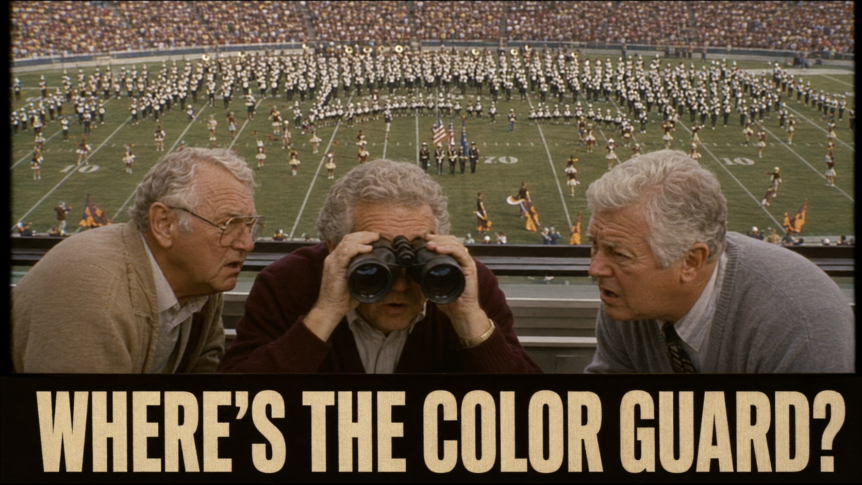
It’s marching band season again—or should I say football season?
With the football games come the pregame and halftime shows. During pregame, the band creates excitement, expresses school identity, and prepares the audience for the game. Cheerleaders, twirlers, dancers, and the marching-band color guard add movement, color, and spectacle. The combined production may involve hundreds of performers, carefully written drill, and weeks of rehearsal.
Then the military color guard enters for the presentation of the Colors and the national anthem.
At that moment, the purpose of the production changes. Entertainment gives way to ceremony. The field is no longer merely a performance space; it becomes a ceremonial space. The band and every other element on the field assume a supporting role while attention turns to the National Colors.
At least, that is what should happen.
Too often, the production does not visibly acknowledge this change. The band remains the dominant image. The auxiliary units remain staged for the show. The military color guard is inserted into whatever space is available, performs its duty almost unnoticed, and departs so that the “real” performance can continue.
I know how easily this mistake can happen because I made it myself.
My First Year as Drum Major
During my senior year of high school (‘82/’83), I served as drum major of our corps-style marching band. At one of our first home football games, the visiting school did not bring its band. Ordinarily, the visiting band performed the pregame show and concluded with the national anthem. That evening, our band was responsible for both the pregame and halftime performances.
I was nervous. My first time to conduct the Star-Spangled Banner on the field.
Our AFJROTC color guard—made up of my friends and fellow cadets—entered from the end zone to my left for the presentation of the colors. I was supposed to wait until they were right next to the band. Instead, I signaled the snare drummers to begin their roll. I then gave the downbeat for the first note of the national anthem.
The problem was that the color guard didn’t even make it past the 10-yard line.
The team stopped where it was, went to Present, and remained there while I conducted the anthem. When it ended, the color guard and band marched from the field. Rita Bell, the color guard commander, then yelled at me—and rightfully so.
I had not intended to disrespect the Colors. I had not deliberately disregarded the cadets carrying them. These were my friends, and I understood the importance of their duty. Nevertheless, my nervousness and concentration on the band’s performance caused me to begin the anthem before the color guard had reached its proper position.
Intent did not correct the message communicated on the field.
The band was ready, so I began. The color guard was still moving, but its movement had become secondary. Without meaning to, I treated the presentation of the Colors as something that had to fit within the band’s performance instead of recognizing that the performance had to support the presentation of the Colors.
Rita taught me a valuable lesson that evening: the color guard cannot be an afterthought.
[We miss you, Rita, life was too short for you.]
The Visual Grammar of the Field
Grammar is the system that organizes words so that they communicate meaning. Consider the sentences “The dog bites the man” and “The man bites the dog.” They contain the same principal words, but their arrangement changes the subject, the action, and the meaning.
Visual presentations work in much the same way.
On a football field, the performers, equipment, formations, spacing, movement, timing, and direction of attention function together as a kind of visual grammar. Placement establishes relationships. Movement directs the eye. Isolation can create prominence. A surrounding formation can frame something important—or swallow it completely. What moves, what remains still, what occupies the center, and what is pushed to the edge all communicate meaning before the announcer says a word.
During a pregame performance, the band, cheerleaders, twirlers, marching-band color guard, and military color guard are not merely separate groups sharing the field. Their arrangement tells the audience which element is the subject and which elements are supporting it.
If hundreds of performers occupy the primary formation while the military color guard is placed wherever space remains, the visual sentence has already been written: the show is the subject, and the Colors are a subordinate element.
Current Pregame Examples
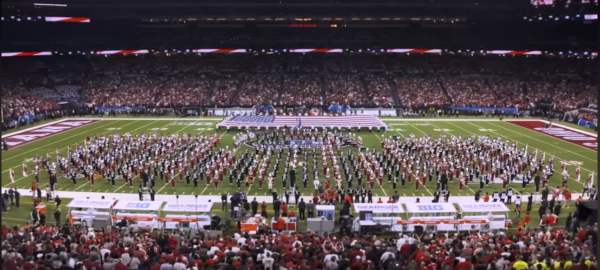
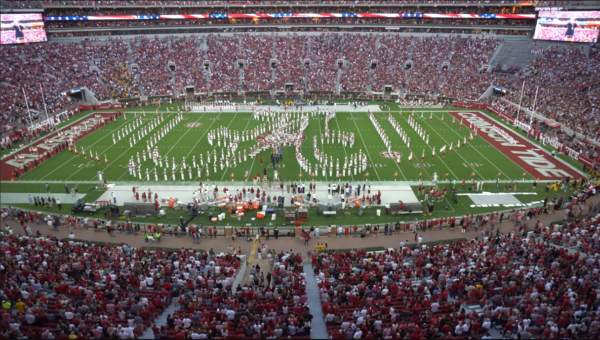
The University of Alabama demonstrates what intentional visual grammar can accomplish. The band forms its stylized “A” while positioning the military color guard front and center on the 50-yard line, within the space created by the legs of the letter. The formation remains unmistakably Alabama, but its design directs attention toward the Colors. The color guard is neither outside the production nor swallowed by it. The show itself becomes the frame for the ceremony.
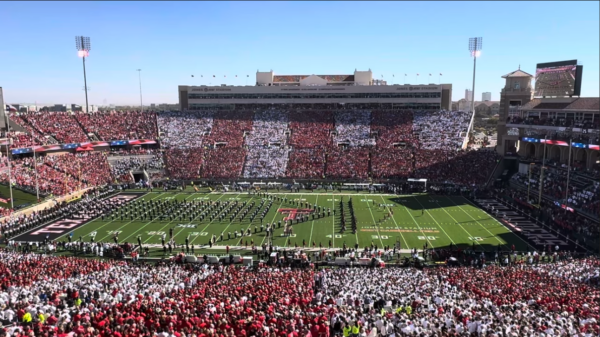
For Texas Tech, the staging does not visually support the presentation of the Colors.
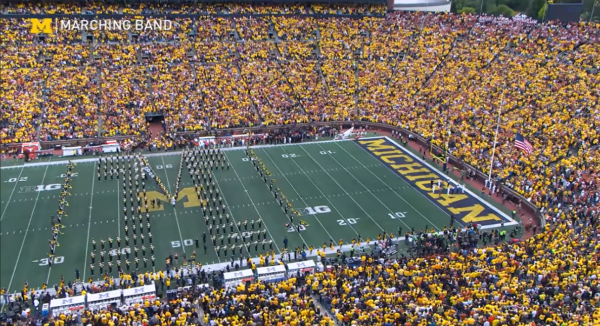
A marching color guard is not the only way to establish a dignified anthem ceremony. Michigan State uses a flag raising instead of a formal presentation of the Colors. The important point is that the ceremonial action is deliberate, visible, and incorporated into the production. The institution has chosen a method and designed the moment around it.
These examples prove that the problem is not the size of the band, the complexity of the drill, or the number of performers on the field. The difference is planning. Some productions ask the color guard to fit into the show. The best productions temporarily reshape the show around the Colors.
Horrible Visual Grammar
The announcer may ask everyone to honor America. The band may play “The Star-Spangled Banner” beautifully. Yet if the Colors are visually buried within the production, the spoken and musical language says honor while the visual language says obligation—something that had to be included before the performance could continue.
Proper visual grammar reverses that relationship. When the Colors enter, movement should resolve, attention should shift, and the formation should frame the military color guard as the unmistakable ceremonial focal point. For those moments, the Colors become the subject. Every other element on the field supports the meaning of their presentation.
Today…
After my big mistake, decades later, I still see the same failure at high school, college, and professional sporting events. The productions are larger, the formations are more elaborate, and the performers are often exceptional. Yet the military color guard is sometimes inserted into whatever space remains, nearly invisible among hundreds of musicians, marching-band flag performers, cheerleaders, dancers, and twirlers.
The anthem is played. The color guard renders honors. The schedule is satisfied. The team leaves the field. Then the “real” performance continues.
That is not merely weak staging, it’s horrible visual grammar. It communicates that the spectacle is important while the colors presentation is an obligation to be accommodated, processed, and moved out of the way.
The Colors are not an interruption in the pregame show. The pregame show must yield to the Colors.
The military color guard cannot just be inserted into whatever space remains after the band, cheerleaders, twirlers, dancers, and marching-band auxiliary have been staged. That does not merely produce an unattractive picture. It establishes a visual hierarchy in which the spectacle commands attention and the National Colors become incidental. Again, horrible visual grammar.
The institution may announce the presentation of the Colors, play the national anthem, and satisfy every item on its event schedule. Nevertheless, the visual production can communicate something entirely different: that the color guard is an obligation to be accommodated briefly before everyone returns to the performance that actually matters.
When the military color guard enters, the visual language must change. The formation, posture of the performers, stadium announcement, music, camera direction, and movement on the field must identify the Colors as the ceremonial focal point. The other elements may remain visible, but they must become the frame rather than the subject.
If the color guard is swallowed by a massive formation, hurried through its duties, and sent away almost unnoticed, the Colors have not truly been honored, just processed. Such treatment verges on insulting—not necessarily because anyone intended disrespect, but because the production’s visual language unmistakably assigns the Colors a position of lesser importance.
Write the Ceremony Into the Show
The solution is not to diminish the band’s performance. Show designers can write outstanding drill, stage hundreds of performers, and have everyone positioned for a powerful opening immediately after the presentation of the Colors. However, that drill set must be adapted briefly to serve the ceremony taking place within it.
The formation can open to create a deliberate ceremonial space. Performers can redirect their bodies and attention toward the military color guard. Movement can stop, visual distractions can be reduced, and the color guard can be given a clear route to its designated position. For those few moments, the staging must identify the Colors—not the band—as the focal point.
After the anthem, the color guard must also be given the time and visual space necessary to recover from Present, depart with dignity, and clear the field. The formation can then reset, the visual focus can return to the band, and the pregame performance can continue exactly as designed.
This does not require sacrificing musical or visual excellence. It requires planning the ceremony with the same care used to plan the show. The band director, drill designer, athletic staff, stadium-production personnel, and color guard commander must coordinate early enough that the presentation of the Colors is built into the production rather than inserted into it afterward.
The transition may last only a few minutes, but its meaning is unmistakable: the performance has paused because something more important is taking place.
Do not find an empty spot for the color guard. Write the ceremony into the show.