
While watching an older video of Morning Colors at Marine Barracks Washington, I initially heard the preparatory command as: “Colors, ATTENTION.”
That immediately caught my attention. Colors identifies a color guard, while the personnel raising the flag at a stationary flagpole or mast constitute a detail. I returned to the recording, listened more carefully, and found that the complete command was: “Color Detail, ATTENTION.”
The word detail was difficult to hear for me. Finding it resolved what had actually been commanded, but it did not entirely resolve the terminology problem.
Marine Barracks Washington was following its written order. The deeper question is whether color detail accurately identifies personnel who do not carry colors but instead hoist the national ensign during the ceremony historically known as Morning Colors.
A Brief History of Morning and Evening Colors
The daily colors ceremony developed from British naval custom. Official U.S. Navy historical accounts trace its formalization to 1797, when Admiral Lord St. Vincent established a more formal Royal Navy practice for raising and lowering the ensign and jack with the guard and band present. This followed the fleet mutinies at Spithead and the Nore, during a period in which St. Vincent sought to restore discipline and regularity throughout the fleet.
The United States Navy adopted the practice early in its history. Modern Navy and Marine Corps historical accounts frequently identify the 1843 Rules and Regulations for the Government of the Navy as the point at which the United States adopted the British tradition. However, the expression morning colors appears in the 1815 general orders for USS Independence. American naval use therefore predates the 1843 regulations by at least 28 years.
The 1843 publication is better understood as an early Navy-wide regulatory codification, particularly of the time at which Morning Colors would occur. If sunset occurred after 1800, Morning Colors was conducted at 0800. If sunset occurred earlier, Morning Colors was conducted at 0900. This seasonal schedule reflected contemporary British naval practice.
During the 1870s, the Navy standardized Morning Colors at 0800 regardless of the season. Evening Colors remained tied to sunset.
Navy General Order No. 374, dated July 26, 1889, prescribed a uniform routine “at morning and evening colors” aboard commissioned warships and at naval stations. When a band was present, it played “The Star-Spangled Banner” at Morning Colors and “Hail Columbia” at Evening Colors. Naval personnel faced the colors and saluted as the ensign reached the peak or truck when hoisted or reached the deck or ground when lowered.
Later Navy musical manuals separately identified “Morning Colors” and “Evening Colors” as routine bugle calls. The Navy’s Manual for Buglers described Morning Colors as the call sounded during the raising of the flag at 0800. Evening Colors, also identified as “Retreat,” accompanied the lowering of the flag at sunset.
Current United States Navy Regulations, Chapter 12, Article 1206, retains the historical terminology. It formally identifies the ceremonial hoisting and lowering of the national ensign at 0800 and sunset as morning colors and evening colors, respectively.
The custom inherited from the age of sailing ships therefore remains part of the daily ceremonial language of the United States sea services.
What Morning Colors Identifies
Morning Colors identifies the ceremony. It can also identify the associated naval bugle call, depending on context. The term does not identify the personnel standing at the mast. It also does not change the technical identity of the flag being raised. MCO 5060.20, Marine Corps Drill and Ceremonies Manual, distinguishes among the national flag, national colors, and national ensign according to how the flag is used.
When the national flag is mounted on a staff and carried by an individual or displayed in a fixed location, it is called the national colors. When the national flag is flown from a flagstaff or mast, it is called the national ensign.
The distinction is functional:
- Colors are carried or displayed on a staff.
- The ensign is hoisted, flown, and lowered on a halyard.
- Morning Colors is the ceremony during which the ensign is hoisted.
These related terms belong to the same ceremonial system, but they do not identify the same thing.
The Personnel at the Mast
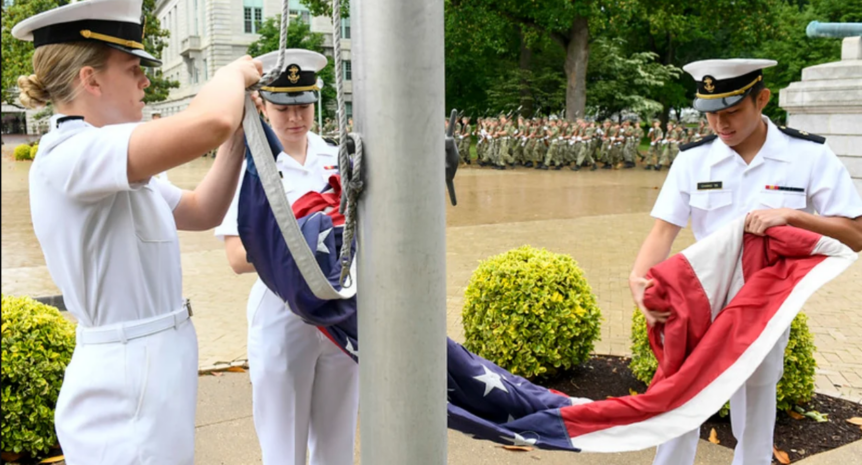
MCO 5060.20 identifies the personnel assigned to hoist and lower the national ensign as a detail. Chapter 7 describes a detail consisting of a noncommissioned officer and two enlisted members of the guard. The detail forms at the guardhouse, marches to the flagstaff, mans the halyards, hoists or lowers the ensign, secures the halyards, reforms, and returns to the guardhouse.
The general grammar of Marine Corps drill also permits a small assigned formation to be addressed as a detail:
“Detail, ATTENTION.”
That preparatory command identifies the formation who must respond. It does not rename them according to the ceremony they support or the equipment they handle.
A color guard is different from a detail. Its members carry the national and organizational colors. MCO 5060.20 appropriately permits the senior color bearer to address that formation as Colors, as in:
“Colors, ATTENTION.”
In that instance, Colors identifies the formation being commanded.
The mast detail is not a color guard. Its members do not march with national and organizational colors. They do not have guards. They hoist or lower the national ensign. The appropriate identification of the formation is therefore simply:
“Detail, ATTENTION.”
A Flag Detail, but the Command Is “Detail”
The formation assigned to hoist or lower a flag, or national ensign may be descriptively identified as a Flag Detail. The qualifier flag distinguishes that formation from the other recognized use of the term, a work detail.
When either formation is addressed in drill, however, the command identifier is simply:
“Detail, ATTENTION.”
This distinction between a descriptive name and a command identifier is important. The full name tells us what kind of detail has been assembled. The preparatory command tells the formation that it must respond.
The widespread use of detail as a generic name for almost every formation is a separate example of terminological drift. Most formations possess their own prescribed or functionally accurate identifiers, including Colors, Platoon, Firing Party, Cordon, and Squadron. Those identifiers are used because they preserve the formation’s identity and function. For more on why every temporarily assembled ceremonial group should not be addressed as “Detail,” see “‘Detail’ and Its Connotation.”
Only a formation doctrinally organized and addressed as a detail should receive the preparatory command “Detail.” A firing party does not become a detail merely because its members were detailed to the assignment. A color guard does not become a detail because it was assembled for one ceremony. Assignment and formation identity are not the same thing.
The correct distinction is therefore:
- The formation is descriptively a Flag Detail.
- The preparatory command is “Detail.”
- The ceremony is Morning Colors.
- The object hoisted is the national ensign.
The expression “Color Detail, ATTENTION” mixes the historical name of the ceremony—or the identity of carried colors—with the command identifier of the flag detail.
An Inconsistency in the Marine Corps Manual
MCO 5060.20 uses color detail in several places. When describing the replacement of an ensign on a flagstaff with only one halyard, Chapter 7 refers to “two color details.” One detail lowers the old ensign, while the other hoists the replacement. The manual also describes a folded flag being carried to Morning Colors or from Evening Colors “by a color detail.”
Therefore, color detail is not merely an unauthorized local expression. Marine Barracks Washington has support for the terminology in the Marine Corps manual. That fact requires an important distinction between authority and accuracy.
Marine Barracks Washington is following its governing order. The Barracks Order draws from terminology that appears in MCO 5060.20. It would therefore be inaccurate to accuse the participating Marines of violating the written procedure. It is still appropriate to examine whether that written terminology maintains the necessary distinctions.
The manual already gives us the accurate terms:
- The ceremony is Morning Colors.
- The flag on the halyard is the national ensign.
- The personnel at the flagstaff constitute a detail.
- A formation carrying colors is a color guard.
Calling the mast personnel a color detail blurs those categories. The problem is not that the term lacks written authority. The problem is that the written authority uses its own terminology inconsistently.
What Is Raised?
The final order presents another example of compressed terminology:
“STRIKE EIGHT BELLS, SOUND AND RAISE THE MORNING COLORS.”
The intended action may be understood within the Barracks, but the sentence combines several separate acts. Its grammar makes the morning colors appear to be the object of both sound and raise. Morning Colors can be sounded as a bugle call. Morning Colors can also be conducted as a ceremony. The national ensign is what is physically hoisted.
A more precise construction would be:
“STRIKE EIGHT BELLS. SOUND MORNING COLORS AND HOIST THE ENSIGN.”
The procedural text could then specify that the detail begins hoisting the ensign smartly on the first note of the music.
That wording preserves the separate identities:
- The bell is struck.
- The call is sounded.
- The ensign is hoisted.
- The ceremony is Morning Colors.
- The personnel constitute the detail.
Is This Really a Correction of Marine Barracks Washington?
Some readers may regard any criticism of terminology used at Marine Barracks Washington as presumptuous. The Barracks possesses extraordinary ceremonial experience, institutional knowledge, and national visibility. That prestige deserves respect. It does not make every sentence in every order immune from examination.
This article does not allege that the Marines in the video performed Morning Colors incorrectly. They followed the command prescribed by their order. Nor does it claim that color detail was invented casually at the Barracks. The analysis concerns the language of the written system.
An authoritative publication can prescribe a term while still using that term imprecisely. Authority establishes what personnel are required to do. Analysis determines whether the language accurately identifies the people, objects, relationships, and actions involved.
Those are different questions.
“Color Detail, ATTENTION” is prescribed.
“Detail, ATTENTION” is more precise.
Recognizing that distinction is not disrespect toward the Marines performing the ceremony. It is respect for the ceremony and for the institutional language the Marines have been entrusted to preserve.
Ceremony As Language
Ceremonies communicate through assigned identities, movements, objects, sounds, and words. The preparatory portion of a command identifies who must act. The command of execution tells that person or formation what to do.
- “Detail, ATTENTION” tells the assigned flagstaff personnel to assume attention.
- “Colors, HALT” tells a color guard to halt.
- “Attention” sounded by a bugler tells everyone affected by the ceremony to stop and render the prescribed courtesies.
- “Morning Colors” identifies the ceremonial observance.
- “National ensign” identifies the flag being hoisted.
When those terms are collapsed into one another, experienced personnel may still understand the intent and complete the ceremony successfully. Completion, however, is not the same as meaning.
Authority before aesthetics requires us to begin with the governing publication. It does not require us to stop thinking once we find the printed words. Written authority must also be examined for internal consistency, clarity, and its ability to communicate beyond the institution that produced it.
Ceremony is language. Every word identifies something, assigns a role, or directs an action. The more precisely those words are used, the more faithfully the ceremony communicates.
Conclusion
The Marines completed the ceremony using the command audibly rendered in the video. Because MCO 5060.20 itself uses the term color detail, the expression has institutional precedent. The question is not whether the command was locally authorized; the available public evidence does not answer that. The question is whether color detail preserves the distinction among Morning Colors, the national ensign, the Flag Detail, and a color guard.
This analysis is based exclusively on the publicly observable ceremony and publicly available governing publications. It does not attempt to describe or evaluate any internal Marine Barracks Washington order or locally controlled procedure.