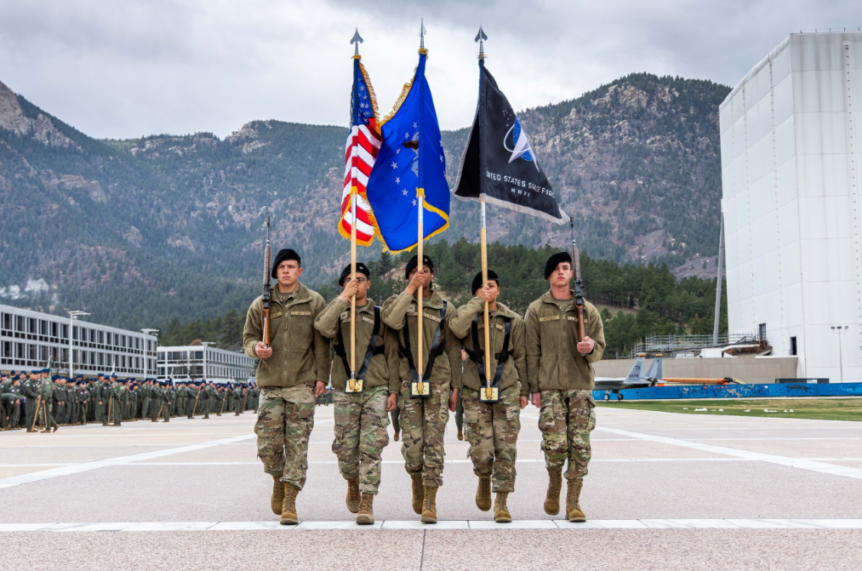
Joint color guards representing the Department of Homeland Security are increasingly visible at national ceremonies, public events, and major sporting venues. Their presence reflects the broad mission of DHS and the service of its many law-enforcement components.
Color Guard — The History of the Flag and Sword
In recent years, I have seen an increasing number of color guards—military, veteran, cadet, and ceremonial—placing swords or sabers in escort positions.
Why Drift and Ego Are So Prevalent in Drill & Ceremonies
Drift in Drill & Ceremonies is not accidental.
It is not generational. It is not ignorance alone. And it is not simply ego.
The Simultaneous-Pivot Countermarch Problem
Authority, Emulation, and Ego in Drill & Ceremonies The category error: elite ceremonial technique being imitated in environments where it is not authorized. This is subtle — and therefore more dangerous — because it looks disciplined. What People Are Copying The maneuver being imitated is the four-man color guard countermarch executed with simultaneous pivots, as performed by: This technique is …
Shoulder-to-Shoulder vs. Close Interval
This is a doctrinal bleed-over problem: honor guard practice migrating into regulation drill competition.
The two environments are not the same mission set.
Finial Orientation During Uncasing and Casing
Army JROTC follows the TC to the letter. Marine Corps, Navy, and Coast Guard JROTC follow the same guidance with MCO 5060.20 guidon techniques. Air and Space Forces JROTC follow the same guidance with AFPAM 34-1203 guidon techniques.
Why the Navy and Coast Guard Use the Marine Corps Order for Drill and Ceremonies
Let’s dive into the history of drill and ceremonies manuals and see the progression of drill and ceremonies for the US Marine Corps (USMC), US Navy (USN), and US Coast Guard (USCG).
Who Does Your Color Guard Represent?
This subject is one of the most common sources of confusion in Color Guard training, especially in scholastic and cadet programs. The root problem is that people treat flags as decoration, local pride, or a “nice touch,” when in reality every color carried in formation is a public statement of authority and representation.
When the Route Forces Your Back to the Audience
For more than a decade, one particular competition scenario has generated persistent confusion among instructors, judges, and competitors alike: the U-shaped posting route commonly used in Veterans of Foreign Wars (VFW) and American Legion (AL) color guard competitions.
The “Retreat” of the National Color Bearer
Within military and ceremonial traditions, the color guard exists to present, protect, and honor the national colors. Every movement executed by the formation is governed by doctrine, purpose, and symbolism—not improvisation.