
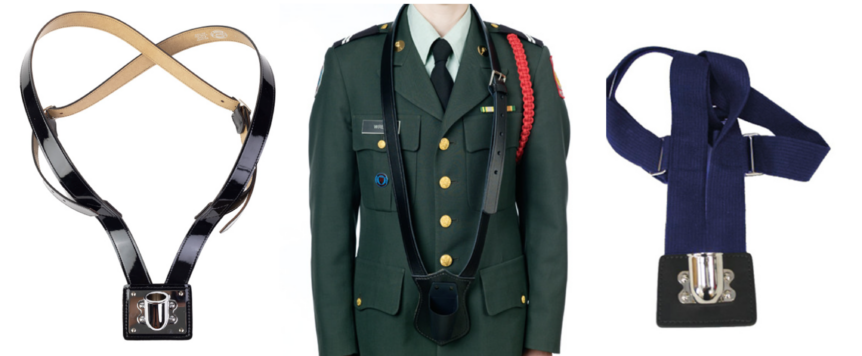
The traditional military term for the equipment worn by a color bearer is the “colors sling.” The Institute for Ceremonial Standards uses the term “colors harness” instead. “Sling” can easily be confused with the sling attached to a rifle, while “colors harness” clearly identifies the load-bearing equipment worn by the bearer.
That distinction matters because the harness is not merely a uniform accessory. It carries the weight of the flagstaff, finial, color, cords, and potentially numerous battle or campaign streamers.
The Army authorizes both single-strap and double-strap designs. The single strap is relatively common because it is inexpensive and widely available. It is also the weaker design from an ergonomic standpoint.
A single-strap colors harness passes around the neck and concentrates the suspended load across a relatively narrow area. The wearer may compensate by tightening the neck and shoulders, changing posture, leaning, or pulling upward on the staff with the hands.
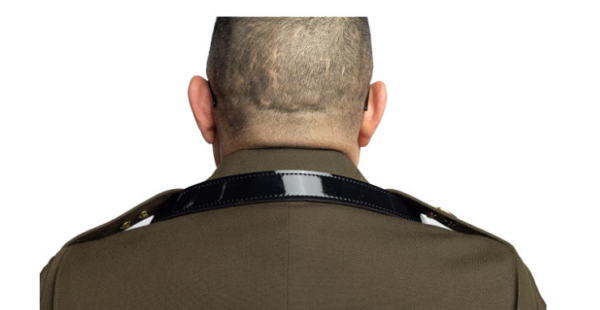
A double-strap harness passes over both shoulders and crosses at the back. This distributes the load across the shoulders and upper back instead of suspending it primarily from the neck.
Authorization does not mean that both designs are equally suitable.
The difference becomes more important when the color assembly is heavy, carries many streamers, is used during repeated rehearsals, or must remain at Carry for an extended ceremony. It is especially relevant for cadets and smaller-framed bearers who may be reluctant to report pain or discomfort.
In the image at the top of the page is a single harness in the center flanked by two double harnesses.
Organizations often purchase single-strap harnesses because they cost less. The person making the purchase, however, is usually not the person who must wear the equipment. The organization receives the savings while the bearer carries the physical burden.
The Institute for Ceremonial Standards recommends the properly fitted double-strap colors harness for routine training and ceremonial use. Existing single-strap harnesses should be evaluated and gradually replaced, particularly for heavy colors, extended ceremonies, frequent use, and youth programs.
Ceremonial personnel should not be expected to overcome preventable equipment deficiencies through pain, muscular effort, or silence.
When two authorized items accomplish the same ceremonial purpose, leaders should select the one that reduces unnecessary physical stress on the performer.
The full discussion, implementation framework, and ICS position are available in ICS DCS 19-017, Load Distribution and the Single-Strap Color Bearer Harness: Ergonomic Risk, Equipment Selection, and Command Responsibility.
All images courtesy of Glendale Parade Store.