
INSTITUTE FOR CEREMONIAL STANDARDS
Doctrine Clarification Series
DCS 20-001 Competitive Timing Logic in Military Drill Performance
- DCS 20-001 — Full Paper
- DCA 20-001 — Website Condensed (this) Article
- DCA 20-001I — Infographic Summary
The Structural “Why” Behind Time Limits
Time limits in drill competition are not arbitrary administrative constraints. They are structural safeguards rooted in physiology, motor learning science, program design theory, audience psychology, and adjudication reliability.
When timing windows are inflated without structural justification, performance density declines, fatigue artifacts increase, and evaluation integrity degrades.
This paper explains why.
Performance Quality Is Density, Not Duration
Competitive drill performance is evaluated on:
- Vocabulary depth
- Transitional control
- Risk execution
- Precision recovery
- Visual clarity
None of these variables inherently improve with longer duration. In fact, beyond specific physiological thresholds, duration begins to work against performance precision.
Time limits exist to protect density.
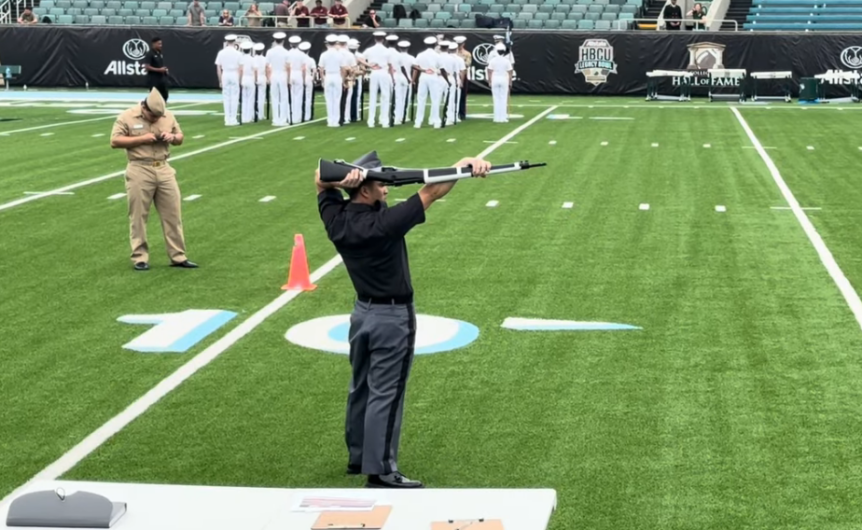
Exhibition Solo: The Physiological Window
An exhibition solo is a sustained high-intensity neuromuscular task requiring:
- Continuous grip endurance
- Repetitive forearm flexion and extension
- Rapid shoulder stabilization
- Trunk rotational control
- Fine motor correction under velocity
From a kinesiology perspective, this involves repeated submaximal contractions of the forearm flexors/extensors, deltoids, rotator cuff stabilizers, and core musculature.
Fatigue Thresholds
Research in neuromuscular physiology demonstrates:
- Fine motor precision declines as muscular fatigue accumulates due to motor unit recruitment shifts and metabolite buildup (Enoka & Duchateau, 2008).
- Sustained isometric and repetitive concentric contractions beyond 2–3 minutes increase tremor amplitude and reduce movement smoothness (Hunter, 2018).
- Grip endurance specifically shows measurable force variability increases after prolonged sustained activation (Vigouroux et al., 2006).
In practical terms:
After approximately three minutes of sustained high-output rifle manipulation:
- Micro-tremor increases
- Spin velocity consistency declines
- Drop probability rises
- Recovery margins shrink
Beyond four minutes, performers must either reduce vocabulary density or accept visible precision degradation.
An exhibition solo is not an endurance event. It is a precision event under dynamic load.
Recommended Structural Window
- Minimum: 2:00
- Maximum: 4:00
- Optimal Design Target: ~3:00
This window preserves intensity without forcing fatigue-induced decay.
Programming Integrity and Design Density
A well-constructed solo must include:
- Plane variation
- Tempo contrast
- Directional travel
- Risk escalation
- Structured developmental arc
As duration extends beyond four minutes, designers typically compensate by:
- Repeating vocabulary
- Inserting transitional filler
- Artificially pacing to conserve stamina
This reduces density per minute — the opposite of competitive refinement.
In motor learning terms, prolonged performance under fatigue increases variability of execution (Schmidt & Lee, 2019). Increased variability is not artistic nuance — it is neuromuscular instability.
Audience Engagement Dynamics
Attention science indicates that sustained focus on a single performer without major environmental change typically peaks around 2–4 minutes before engagement declines (Kahneman, 2011).
Exhibition solos require escalating novelty to maintain audience energy. If novelty plateaus while duration increases, enthusiasm decreases.
Audience reciprocity matters. Energy exchange between performer and spectators influences perceived intensity and overall effect.
Well-calibrated timing preserves engagement without stagnation.
Team Exhibition: Different Structural Mechanics
Team events operate under distributed load:
- Responsibility is shared
- Staging geometry evolves
- Visual density sustains attention
- Feature moments rotate
With 9–25 performers, endurance is not concentrated in one neuromuscular system.
An 8–10 minute window allows:
- Introduction
- Development
- Feature staging
- Impact sequence
- Controlled resolution
Shorter compresses development.
Longer risks structural drag and repetitive staging.
Here, duration supports architecture because load is distributed and visual variables shift continuously.
Color Guard: Ceremony + Precision
Color Guard competition integrates:
- Ceremonial pacing
- Manual of arms precision
- Marching alignment
- Flag handling transitions
- Reporting protocol
Unlike exhibition drill, pacing must accommodate dignity and formal sequence.
An 8-minute maximum is structurally appropriate. It allows:
- Proper presentation
- Evaluated movement segments
- Technical transitions
- Formal closure
Excessive duration risks stagnation. Insufficient duration compresses procedural integrity.
Adjudication Reliability
Judges are subject to cognitive load limitations.
Prolonged exposure to repetitive high-speed performance increases:
- Scoring drift
- Recency bias
- Comparative distortion
- Decision fatigue
Research in cognitive psychology demonstrates that sustained decision-making degrades accuracy over time (Baumeister et al., 1998).
Concise, dense programs are easier to evaluate consistently and comparatively.
Competition design must protect judging integrity as much as athlete safety.
Comparative Systems
Established pageantry circuits such as Winter Guard International and Drum Corps International utilize calibrated timing structures for the same reasons:
- Density over duration
- Competitive equity
- Physical sustainability
- Judging consistency
Timing is architectural — not cosmetic.
Structural Principle
Time limits should reward:
- Precision over exhaustion
- Design over repetition
- Density over duration
- Mastery over stamina
If a solo is extended to seven minutes, the critical question is not whether a performer can survive it.
The question is:
What structural principle requires it?
If no physiological, design, or adjudicative justification exists, recalibration is warranted.
Selected References
Baumeister, R. F., et al. (1998). Ego depletion and decision fatigue. Journal of Personality and Social Psychology.
Enoka, R. M., & Duchateau, J. (2008). Muscle fatigue: What, why, and how it influences performance. Journal of Physiology.
Hunter, S. K. (2018). The relevance of fatigue in neuromuscular performance. Exercise and Sport Sciences Reviews.
Schmidt, R. A., & Lee, T. D. (2019). Motor Learning and Performance.
Vigouroux, L., et al. (2006). Grip force variability under fatigue conditions. Clinical Biomechanics.
Doctrine Clarification Article — DCA 26-001A
Institute for Ceremonial Standards