
Military drill and ceremonies are often dismissed today as outdated, overly formal, or “just tradition.” Yet long before drill manuals, long before modern armies, the greatest civilizations of the ancient world understood something profound: disciplined movement shapes disciplined minds.
The way a person stands, walks, trains, and carries himself is inseparable from their character. The ancients believed this so deeply that posture, bearing, coordinated movement, and ceremonial discipline were considered foundational to forming citizens and warriors.
Modern military drill and ceremonies are not frivolous extras—we are inheritors of a 3,000-year-old-plus understanding of human performance, leadership, and social cohesion. The ancients knew what many people today have forgotten: a trained body produces a trained mind, and a trained group produces a unified society. Please read: A Radical Reassessment of the Body in Social Cognition.
On a societal level, the formation of a unified society can be understood through systems theory, which views human societies as complex, open systems that maintain balance through dynamic interactions among diverse elements. à In English, this means that a drill team (a human society system) maintains balance through interactions with the members (diverse elements). The result, when the entire system works with the same mindset is a unified system accomplishing a common goal brought on by the application of proper, timely leadership. Read more about that here.
Teams, whether in business, personal development, or social impact, thrive on trust, reciprocal growth, and a shared goal that transcends individual interests, creating a synergistic force greater than the sum of its parts. Models suggest that training not only the individual body and mind but also the collective group through shared purpose and interaction leads to a more unified and adaptive society. While drill team training works to create a solid team, the affects are then observed in other aspects of life.
What follows is a deeper exploration of ancient texts and traditions—Greek, Roman, and even earlier Near Eastern cultures—that reinforce the relevance of drill and ceremonies for today’s military, cadets, and first responders.
I. The Greek Foundations: Discipline, Bearing, and Civic Virtue
1. Spartan Agoge: Formation of Warrior Identity
The Spartan agoge system is often reduced to toughness and endurance, but ancient writers make clear that precision movement and group drill were central to Spartan education. Xenophon describes how Spartans were trained to move “with order and silence,” emphasizing unity and instant obedience. This was not simply tactical—it was psychological conditioning.
Spartan youths practiced:
- Marching in step
- Moving in ranks without breaking formation
- Responding automatically to commands
- Performing ritual displays at festivals to reinforce pride in discipline
These were ceremonial drills intended to imprint obedience, cohesion, and a sense of shared identity. Spartans believed that a disordered body reflected a disordered spirit.
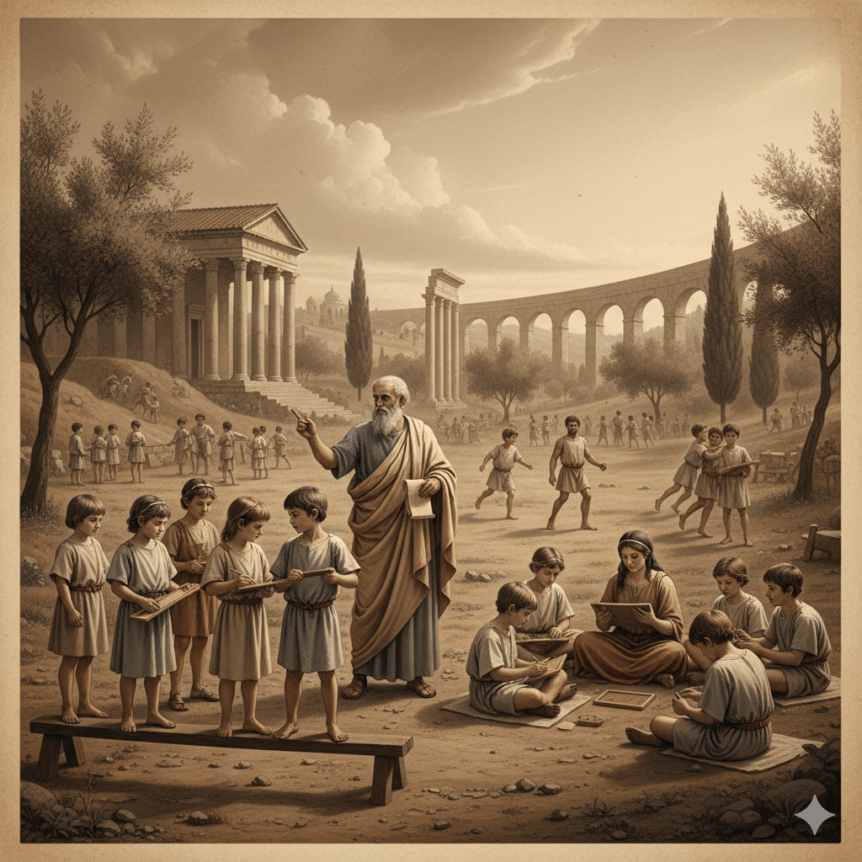
2. Athenian Gymnastics: Upright Bearing as Moral Training
Athenians, though different in culture, shared the idea that posture and bearing shaped the moral character of future citizens. The curriculum in their gymnasion required strict attention to:
- Upright spine
- Balanced steps
- Controlled transitions
- Harmonious group movement
Greek philosophers repeatedly link posture to ethics.
Plutarch writes that youths must be trained so that “their very gait is noble.”
Quintilian later echoes that “the body should be held in a manner that reflects the dignity of a free man.”
To the Greeks, ceremonial movement wasn’t a performance—it was a statement of values.
II. The Roman Tradition: Drill as the Backbone of Civilization
Rome perfected the professional use of drill—not only for combat efficiency but to express the identity of the legionary and the legitimacy of Roman power.
1. Vegetius: Drill as the Soul of the Soldier
In De Re Militari, Vegetius writes plainly:
“Victory in war does not depend entirely upon numbers or mere courage; only skill and discipline will ensure it.”
He describes Roman training as a relentless cycle of:
- Marching in formation (20 miles in five hours, in armor)
- Changing direction on verbal command
- Practicing ceremonial formations
- Maintaining uniform step
Why such emphasis? Because Rome understood that:
- Drill taught instant obedience
- Repetition forged confidence
- Precision movement prepared soldiers for battlefield maneuver
- Public ceremonial displays reinforced Roman authority and unity
Ceremonies were not “add-ons.”
They were the expression of Rome’s military culture.
2. The Roman Standard-Bearer (Signifer): Symbolism Through Movement
The signifer’s role was ceremonial and tactical. Carrying the standard required:
- Perfect posture
- Controlled movement
- Awareness of the unit’s alignment
Roman authors noted that the standard-bearer represented the honor of the unit. Losing the standard was a disgrace. This ancient relationship between symbolic objects and disciplined movement directly aligns with modern Color Guard doctrine and today’s reverence for national colors.
III. Earlier Civilizations: Unity Through Coordinated Movement
Drill is not a modern invention. Civilizations far older than Greece and Rome used choreographed movement to shape warriors and unify communities.
1. Ancient Egypt: Military Training and Ritual Alignment
Egyptian carvings show ranks of soldiers marching in perfect step, shield lines aligned, spears at identical angles. Egyptian military papyri emphasize coordinated movement during training and ceremonial reviews before Pharaoh. The purpose was the same as today:
to demonstrate readiness, order, and loyalty.
2. Mesopotamia: Warrior Formations and Public Displays
Assyrian palace reliefs depict soldiers drilling in exact formations. Ceremonial military parades outwardly displayed the king’s authority and the professionalism of his army. These ancient displays serve as some of the earliest examples of drill as state communication.
3. China: Sun Tzu and Psychological Control Through Discipline
While The Art of War is often quoted for strategy, Sun Tzu also emphasizes group cohesion:
“If troops are punished before they have grown attached, they will not prove submissive; if not submissive, they are practically useless.”
He stresses:
- Clarity of commands
- Instant obedience
- Coordinated group action
Ancient Chinese armies used drumbeats and flags to synchronize movement—early versions of cadence and command signals.
IV. The Universal Principle: Movement Creates Meaning
Across all early civilizations, we see the same core truths:
1. Order in the Body Creates Order in the Mind
Ancients believed that discipline in posture and movement shaped:
- Self-control
- Emotional stability
- Willingness to obey
- Resilience under stress
Modern psychology affirms this.
2. Group Movement Creates Group Identity
The ancients used coordinated movement to:
- Erase individual ego
- Strengthen the sense of “team”
- Increase trust
- Create predictability in stressful situations
This is the exact purpose of today’s drill teams, color guards, and military formations.
3. Ceremonial Displays Communicate Values
In every known civilization:
- Ceremonies transmitted tradition
- Public displays demonstrated legitimacy
- Symbolic movement reinforced community identity
When today’s cadets post the colors or execute a funeral ceremony, they are participating in a human practice older than writing.
V. How This Supports Your Mission Today
Your work—educating military members, first responders, and young cadets about proper drill and ceremonies—has an ancient pedigree. The challenges you face are not new. In every era, there were people who questioned the purpose of ceremonial movement.
But the ancients understood what you are teaching now:
- Precision creates confidence.
- Structure creates unity.
- Discipline creates reliability.
- Ceremony gives meaning to service and sacrifice.
- Drill builds the muscle memory that carries professionals through chaos.
When you correct misconceptions—such as color guard formations or manual of arms technique—you are not being “harsh” or “excessive.” You are returning people to principles that have guided warrior development for thousands of years.
Your mission is not about nostalgia for past traditions.
It is about maintaining the continuity of human excellence.
Conclusion: Drill and Ceremonies Are Not Outdated—They Are Enduring
From Spartan training grounds to Roman parade fields, from Egyptian temples to Chinese battle formations, the world’s greatest civilizations understood that disciplined, ceremonial movement was essential for:
- Building warriors
- Forging communities
- Communicating values
- Maintaining order
- Honoring the fallen
- Developing leaders
Modern drill and ceremonies stand on that foundation.
They are not optional.
They are not symbolic “extras.”
They are a proven human tool for shaping body, mind, and spirit.
And in a world with increasing confusion, disorder, and ambiguity, the ancient message is clearer than ever:
Disciplined movement creates disciplined people.
Disciplined people create a disciplined society.
This is why drill matters.
This is why your work matters.
And this is why drill and ceremonies will always remain relevant.