


The Firing Party: History, Authority, and the Three-Volley Rifle Salute
A question I recently received illustrates one of the most persistent misunderstandings surrounding the military firing party:
“Can I use a firing party of seven to fire 13 shots? The first volley would be seven and the second would be six to complete 13 as requested. This is for a county’s 250th-anniversary concert.”
The answer is no; it’s not authorized.
Seven members firing the first time and six firing the second time would not create a recognized 13-shot salute. It would produce two uneven rifle discharges, omit the third required volley, and improperly use a firing party to imitate a numbered gun salute.
A firing party renders the Three-volley Salute. A cannon battery (artillery) or ship renders a gun salute. They are separate honors and are not interchangeable.
It Is Not a 21-Gun Salute
A seven-man firing party fires three volleys. Each member fires one blank cartridge during each volley:
7 rifles × 3 volleys = 21 individual cartridge discharges.
That arithmetic has caused generations of people—including journalists, ceremony organizers, veterans, and even some ceremonial teams—to call it a “21-gun salute.”
That name is incorrect.
The members carry rifles, not guns in the ceremonial meaning of a gun salute. More importantly, the number 21 does not define the honor. The firing party renders three volleys regardless of whether three, five, seven, nine, ten, or twelve members fire.
A numbered gun salute is rendered with cannon, artillery pieces, or naval saluting guns. The rounds are fired separately at prescribed intervals. The number of rounds is determined by the recipient, office, occasion, or governing authority.
A firing party cannot be used as a substitute merely because rifles are available.
European and British Antecedents
The American three-volley rifle salute did not originate in isolation. The early American military inherited much of its organization, drill, terminology, and ceremonial culture from European armies, especially the British Army.
Military escorts, armed funeral processions, salutes, and ceremonial firing were already established features of prominent funerals in colonial America. These practices strongly suggest the continuation and adaptation of European custom rather than the creation of an entirely new American ceremony.
A frequently repeated explanation traces the three volleys to European battlefields of the 17th and 18th centuries. According to that account, opposing forces temporarily suspended fighting so that the dead and wounded could be removed. Three shots or volleys then signaled that the work was complete and that the forces were prepared to resume combat.
That explanation is plausible and has been repeated in later military publications, but the precise documentary chain has not yet been established. A contemporary European or British regulation directly connecting the battlefield signal to funeral firing has not been identified in this research.
British military regulations nevertheless provide clear evidence that three rounds became part of formal funeral procedure. The 1844 Queen’s Regulations and Orders for the Army prescribed funeral parties and three rounds of small-arms fire. Later British drill publications continued to prescribe three volleys over the grave.
Alexander Smyth’s 1812 manual therefore probably did not originate the American practice. It appears instead to have recorded an inherited Anglo-American military custom within one of the earliest comprehensive American systems of drill and ceremonies.
Smyth remains the earliest formal American military source presently identified in this research that explicitly prescribes three rounds during a funeral.
Early American Practice
Military funeral salutes were present in the American colonies long before the publication of Smyth’s 1812 manual. At the 1649 funeral of Massachusetts Governor John Winthrop, the colonial government provided a barrel and a half of powder for military salutes. Prominent colonial funerals also included military companies, regiments, and armed escorts.
These records establish the early use of military funeral salutes, but they do not yet identify the exact firing procedure. They should not be interpreted as proof that three rifle volleys were prescribed in 1649. Smyth’s 1812 manual remains the earliest formal American military instruction presently identified in this research that explicitly requires three rounds.
The Three Rounds Came Before the Seven Rifles
The history is important because it disproves the idea that the three-volley salute was designed to create a total of 21 rifle discharges. The requirement to fire three rounds existed long before the modern seven-member firing party. Alexander Smyth’s 1812 manual prescribed ceremonial rifle fire during military funerals:
“On lowering the body of a brigadier general into the earth, three rounds will be fired by the line. In either case, the firing will be concluded by the escort of infantry, who will fire three rounds over the grave.”
This early American instruction is significant. The firing could be performed by the line and was concluded by the infantry escort. It was not assigned to seven selected riflemen, nor was the total number of individual weapon discharges used to identify the honor.
More than 60 years later, Emory Upton’s 1874 infantry tactics continued the established practice. After the coffin was lowered and the funeral services completed, Upton directed the commander to cause the escort to fire three rounds of blank cartridges with the muzzles elevated.
The Infantry Drill Regulations of 1891, 1904, and 1911 retained essentially the same requirement. When the funeral escort was larger than a battalion, one battalion was designated to fire the volleys.
These formations could include dozens or hundreds of rifles. The number of individual discharges changed with the size of the formation, but the ceremonial requirement remained three rounds.
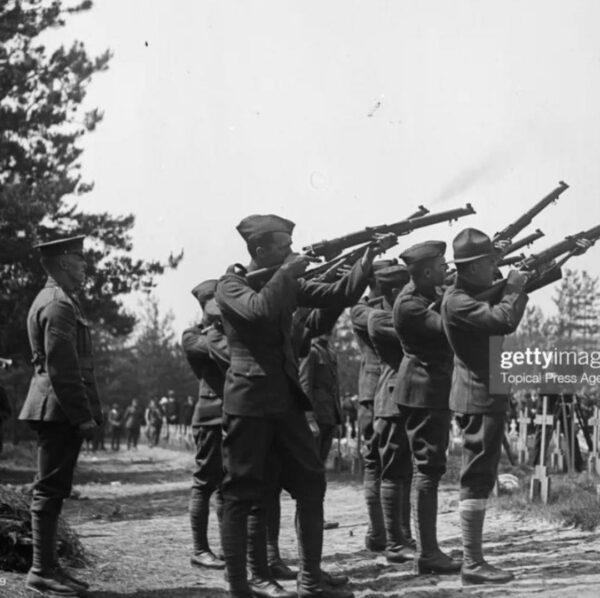
The Platoon and Squad Firing Formations
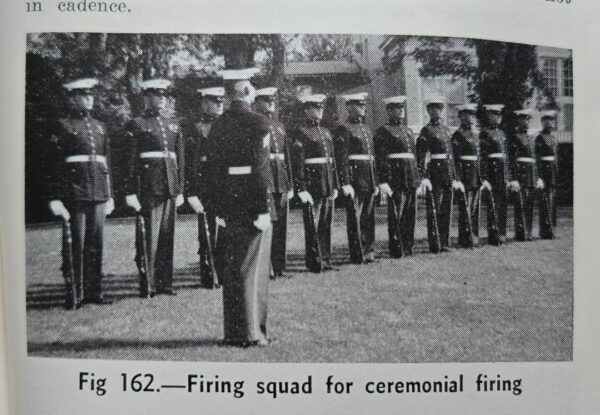
Photographic evidence from the early 20th century shows another method. A platoon composed of three squads could perform the salute with each squad firing one round.
The first squad fired, the second squad fired, and then the third squad fired.
This produced three distinct firing events through the organization of the platoon. Again, the procedure was based on three rounds, not a predetermined total number of rifle discharges. The squad was the military’s fundamental formation for this purpose, but squad strength was not permanently fixed at seven.
The traditional squad commonly numbered as many as 12 members. Historical photographs show 12-man and 10-man squads firing ceremonial volleys. The number of firers varied. The three rounds remained.
The 1946 Standard
War Department Field Manual 22-6, published in 1946, stated:
“For ceremonial firing, the front rank only of units larger than a squad executes the loading and firing. A squad is always formed in line preliminary to such firing.”
Elsewhere in that edition, the squad formation illustration shows 12 soldiers. This is significant. A squad firing three rounds could produce 36 individual cartridge discharges:
12 rifles × 3 rounds = 36 discharges.
It was not a 36-gun salute. It was ceremonial rifle firing consisting of three rounds.
For formations larger than a squad, only the front rank fired. This controlled the size and arrangement of the firing element, but it did not change the nature of the honor.
The Formation Continued to Change
The number of firing members continued to vary through the middle of the 20th century. A photograph in the 1953 edition of FM 22-5 shows nine members firing. Nine rifles firing three rounds produce 27 individual discharges. A 1956 Marine Corps publication shows ten members in the firing formation. Ten rifles firing three rounds produce 30 individual discharges. Historical photographs also show 12-man and 10-man firing squads. None of these formations rendered a numbered gun salute. Each performed the established three rounds of ceremonial rifle fire.
In 1958, FM 22-5 used the term firing squad and illustrated seven members who fired. This appears to be clear Army evidence of the seven-man formation that became familiar in modern military funeral honors.
The historical sequence is therefore unmistakable:
- Three rounds were prescribed in American military funeral procedure by at least 1812.
- The funeral escort originally performed the firing.
- At times, a battalion, platoon, squad, front rank, or other designated element fired.
- Squad and firing-element strength varied.
- Seven firers appeared long after the three-round requirement was already established.
The three rounds did not originate from the number seven. Seven riflemen firing three times merely happens to produce 21 individual cartridge discharges.
Twenty-One Is the Result, Not the Honor
The arithmetic changes whenever the firing-party strength changes:
- 12 firers × 3 rounds = 36 cartridge discharges.
- 10 firers × 3 rounds = 30 cartridge discharges.
- 9 firers × 3 rounds = 27 cartridge discharges.
- 7 firers × 3 rounds = 21 cartridge discharges.
- 5 firers × 3 rounds = 15 cartridge discharges.
- 3 firers × 3 rounds = 9 cartridge discharges.
Every one of these formations renders the same basic ceremonial element: three rifle volleys. The total number of cartridges fired is incidental. It is not the title, purpose, or authority for the honor. The most historically accurate way to describe the modern formation is a seven-man firing party rendering the three-volley rifle salute.
It is not a 21-gun salute, a 21-rifle salute, or a 21-shot salute.
Firing Party, Firing Squad, and Firing Team
Historical military manuals used the term firing squad, including the 1958 edition of FM 22-5.
The term is doctrinally legitimate in its historical context, but today it is strongly associated with execution by rifle fire. For public education and modern ceremonial use, firing party is the clearer term.
The phrase firing team is also used in some military funeral-honors programs and by veteran organizations. However, it can create confusion with the infantry fire team, which is a tactical formation.
For ceremonial instruction, I prefer:
- Firing party for the complete ceremonial element.
- Firing-party commander for the person directing it.
- Firers for the members discharging the rifles.
- Three-volley rifle salute for the honor performed.
Clear terminology supports clear understanding. For more on terminology, click here to read Fire Team, Firing Party and Firing Squad. What’s the Difference?
Three Volleys, Not Three Individual Shots
Another common error is saying that the firing party “fires three shots.”
The individual members each fire three blank cartridges, but the formation renders three volleys.
A volley is the coordinated discharge of multiple weapons at essentially the same time.
With seven firers, the audience should hear three distinct reports:
- First volley
- Second volley
- Third volley
A well-trained firing party should sound like a single rifle during each volley. Minor mechanical differences and human reaction time can make perfect simultaneity difficult, but the goal is one unified report.
Calling the ceremony “three shots” can create the impression that only three cartridges are discharged. Calling it “21 shots” places attention on irrelevant arithmetic.
The correct description is three volleys.
Why Seven Rifles Followed by Six Is Incorrect
Returning to the original question, suppose seven members fire the first time and only six fire the second time. The organizer would then count 13 individual rifle discharges.
That does not create a 13-gun salute. It creates an improvised sequence with several problems. First, only two firing events would occur. The established rifle honor consists of three volleys. Second, the volleys would be uneven. The second report would be weaker because one member would not fire. Third, one member would be required either to remain visibly inactive or simulate participation during the second firing event. Fourth, the procedure would be created solely through arithmetic. The team would begin with a desired number and manipulate its formation to reach that total. Fifth, it would use rifles to imitate an honor belonging to artillery or naval saluting guns.
A firing party does not count backward from a requested total and distribute cartridges among its members. It performs three complete volleys with the authorized or available firing element. The proper response is:
No. A firing party renders three complete rifle volleys. It cannot be altered to manufacture a requested number of individual discharges.
A 13-Gun Salute Is a Different Honor
The number 13 naturally carries historical meaning in the United States because of the original colonies. That symbolism does not automatically authorize a 13-gun salute at a county concert, anniversary, or patriotic event. A gun salute is a formal system of honors. It uses cannon, artillery, or naval saluting guns. The rounds are fired individually at the prescribed interval.
Gun salutes have historically ranged in number according to the individual, office, nation, military occasion, or governing regulation. The familiar 21-gun salute is the highest commonly recognized national honor, but it is not the only authorized number. The existence of other numbered gun salutes does not mean an event organizer may choose a personally meaningful number and create a new salute.
Before rendering a proposed 13-gun salute, the organizers would need to determine:
- What established honor is being requested?
- What authority prescribes 13 rounds for that occasion?
- Who or what is entitled to receive the salute?
- What type of cannon or saluting gun is authorized?
- Who is qualified to operate it?
- What safety, legal, venue, and local requirements apply?
The desire to recognize the original 13 colonies does not convert 13 rifle discharges into a 13-gun salute. Symbolism does not create ceremonial authority.
The Proper Setting for a Firing Party
Military doctrine places the three-volley rifle salute within funeral honors. Military services use firing parties for qualifying military funerals according to the decedent’s status, the level of honors authorized, service policy, personnel availability, and local capability.
Law enforcement, fire service, emergency medical service, and other uniformed public-safety organizations may also use firing parties for funerals and memorial services under their own established policies. The firing party should not become a generic patriotic special effect.
It should not be added casually to ceremonies like:
- Grand openings
- Concerts
- Banquets
- Sporting events
- General patriotic programs
- Anniversaries
- Retirement ceremonies
- Community festivals
Historically, the firing party has been adopted as a salute for Veterans Day and Memorial Day programs for over one hundred years. I am not a huge fan of putting a firing party on TV for the “Memorial Day Race” or other event as shown below. The Pentagon using the US Navy Ceremonial Guard in this manner does not sit well with me.
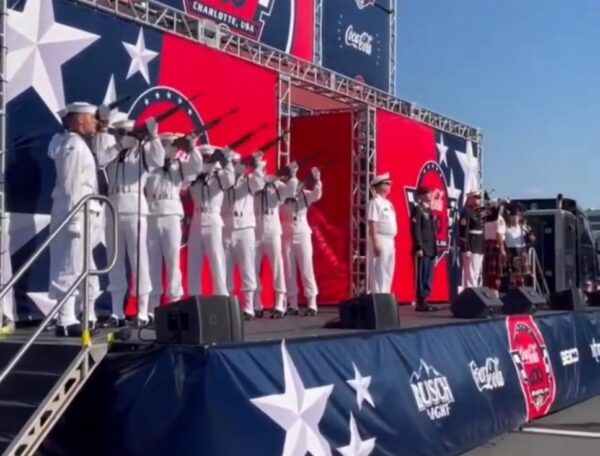
The subject of an event may be patriotic, military, or memorial in character, but the setting does not automatically authorize a funeral honor. There may be organizations with historically established memorial practices outside a graveside funeral. Those practices must be evaluated under the organization’s actual authority and tradition. They cannot simply be assumed to be military funeral procedure. General permission to honor veterans is not authorization to use every ceremonial element associated with a military funeral. The ceremonial setting may support the meaning of an honor, but the setting does not create the authority to render it.
Modern Military Funeral Honors
Federal law establishes military funeral honors for eligible veterans, but it does not guarantee a firing party for every funeral.
The basic statutory military funeral-honors detail centers on the folding and presentation of the United States flag and the sounding of Taps. The composition of the detail and any additional ceremonial elements depend on the decedent’s status, service policy, level of honors, personnel availability, and other governing requirements.
A full military funeral may include:
- Casket team or pallbearers
- Color guard
- Firing party
- Bugler
- Escort or other ceremonial elements
A basic veteran funeral may be performed by a much smaller detail and may not include a military firing party.
Veterans service organizations frequently provide firing parties when the military service cannot provide one. These organizations perform an invaluable service, but they must still use correct terminology, safe procedures, appropriate weapons, and a recognized ceremonial sequence.
Providing the honor voluntarily does not authorize inventing a new version of it.
The Three-Man Firing Element
Three firers are commonly encountered in modern veteran funeral honors, particularly among veterans organizations and reduced-manpower ceremonial details.
The precise date and policy through which the three-rifle formation entered widespread official use require further research.
It seems reasonable that reduced funeral-honors manning and the nationwide expansion of military funeral-honors requirements contributed to the increased use of smaller firing elements. However, the federal requirement for military funeral honors should not be described as having directly created or mandated a three-person firing party without a specific supporting source.
What can be said with certainty is that the smaller formation does not alter the honor. Three members firing three volleys discharge nine blank cartridges. That is still the three-volley rifle salute.
Positioning the Firing Party
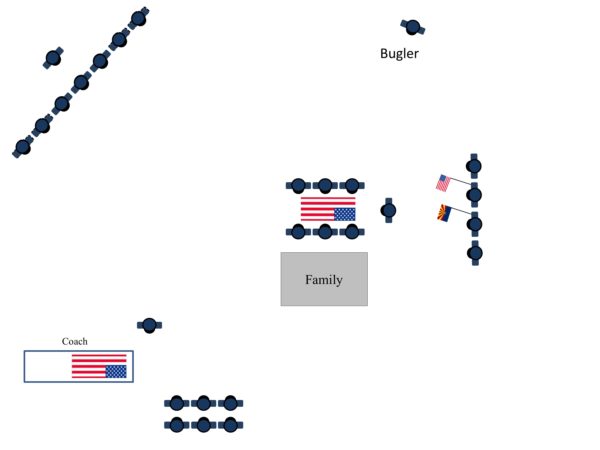
The firing party must be positioned as part of the complete ceremonial picture, not as an isolated group placed wherever space happens to remain.
The next of kin should be able to see, as circumstances permit:
- The casket or urn
- The pallbearers or casket team
- The color guard
- The firing party
- The bugler
- The flag-folding and presentation sequence
Terrain, monuments, trees, roads, buildings, other graves, crowds, and cemetery restrictions may affect placement.
A distance of approximately 50 paces is commonly used as a planning reference, but it should not become an inflexible rule that overrides safety, visibility, site limitations, or governing service procedure.
The firing party should be far enough from the family to reduce the physical effect of the muzzle blast while remaining visible and clearly connected to the ceremony.
The team should coordinate placement with:
- The military funeral-honors representative
- The cemetery
- The funeral director
- The family’s representative
- The bugler
- The casket team
- Law enforcement or venue security when applicable
The firing direction must be safe. The team must account for buildings, roadways, crowds, animals, vehicles, aircraft concerns, overhead structures, dry vegetation, and any other site hazard.
Ceremonial appearance never overrides safety.
Do Not “Take Aim”

Firing-party members should not assume a conventional marksmanship position. They do not shoulder the rifle, lower the head behind the sights, establish sight alignment, and aim at a target. The rifle is brought to the prescribed elevated ceremonial position. The head remains erect, and the member looks forward or over the barrel according to the authorized technique.
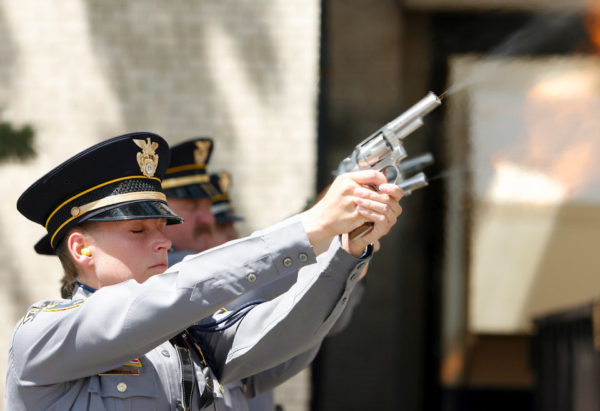
The muzzle is elevated in a safe direction. The ceremony is not target shooting. It is controlled ceremonial blank fire. Notice in the image above that the law enforcement officers are looking over the front site. I suggest a bit more elevation for the muzzle.
The exact rifle position, angle, stance, and sequence should come from the organization’s governing manual or established ceremonial training system.
Do Not Step Forward Into an Awkward Stance
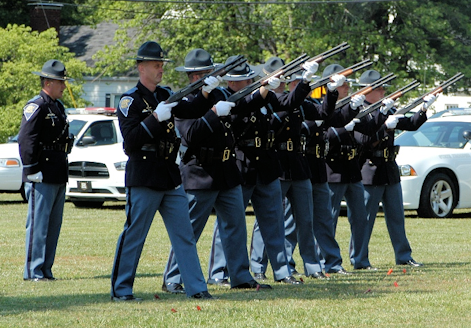
Some teams step forward with one foot when preparing to fire. This often produces an unstable and visually awkward position. In the image above, you can see how the team is awkwardly angled, twisting at the waist, with their centers of balance not centered but more on the back foot.
A lateral movement (a sidestep) into a balanced stance is generally more effective. The position should support:
- Stability
- Uniformity
- Safe muzzle control
- Efficient weapon operation
- A clean return to the position of attention
The team should not invent movements merely because they appear dramatic. Every movement must serve safety, control, synchronization, or ceremonial communication.
Commands and Timing
The firing-party commander must produce a clear, precise, and predictable sequence. The traditional commands are associated with loading, readiness, aiming or positioning, and firing. Exact commands vary by service, period, and ceremonial system.
- “With blank ammunition, LOAD!”
- “Ready, Take Aim, FIRE”
- “Ready, Aim, FIRE”
- “Ready, Aim, PULL”
- “Ready, Aim, PIRE”
The word “fire” does not have a definite beginning. Techniques using a word such as “pull” have been used to create a more definite execution point. The word found best to enable the cadence has been “Pire” because the “P” has a defined beginning.
The command itself does not create synchronization. Synchronization comes from:
- A consistent cadence
- Listening to the commander
- Identical and simultaneous preparation
- Familiarity with the weapon
- Repetition
- Proper trigger control
- Resisting anticipation
- Correct follow-through

Members must not guess when the command will occur. They must respond to the command. Practice makes permanent. Inconsistent practice permanently installs inconsistent timing.
Weapon Operation and Synchronization
Different weapons require different firing-party techniques. A semiautomatic rifle may cycle automatically when properly configured (blank adapter) for blank fire. If you do not have the blank adapter, the rifle will probably not cycle because blanks are loaded for the effect and not to put a projectile down range.
Other ceremonial rifles require manual operation between rounds.
The M1903 requires the firer to operate the bolt manually and is not recommended unless the team is highly skilled with it. This introduces several movements between volleys:
- Lift the bolt handle.
- Pull the bolt to the rear.
- Push the bolt forward.
- Lock the bolt down.
- Return to the prescribed firing position.
The M1 Garand and M14 operate differently from the M1903 requiring a cleaner ceremonial sequence.
The M16-series and M4 rifles may be used when it is the weapon authorized and available to the unit. Personal opinions about its ceremonial appearance (they are not the best look) do not override service issue, policy, logistics, or training. Law enforcement firing parties may use rifles, shotguns, or handguns according to departmental authorization.
Read the Army’s Donations Program for a Firing Party.
The Historical Battlefield-Truce Explanation
The story is that the three-volley salute originated when opposing forces temporarily stopped fighting to remove their dead. After each side had cared for its dead, three volleys were fired to signal readiness to resume combat. The explanation is widely circulated, but repetition does not establish historical proof. I cannot find this explanation documented anywhere.
The documentary evidence in American drill manuals is much stronger. In 1812, Smyth’s Manual Drill and Ceremonies manual By 1874, Upton clearly prescribed three rounds of blank cartridges after the funeral services were completed. Later Infantry Drill Regulations retained the same basic procedure.
Until the battlefield-truce account can be tied to reliable primary historical evidence, it should be presented as a traditional explanation rather than an established fact. Ceremonial history deserves the same evidence-based discipline as ceremonial procedure.
Three Complete Volleys or No Rifle Salute
The firing party is not a device for producing a requested number of loud reports. Its members do not fire seven rifles, then six, to reach 13. They do not fire seven rifles three times to imitate artillery. They do not add or remove members between volleys to create an anniversary number. They do not convert a funeral honor into entertainment for a concert.
A properly constituted firing party renders three complete volleys under appropriate authority. The number of firing members may vary, but the members who constitute the firing element fire together during all three volleys unless a weapon malfunction or genuine safety issue prevents it. That is the standard.
The history confirms it. The three rounds were established long before the seven-member firing party. Twenty-one individual discharges are merely the arithmetic result of one modern formation. Ceremonial meaning does not come from manipulating numbers. It comes from rendering the correct honor, for the correct purpose, with the correct equipment, under the proper authority.

Updated April 5, 2022, and July 25, 2026
Comments 8
Our American Legion Post uses a Firing Party not just at funerals but at 911 Commemoration, memorial programs and even at a Walmart grand opening. I felt tags the there-volley salute should be done only at military funerals. Am I wrong?
Author
Mr. Williams,
You are not wrong at all. Your organization is abusing the during party. It’s reprehensible that the team should fire volleys at the grand opening of a store.
We know that the volleys are only fired for fuberals because that’s what the Army Training Circular and Marine Corps Order tell us. We don’t look to manuals for an endless list of forbidden situations, we look at them for what is authorized and that’s funerals.
When the Hearse & family drive up to enter the shelter & the Honor Guard is lined up (without rifles)
Is the command Aten-Shun Hand Salute
Or
Present Arms
I am a Navy Veteran Volunteer at the Tahoma National Cemetery
Author
Mr. Smith,
As soon as the team sees the NOK, they should all come to Attention. You can give a simple “tighten up” to go to Parade Rest from At Ease, and then call “Honor – Guard, Ah-Ten-Shun!” The space between Honor and Guard should be a slightly long pause. If no one on the team is armed, Hand Salute and Ready Two are appropriate, if everyone is from the sea services. If anyone is there from the Army, Present Arms and Order Arms is required. If anyone is from the Air Force, or Space Force, Present Arms and Order Arms is preferred for them but not required.
DM
Drill Master: We have been taught that the 3 shoot volley is to be aimed to the East for over 50 years. We have a new person that is telling us that we can shoot in any direction. Which way is correct and why were we always shooting to the east? We were under the impression that it involved the fact that the sun rises from the East!
Author
Mr. Poull,
It never ceases to amaze me as to the folklore that is created and passed down for years and even decades. Your newbie is correct and I’ve learned something new.
The only requirements for the firing party are to be approximately 50 paces from the NOK and you must fire over the grave. The rifle muzzle should be at an approximate 45-degree angle from horizontal. If the direction just happens to be due east or even “sou-souwest” it doesn’t matter.
I’m so glad that you wrote in! Thank you for this opportunity to help you and your team understand the requirements of a firing party and also my thanks to you and the team for wanting to render military honors appropriately.
DM
I am in the American Legion here in Sierra Vista, AZ. I have been trying to organize, and become certified for a Service member Ceremonial Firing team. We have difficulty in getting a Firing Team for any veteran other than US Army. I recently had a Navy Veterans family that tried everything possible and failed to be able to have a Memorial Firing team present the Honors. That is disgusting. We have a National Cemetery but they refuse to let me present honors unless I am a Certified Team. So, HOW DO I BECOME A CERTIFIED TEAM? Where do we start and finish?
Vernal J. Smith
Retired US Army, LTC
Many hours of memorial unit training and flag Honors training. Served as Survival Assistance Officer many times in my career.
Please HELP!!!!!
Author
LTC Smith,
Thank you for your question. I understand your frustration.
There are three levels of honirs: Active Duty Death, Retiree, and Veteran. Active Duty are authorized the three ceremonial elements: colors, pallbearers, and firing party. Retirees are authorized pallbearers and firing party. Veterans are authorized two team members who fold and present the flag and sound Taps. Retirees are usually put in the Veteran category as well.
It depends on the ability of the local installation ceremonial team’s manning whether any of the elements are manned.
Unfortunately, the Navy’s presence in many states is just recruiters. It would be impossible for them fully man a funeral except for the Veteran category.
As for certification, training is offered through Post and Base honor guards through the Authorized Provider Partnership Program (AP3). However, this is not that well known and many team NCOICs are completely unaware of it. You can read a little bit about it here, https://thedrillmaster.org/2019/04/11/the-authorized-provider-partnership-program-ap3/. I also have a PDF on the program under the Honor Guard tab on the Downloads page, https://thedrillmaster.org/downloads/.
DM