

This article is written as a thought-leadership piece designed to bridge the gap between respect for first responders and the non-negotiable standards of military protocol. Its goal is not to diminish anyone’s service, but to defend institutional identity and restore ritual integrity in public ceremonies.
Every year—on Memorial Day, Pearl Harbor commemorations, veterans’ funerals, September 11 ceremonies, and even Christmas parades—a subtle but significant erosion of tradition unfolds. Police officers, firefighters, and EMS professionals take the field in sharp uniforms, hoisting the colors. Their intent is unquestionably respectful.
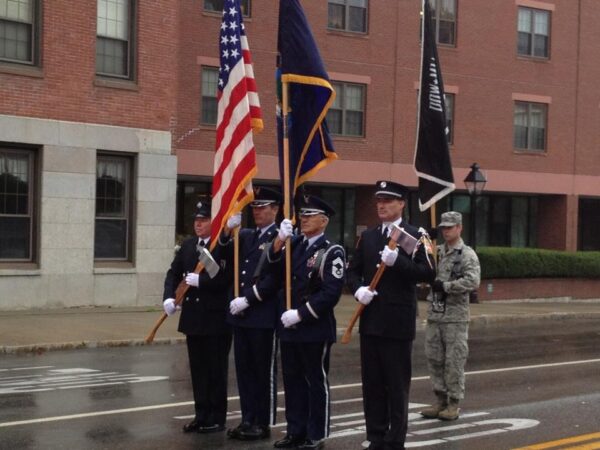
But to those trained in the rigorous discipline of military customs and courtesies, the image is often jarring. In the image above of the Pittsburgh Bureau of Fire Color Guard (December 2025), the following is noted:
1) There is no rhyme or reason behind the order of the colors, they are all out of sequence. 2) The formation is beyond non-standard. 3) fringe is required on all of the colors but. 4) These flags are not colors; they are meant to be attached to clasps on a halyard for display on an outside flagpole. 5) the staffs and finials do not conform to the military standard. 6) The POW is not carried in a colors formation with the service departmental colors. 7) no one officially represents the military services.
There are mismatched staffs, incorrect finials, improper precedence of flags, and—most critically—the presence of U.S. Military Service Colors (Army, Marine Corps, Navy, Air Force, Space Force, Coast Guard) carried by non-military personnel.
The intent is unity.
The effect is confusion.
And the result is an inadvertent breach of ceremonial protocol.
It is time for a professional, respectful conversation about Ritual Integrity.
The Sanctity of the Standard
In the military, the “Colors” are not decorative flags. They represent:
- The lineage of battle
- The blood of the fallen
- The authority of the Commander-in-Chief
- The living identity of a military service
The right to carry a military service color is governed by strict regulations (Army TC 3-21.5, Marine Corps Order 5060.20, NTP 13, AFMAN 34-1201, AFI 34-1201, etc.). It is a right granted only to the members of that service.
When a first responder agency carries a military color, the act unintentionally assumes a lineage and authority that do not belong to them. A police uniform—noble and heroic—does not confer representation of the United States Marine Corps or its battle honors. A firefighter’s turnout gear—symbolic and courageous—does not carry the institutional authority of the United States Army.
This is not a matter of ego or exclusion.
It is a matter of accurate representation.
Displaying the Colors vs. Carrying the Colors
Much of the confusion comes from treating displaying flags and carrying flags as if they are interchangeable. They are not.
Displaying the Colors
A display is stationary. It includes:
- Flagstaffs in stands indoors or outdoors
- Flags on halyards at outdoor poles or masts
- Permanent displays in auditoriums, lobbies, or memorials
Displays are widely permitted. Nearly any organization may display:
- The U.S. Flag
- State and municipal flags
- Organizational or department flags
- Historical or commemorative flags
These displays do not constitute a military formation and do not imply military representation.
Carrying the Colors
A color guard is a moving formation performing:
- Marching
- Posting
- Rendering honors
- Presenting institutional authority
Once a flag is carried, it becomes a color and carrying it becomes a representational act.
This is why:
- Only military members may carry military service colors.
- Public safety agencies may carry their own organizational flags only.
- Manuals of arms, pole height, ornamentation, and technique become regulated.
A displayed flag is universal.
A carried color is institution-specific.
The “One Flag Rule” Myth
Another misconception sometimes used to justify mixed color guards is the belief that only one American flag should appear in a ceremony.
This is incorrect.
The myth originates from General Douglas MacArthur’s personal preference that only one U.S. flag be displayed when he spoke. His preference was never law, never doctrine, never adopted by any service.
Today’s guidance is clear:
Multiple US flags may appear in a ceremony as long as each follows proper etiquette.
The “one flag rule” is ceremonial folklore—not protocol.
Precision Is the Highest Form of Respect
Military ceremony is a science of inches. Everything matters:
- The correct staff type and material
- The proper brass joints
- The appropriate finial (spade, spear, or ball)
- The exact order of precedence
- The correct flag size for the pole height
- Proper alignment and spacing
When civilian agencies attempt to perform military ritual without military training, errors are inevitable—not due to lack of respect, but because the ritual belongs to a different profession with its own technical demands.
They unintentionally use:
- Incorrect pole heights
- Outdoor flags indoors
- 4×6 flags on mismatched 8-foot staffs
- Improper manual movements
- Incorrect presentation techniques
- Service flags carried out of precedence
An error in ritual is an error in honor.
A misrepresented symbol is a misrepresented institution.
If you perform a sacred rite incorrectly, you dilute the meaning of the very honor you hope to uphold.

Why Mixed Color Guards Are Incorrect
A color guard represents one chain of command and one authority.
Mixing military and first responders in one formation creates a false impression that:
- They share a common commander
- They operate under the same body of law
- They belong to a unified organization
This is neither legally nor symbolically accurate.
A police officer does not command military personnel.
A junior enlisted service member does not command municipal officers or firefighters.
A color guard must communicate unity of authority.
A mixed formation communicates the opposite: organizational confusion.
For information on joint order for federal, state, and local organizations, read here. Never parade the POW/MIA flag.
Identity Crisis: Mimicry vs. Authenticity
The strongest honor guards are those that embrace their own identity.
A Fire Department Honor Guard is more impressive when it uses:
- Rifles (traditional)
- Ceremonial axes (much better)
- Pike poles (less recognizable)
- Department and municipal flags
A Law Enforcement Honor Guard looks its best when it reflects:
- Police tradition
- Police tools (rifles, shotguns, sidearms)
- Police authority
- Police ceremonial presence
When first responders mimic the military, they unintentionally become:
A sub-par imitation instead of an excellent original.
Professional distinction—not mimicry—is the mark of ceremonial excellence.
A Call to Professional Distinction
To my colleagues in the first responder community:
Your service is respected, valued, and honored. This conversation is not about exclusion—it is about accuracy and dignity.
1. Carry Your Own Colors
Lead with:
- The U.S. Flag
- Your State Flag
- Your Department or Agency Flag
These represent your jurisdiction, your identity, your honor.
2. Leave Military Service Colors to the Military
If a ceremony requires representation from the Army, Marine Corps, Navy, Air Force, Coast Guard, or Space Force:
Invite a local military unit—Reserve, Guard, Active, ROTC, or a veteran ceremonial team authorized to carry them.
This ensures precision, authenticity, and institutional respect.
3. Invest in Your Own Tradition
Do not borrow a manual that wasn’t written for you. Build:
- Agency-specific SOPs
- Distinct ceremonial movements
- Tools and symbols unique to your profession
- A tradition that elevates your identity rather than replaces it
This is how excellence is built—and how honor is maintained.
Unity Does Not Require Mixing — It Requires Clarity
Military members and first responders absolutely can (and should) participate together in ceremonies. They should stand side-by-side as equal professionals.
But they must not stand inside the same color guard formation, because a color guard is a representation of one authority, not many.
The correct approach is simple:
Use separate color guards within the same ceremony.
Allow only the military to carry military colors.
Allow first responders to carry the symbols that belong to them.
This preserves:
- Legal correctness
- Ceremonial clarity
- Institutional identity
- The dignity of all participants
Conclusion
Military ritual is not background decoration—it is a codified language of respect. When we blur the boundary between military and civilian roles, or allow technical errors to become commonplace, we erode the very traditions we claim to honor.
Let us return to a standard of excellence where:
- Every uniform reflects its own history
- Every flag is carried by those who have earned that right
- Every ceremony communicates clarity, dignity, and truth
That is how we safeguard the sanctity of the standard.
That is how we honor both the military and our first responder community.
Comments 3
I saw that you made a distinction between law enforcement and fire service honor guards. Would you advise for or against a join honor guard having a divided detail of (say) 2 police officers and 2 firefighters?
Author
Sir,
I highly encourage joint first responder color guards. I address the set up of the team here in this article. To me, joint work, when available, sends a great message to the public.
I hope that clears up any ambiguity I might have conveyed in this article.
DrillMaster
Mr. Marshall,
Understood! I reread the article and- with the clarification of your past comment- now fully understand it.
Thank you for your time!