
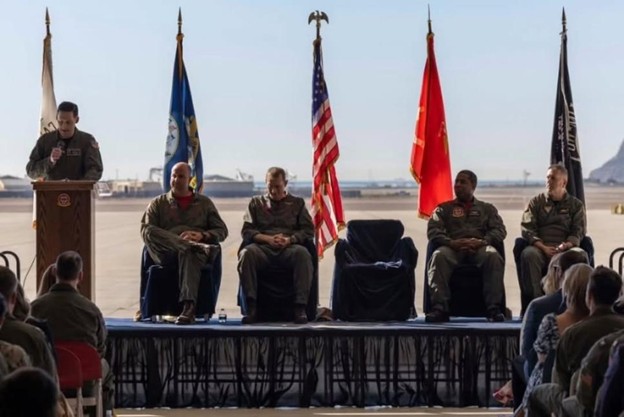
The image above is from the US Naval Air Forces Instagram account (Dec 2025). The colors display is in an aircraft hangar on NAS North Island (San Diego, CA). It is a majority civilian standards display mixed with a military accent.
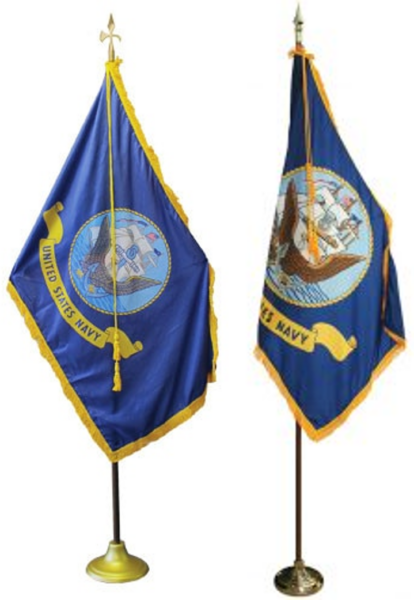
Similarly, the image of the Navy flag at the right looks to be a military display in both instances but is not. We will look at both images at the end of the article.
Purpose
This article addresses a persistent and widespread problem in Navy indoor flag displays:
- Incorrect placement, incorrect flagstaffs, and unauthorized finials—all driven by a gradual loss of institutional knowledge and the dominance of civilian commercial products.
What follows explains:
- What the doctrine actually requires
- Why current displays are wrong
- Why correct equipment is nearly impossible to obtain today
- How civilian vendors replaced military standards
- How instructors can push back with authority
1. The Centered US Flag Myth (Placement Error)
Indoor Navy displays frequently place the US flag in the center of a group of three flags. This configuration is not authorized.
The Army Exception—And Why It Fails
The only time the US flag is ever described as being centered is in Army ceremonial logic, Army regulation (AR) 840-10, and only when:
The US flagstaff is taller than the others, creating dominance by height.
Paragraph 2-4. (2) When a number of flags are displayed from staffs set in a line, the flag of the United States will be at the right; that is, to the left of an observer facing the display (see fig 2–1). However, if no foreign national flags are involved, the flag of the United States may be placed at the center of the line, provided it is displayed at a higher level (see fig 2–3).” Emphasis mine.
However, this exception immediately collapses a few chapters later:
Paragraph 8-1. “c. Flagstaffs for positional colors, distinguishing flags, and organizational colors are 9 feet, 6 inches or 8 feet. The flagstaff for all flags in a display will be the same length.” Emphasis mine.
Thus, the commonly cited “Army allows it” argument:
- Violates Army regulation
- Does not apply to the Navy
- Cannot be used to justify Navy indoor displays
Navy Logic Is Positional, Not Geometric
The Navy does not assign honor through staff height.
Honor is conveyed through position of precedence.
- The US flag is placed to the observer’s left
- All flagstaffs are equal height
- Centering is not a mechanism of honor in Navy doctrine
2. The Forgotten Half of the Problem: Hardware
Even when placement is corrected, most Navy indoor displays still fail because the hardware itself is unauthorized.
This problem exists because almost no one has researched what the Navy actually authorizes for:
- Everyday indoor displays
- Ceremonial settings
- Formal visits requiring finial changes
The governing documents exist—but they are practically invisible.
Governing Navy Sources
- NTP 13(B)
- US Navy Regulations, Chapters 9 and 12
These documents:
- Are difficult to locate
- Are poorly titled for instructional use
- Are not written as quick-reference guides
- Are rarely taught outside a small ceremonial niche
As a result, hardware standards quietly disappeared from practice.
3. What Replaced Military Doctrine: Civilian Commercial Sets
Into this knowledge vacuum stepped civilian mass production.
What is now common in Navy spaces:
- Brown “office-type” wooden staffs
- Conical spearheads (Greco-Roman decorative forms)
- Spread eagles sold as decorative finials
- Complete matched sets marketed to civilians
These sets were never intended for:
- Military ceremonial authority
- Military heraldic logic
- Situational finial changes
- Differentiation between US, service, and organizational flags
They exist because they are:
- Cheap
- Symmetrical
- Easy to manufacture
- Easy to sell in bulk
Mass production favors decor, not doctrine.
4. Why You Can’t Buy the Correct Equipment Anymore
This is not accidental—it is a supply-chain outcome.
What Used to Exist
- Modular flagstaff systems for interchangeable finials (Navy and Coast Guard)
- Service-specific components
- Low-volume, regulation-driven manufacturing
What Happened
- Demand shrank as knowledge disappeared
- Ceremonial units stopped ordering specialized hardware
- Manufacturers shifted to civilian office markets
- Military-specific tooling was discontinued
- Surplus pipelines dried up
Once the military stopped asking for correct equipment, industry stopped making it.
Today:
- Vendors do not stock what is not ordered
- Civilian demand sets the “standard”
- Availability is mistaken for authorization
5. Why Finials Were Never Decorative
Finials historically indicated:
- Authority and command presence
- Type of organization represented
- Eligibility for specific honors
- Nature of the ceremony
- Status of the individual or visit
The idea that “a finial is just decoration” is a modern civilian assumption—not a military one.
Governing Principle
Authorized flagstaffs and finials are determined by regulation, not availability.
Commercial sale does not equal military authorization.
6. Vendor Warning Sidebar (Instructor Reference)
Vendor Warning: Read Before Purchase
Many commercially sold “military” or “ceremonial” flag sets are civilian decorative products and do not comply with Navy regulations.
Indicators of civilian sets:
- Brown office-style staffs
- Fixed decorative spearheads
- Decorative spread eagles sold as default
- No documentation citing Navy or military regulations
- No option for finial changes
Instructor Guidance:
Before purchasing or approving any display hardware, require:
- Regulatory citation
- Service-specific authorization
- Clear differentiation between US and service flags
If a vendor cannot provide this, the product should be treated as non-doctrinal décor, not a ceremonial standard.
7. Why This Matters
This is not about aesthetics. It is about:
- Preserving military meaning
- Maintaining ceremonial authority
- Preventing civilian standards from replacing doctrine
- Recording knowledge that is no longer institutional
What we see today is not tradition—it is the residue of forgotten standards.
Summary
- Centered US flags indoors are not authorized in Navy displays
- Army exceptions are misquoted and internally contradictory
- Authorized Navy hardware exists in doctrine but not in practice
- Civilian mass production replaced military systems
- Availability became mistaken for legitimacy
Tomorrow is the Analysis of the photos at the top of the page.