
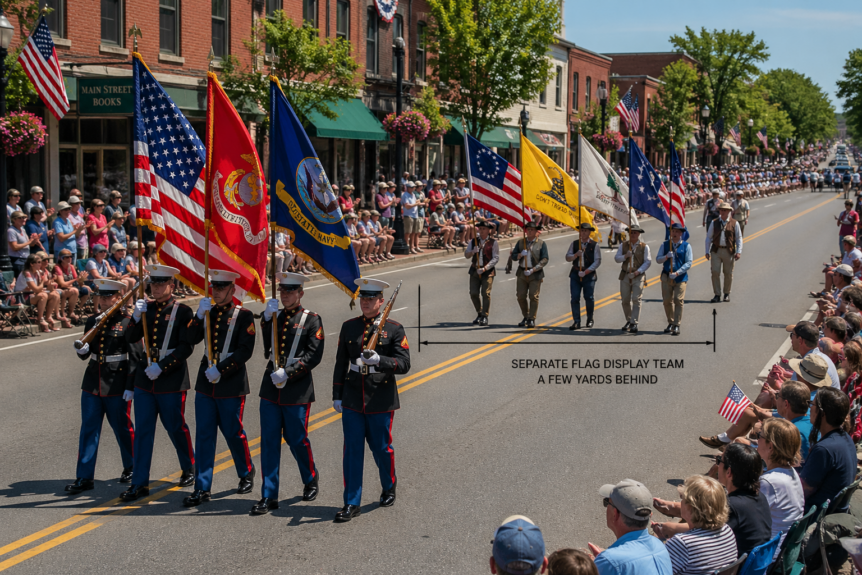
With the United States approaching its 250th anniversary, I’ve started receiving more questions about historical flags—specifically whether groups can carry items like the Betsy Ross flag or the Gadsden flag in parades and ceremonies.
One comment I received summed up a common approach:
“That’s fine—as long as you can find enough people to form a trailing color guard.”
It’s a practical answer. It sounds reasonable. But it also reveals a deeper issue.
This isn’t a question of how many people you have. It’s a question of what the flag is—and what role it has.
The photo at the top. I asked AI to create the photo because I had a very specific idea in mind, it’s mostly correct, but, as you can see, it’s a bit weird in places. The idea that I want to convey here is that the color guard is leading the Flag Display Team that is carrying historical and/or commemorative flags.
What Makes a Flag a “Color”?
I always thought color = military and flag = everyone else. While there is merit to the idea, that’s not the best explanation. In ceremonial terms, not every flag is a “color.” A color represents:
- A current nation
- A state or territory
- A recognized organization
That’s why you’ll see flags from organizations like the United States military or organizations like the Marine Corps League carried in a structured color guard. They represent living entities with recognized authority.
Historical flags don’t fall into that category.
They represent:
- A period
- A movement
- A moment in history
That distinction matters.
“Color” = a flag with ceremonial authority and a defined role in formation.
“Flag” = any cloth emblem, regardless of use.
This distinction is exactly why the Betsy Ross and Gadsden flags
…are flags, but not colors.
They lack:
- Current authority
- Defined ceremonial role
- Integration rules within a guard
A field-friendly version of this idea is:
A color is a flag that has a job. If it doesn’t have a job in the ceremony, it’s a flag.
The Key Principle
Here’s the line that will keep you out of trouble:
Historical significance does not confer ceremonial authority.
Just because a flag is meaningful—or even iconic—does not mean it belongs inside a color guard formation.
Why This Gets Confusing
During major anniversaries like the 250th, people want to:
- Honor history
- Show patriotism
- Include meaningful symbols
That’s a good instinct.
But without structure, that instinct turns into:
- Mixed formations
- Misordered flags
- Overloaded presentations
And ultimately, confusion instead of clarity.
So—Can You Carry Historical Flags?
Yes. But the better question is: How should they be carried?
Three Correct Options
1. Standard Color Guard (Most Correct)
Carry only:
- U.S. flag
- State (or equivalent)
- Authorized organizational colors
No historical flags included.
2. Separate Historical Element
If you want to carry historical flags like the Betsy Ross flag or Gadsden flag:
- Place them in a separate group
- Position that group behind the primary color guard
- Keep the purpose clearly distinct
This is where many people try to create a “second color guard.”
That’s not what it is. This is actually a Flag Display Team.
It’s simply a separate element.
3. Static Display (Often the Best Choice)
For ceremonies, staging areas, or reviewing stands:
- Historical flags work extremely well as displays
- They add context without disrupting structure
In many cases, this is the most effective and respectful option.
What About Parades Without a Formal Color Guard?
Good question—and this is where problems really show up.
Even in informal settings with line flag bearers:
- Flags still need to be logically grouped
- The U.S. flag must remain visually distinct
- Historical flags should not be mixed in as if they carry the same authority
Informal does not mean unstructured.
What to Avoid
As you prepare for events this year, watch out for:
- Mixing historical flags into a standard color guard
- Creating oversized formations just to “fit everything in”
- Placing historical flags in positions that imply equal authority
- Treating all flags as interchangeable
These are common—and they are all avoidable.
The Bottom Line
This isn’t about limiting participation.
It’s about maintaining clarity.
The question is not “Can we carry this flag?”
The question is “What role does this flag have in a ceremonial system?”
Answer that correctly, and everything else falls into place.
For Full Guidance
For those planning parades, ceremonies, or color guard participation during the 250th, I’ve published:
ICS DCS 12-650 – Historical and Commemorative Flags in Ceremonial Formations
This document provides:
- Clear classification standards
- Inclusion and exclusion rules
- Formation guidance
- Common errors to avoid
Use it as your reference before building your formation.
If we’re going to celebrate 250 years, let’s do it right—
with structure, clarity, and respect for what each flag actually represents.
Comments 2
I have a question. Our American Legion Post is going to present a Color Guard at a 4th of July celebration. We plan to parade to an area with Colors, the American Flag, all branch flags, the post colors of the American Legion and VFW, and a rifle squad. We plan to play the National Anthem and a rifle salute. Could you tell me the proper positioning of the colors, for example, where the post colors go? Should the MIA/POW flag be included? Also, should the rifle salute be after or before the National Anthem? Thank you for your help.
Author
Mr. Cherney,
Thank you for your question, let’s go over each point (your text is in italics). I also included links for more reading, if you choose.
We plan to parade to an area with Colors, the American Flag, all branch flags, and the post colors of the American Legion and VFW.
Including your organizational colors (AL and VFW) is absolutely appropriate. However, service (branch) flags need to be addressed carefully. In official military ceremonial doctrine—see DoDI 5040.10 Volume 4 and the all three service drill and ceremonies manuals—only members of the military are authorized to formally carry service colors as representatives of those branches.
That said, many veteran organizations include service flags as a matter of tradition. If you choose to include them, understand that this is a commemorative display, not an official military representation. If your intent is to remain strictly within military ceremonial standards, I recommend omitting the branch flags and focusing on the national, state (if used),you’re your organizational colors.
and a rifle squad. We plan to play the National Anthem and a rifle salute. Also, should the rifle salute be after or before the National Anthem?.
The firing of the Three Volley Salute—often called a “rifle salute”—has a very specific origin and purpose. According to US military drill and ceremonies doctrine, the Three-Volley Salute is a funeral honor, rendered over the grave as part of burial services. It is not a general-purpose salute for ceremonies or patriotic events.
Because Independence Day is a celebratory event and not a funeral or interment, there is no doctrinal basis for firing a volley in this context. While some organizations have adopted the practice over time, that adoption is outside its intended purpose. The most appropriate course here is to have your members march unarmed and render honors (hand salute) during the National Anthem.
Could you tell me the proper positioning of the colors, for example, where the post colors go?
For a standard Color Guard in Line Formation (reading left to right from the audience’s perspective) or Column Formation (reading front to back), the order of precedence is:
Right Rifle Guard
U.S. Flag (national color)
State Flag (if carried)
American Legion Color
VFW Color
Left Rifle Guard
This arrangement maintains national precedence, followed by state (if present), then organizational colors in order of importance.
If no state flag is carried, the formation simply closes the interval:
Right Guard – U.S. – AL – VFW – Left Guard.
Should the MIA/POW flag be included?
The POW/MIA flag is authorized for display and holds significant meaning. However, it is not carried as part of a color guard formation. For the military, it is only carried as the personal color at the funeral of a deceased POW.
Its proper use is as a display flag, typically on a separate staff or halyard, positioned subordinate to the U.S. flag. If you include it, I recommend displaying it at the ceremony site rather than integrating it into the color guard itself. This maintains both its protocol, dignity, and proper flag hierarchy.
Sir, you have a strong foundation for a respectful and well-executed presentation. A few adjustments will ensure that what you present aligns not only with tradition, but with established standards.
DrillMaster