
1. TSA Is a Civilian Security Organization, Not a Military or Armed Service
The Transportation Security Administration is a civilian federal agency under the Department of Homeland Security. While TSA officers perform a security mission, they are:
- Not a uniformed armed service
- Not commissioned or enlisted military personnel
- Not a law enforcement agency with ceremonial arms authorization
Color guards, as a formal ceremonial construct, originate from military and quasi-military traditions where:
- Arms are authorized
- Unit lineage and command authority are clearly defined
- Ceremonial drill doctrine exists and is enforced
TSA does not meet these criteria.
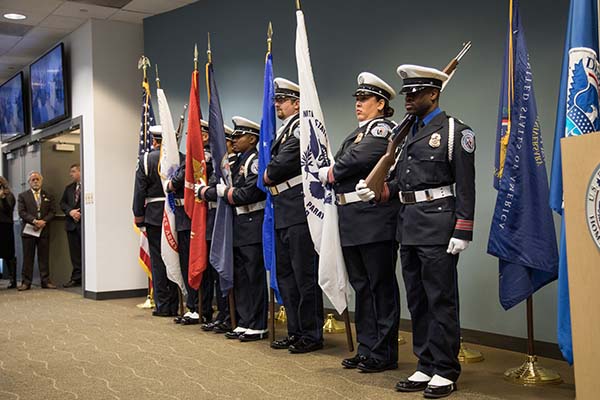
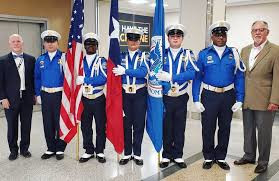
Note: the photo at the top of the page shows a TSA color guard. The guards should not be armed. This must be a Flag Display Team as shown below.
2. Armed Guards Are the Core Defining Element of a Color Guard
A true color guard is not simply “people carrying flags.”
A doctrinal color guard includes:
- A national color
- Organizational or departmental colors (when authorized)
- Armed guards whose weapons symbolize protection of the colors
- Equipment handling governed by established doctrine
TSA officers:
- Are not authorized ceremonial arms bearers
- Do not have a weapons-based ceremonial tradition
- Do not train under any recognized color guard doctrine
Removing arms removes the defining feature of a color guard.
3. Uniform ≠ Authority to Perform Military Ceremony
TSA uniforms are distinctly civilian, even if visually structured. Wearing a federal uniform does not convey:
- Military authority
- Ceremonial arms authorization
- Color guard authority
This is a recurring misconception you have addressed elsewhere:
Uniformed appearance does not equal ceremonial authorization.
The Correct Alternative: A Flag Display with Unarmed Guards
What TSA is authorized to do
A flag display is entirely appropriate and defensible.
A proper TSA flag display would include:
- The US flag (displayed, not maneuvered militarily)
- A DHS or TSA organizational flag (if authorized)
- Unarmed escorts or attendants
- Simple, respectful movements
- No military commands, rifle movements, or simulated guard behavior
This approach:
- Honors the flag without misusing military ceremony
- Avoids false equivalence with military color guards
- Aligns with civilian ceremonial norms
- Prevents doctrinal errors and public confusion
Why Unarmed Guards Matter
Unarmed guards:
- Signal civilian status
- Avoid implying combatant or protective authority
- Remove the need for weapon-handling doctrine
- Reduce errors and misrepresentation
This distinction is critical in public-facing ceremonies, especially in airports where symbolism carries weight.
Is There Any Scenario Where a TSA Color Guard Would Be Authorized?
Practically speaking: no.
Unless TSA were:
- Granted explicit ceremonial arms authorization
- Provided formal color guard doctrine
- Integrated into an armed uniformed service structure
—which is neither current policy nor historically consistent—
a TSA color guard remains ceremonially inappropriate.
Instructor-Level Takeaway
This is not about disrespecting TSA officers or minimizing their role. It is about respecting the boundaries of ceremonial systems.
Remember:
- Do not cross service systems.
- Do not borrow traditions without doctrine.
- Ceremony without authority becomes imitation.
TSA color guards fall into the same category as many civilian groups attempting to replicate military forms without authorization.
Comments 2
I want to start off by saying i am not against this, but very curious where the limits for a Color Guard should be.
With this article I read that TSA is not an armed job so they shouldn’t have a Color Guard.
Based on this I know firefighters have done Color Guard with axes which I know is a tool they use, but not really armed services.
There are corrections officers from prisons and jails that have some, but not all armed officers.
Third example, I know it is based on military armed services, but with American Legion and VFW with ceremonial firearms which I know symbolize protection of the Colors.
Like I said I am not against any group doing anything, but curious where the line is and what the difference is.
Also if there is a request for a Color Guard where firearms are not authorized to go such as onside a prison or into a courthouse or other more secured facility would it be proper to drop the ceremonial movements since there are no official guards?
Thank you
Author
Mr. Boyce,
The information is in this article: https://thedrillmaster.org/2026/01/07/when-a-color-guard-is-not-appropriate/#Who_May_Form_a_Flag_Display_Team
Who May Form a Flag Display Team
A Flag Display Team is appropriate only for organizations that meet both of the following criteria:
They possess independent civilian ceremonial authority, and
They are not subordinate to or embedded within a military ceremonial system
Examples include:
Civilian federal agencies (e.g., TSA)
Law Enforcement, Corrections, Fire and EMS departments (it’s permissible to switch depending on manning and/or location)
Schools, universities, and civic institutions
Scouts, including Sea Scouts
Armed guards are not authorized
Scout guards can use the hiking staff manual of arms
Sea Scout guards can use the boat hook (firefighter pike pole)
Private or corporate ceremonial organizations
In these cases, the FDT provides a legitimate, bounded, and professional solution.
In regards to the symbolic protection of the colors, please see this: https://thedrillmaster.org/2025/08/12/symbolic-protection-of-the-colors/
I hope this helps.